Preventing Food Allergies in Babies: Latest Guidelines (2025)
Updated: 13 Aug 2025
Key takeaways
- Don’t delay allergens. Once baby is ready for solids, introduce common allergens (peanut, egg, dairy/yoghurt, wheat, soy, sesame, fish/shellfish) around 6 months—but not before 4 months—and keep them in the diet regularly.
- Peanut early works—and lasts. Early, regular peanut intake from infancy to age 5 cuts peanut allergy by about80% at age 5 and about70% into adolescence. :
- Egg early helps too. Early cooked egg lowers egg allergy risk in several trials/meta-analyses, though results vary.
- Screening before peanut isn’t routinely required. Discuss with a doctor if baby has severe eczema and/or known food allergy.
- What doesn’t prevent food allergy: delaying solids, maternal avoidance diets, or switching to hydrolyzed formula. Probiotics/Vitamin D show no consistent prevention benefit.
When to start and signs baby is ready
Most babies are ready for solids around 6 months (good head/neck control, interest in food, can sit with support). That’s the window to begin introducing allergens along with other complementary foods. For high-risk babies (severe eczema and/or egg allergy), peanut can be introduced as early as 4–6 months after discussion with your clinician. :contentReference[oaicite:5]{index=5}
What to offer (safe forms)
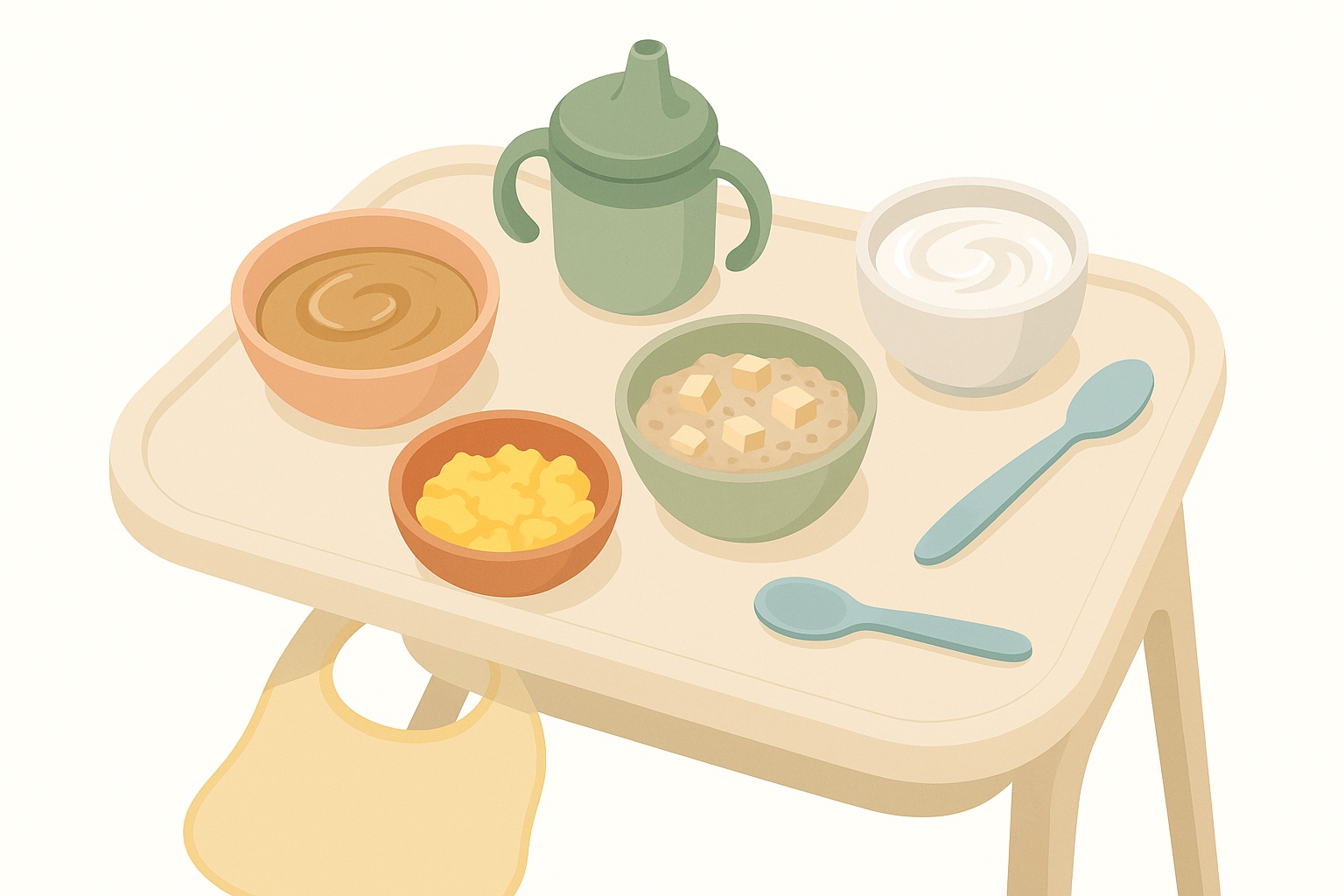
- Peanut: smooth peanut butter thinned with warm water/breast milk, peanut powder in porridge, or peanut puffs. Never whole nuts (choking). Keep offering routinely.
- Egg: well-cooked scrambled egg, hard-boiled egg mashed into purée; avoid raw or runny egg for prevention trials’ consistency.
- Dairy: yogurt/cheese in small amounts are fine; cow’s milk as a drink after 12 months.
- Sesame, soy, wheat, fish/shellfish: introduce in infant-safe textures (tahini thinned, tofu, wheat porridge, flaked cooked fish).
How much and how often?
There’s no single “dose,” but two principles matter: regular intake and ongoing inclusion.
- Peanut (from LEAP protocol): around 6 g peanut protein/week, split over more than or equal to3 servings (e.g., about2 tsp smooth peanut butter per serve).
- Practical rule: once an allergen is tolerated, include it about twice weekly to maintain exposure.
Start with a pea-sized taste, wait 10–15 minutes; if no reaction, gradually offer a few more spoonfuls in the same sitting. Always use textures that are safe for infants.
High-risk babies and testing
For babies with severe eczema and/or known egg allergy, guidelines endorse early peanut at 4–6 months. Routine pre-introduction testing isn’t required but may be considered based on family preference or clinician advice.
If your child already had an immediate reaction to a food, or has poorly controlled eczema, speak with your paediatrician/allergist about the safest setting to introduce allergens (home vs clinic).
What not to do (myths vs evidence)
- Don’t delay allergens. Waiting beyond 6–12 months increases peanut allergy risk compared with early introduction; protection persists into adolescence.
- No maternal avoidance diets. Eliminating peanut, egg, etc. during pregnancy/breastfeeding doesn’t prevent food allergy in the child.
- No switch to hydrolyzed formula for prevention. Evidence does not support hydrolyzed formulas to prevent atopic disease or food allergy.
- Supplements aren’t magic. Probiotics, prebiotics or vitamin D have no consistent benefit for preventing food allergy (some may modestly reduce eczema severity only).
- Moisturisers don’t prevent allergy. Routine emollient use from birth hasn’t prevented eczema or food allergy in large RCTs (control eczema for comfort—but it’s not a proven allergy-prevention strategy).
Why early feeding helps
Research supports the “dual-allergen exposure” idea: regular oral exposure fosters tolerance, while exposure through inflamed skin (e.g., severe eczema) can drive sensitisation—hence the focus on feeding allergens early and controlling eczema.
Step-by-step plan (at home)
- Introduce 1–2 low-allergy foods first (e.g., rice cereal, fruit/veg) to check feeding skills.
- Add allergens one by one in infant-safe forms (peanut, cooked egg, yogurt/cheese, sesame/soy, wheat, fish). Start with a pea-size taste; observe 10–15 minutes; finish the portion if fine.
- Keep them in the diet (aim about2 times weekly per allergen; for peanut, LEAP used about6andnbsp;g protein/week across more than or equal to3 servings).
- Watch for reactions (hives, vomiting, cough/wheeze, lethargy). If symptoms appear, stop, seek medical care; call emergency services for breathing trouble. (General safety guidance.)
FAQ
Is it safe to start peanut at home?
Yes for most babies. For severe eczema or prior immediate reactions, talk to your doctor first; routine pre-testing is not required but may be preferred by some families.
How soon should I start egg?
When baby is taking a few solids, offer well-cooked egg early (not raw). Keep it in the diet regularly.
Whole nuts?
Never give whole nuts or thick globs of nut butter to infants—they are choking hazards. Use thinned nut butter or puffs/powders instead.
Does breastfeeding prevent food allergies?
Breastfeeding has many benefits and is recommended, but current evidence doesn’t show it prevents specific food allergies.
What about sesame?
Treat sesame like other allergens—introduce in infant-safe forms (e.g., thinned tahini) around 6 months and keep it in the rotation.
Key sources
- American Academy of Pediatrics (HealthyChildren): When to introduce allergens (updated Jun 2025). :contentReference[oaicite:29]{index=29}
- NIAID Addendum Peanut Prevention Guidelines (severe eczema/egg allergy: 4–6 months). :contentReference[oaicite:30]{index=30}
- NIH/NIAID and NEJM Evidence: LEAP-Trio—early peanut gives long-lasting protection into adolescence. :contentReference[oaicite:31]{index=31}
- AAAAI/ACAAI/CSACI Consensus and AAP reports: no routine screening; no benefit from hydrolyzed formula; no evidence for maternal avoidance, probiotics/Vit D to prevent food allergy. :contentReference[oaicite:33]{index=33}
- BEEP/other trials: emollients do not prevent eczema or food allergy. :contentReference[oaicite:34]{index=34}
This article is general information and not medical advice. Always discuss your baby’s feeding plan with your paediatrician, especially if your child has eczema or a suspected food allergy.