
Building Confidence Without Overpraising: A Practical Guide for Parents
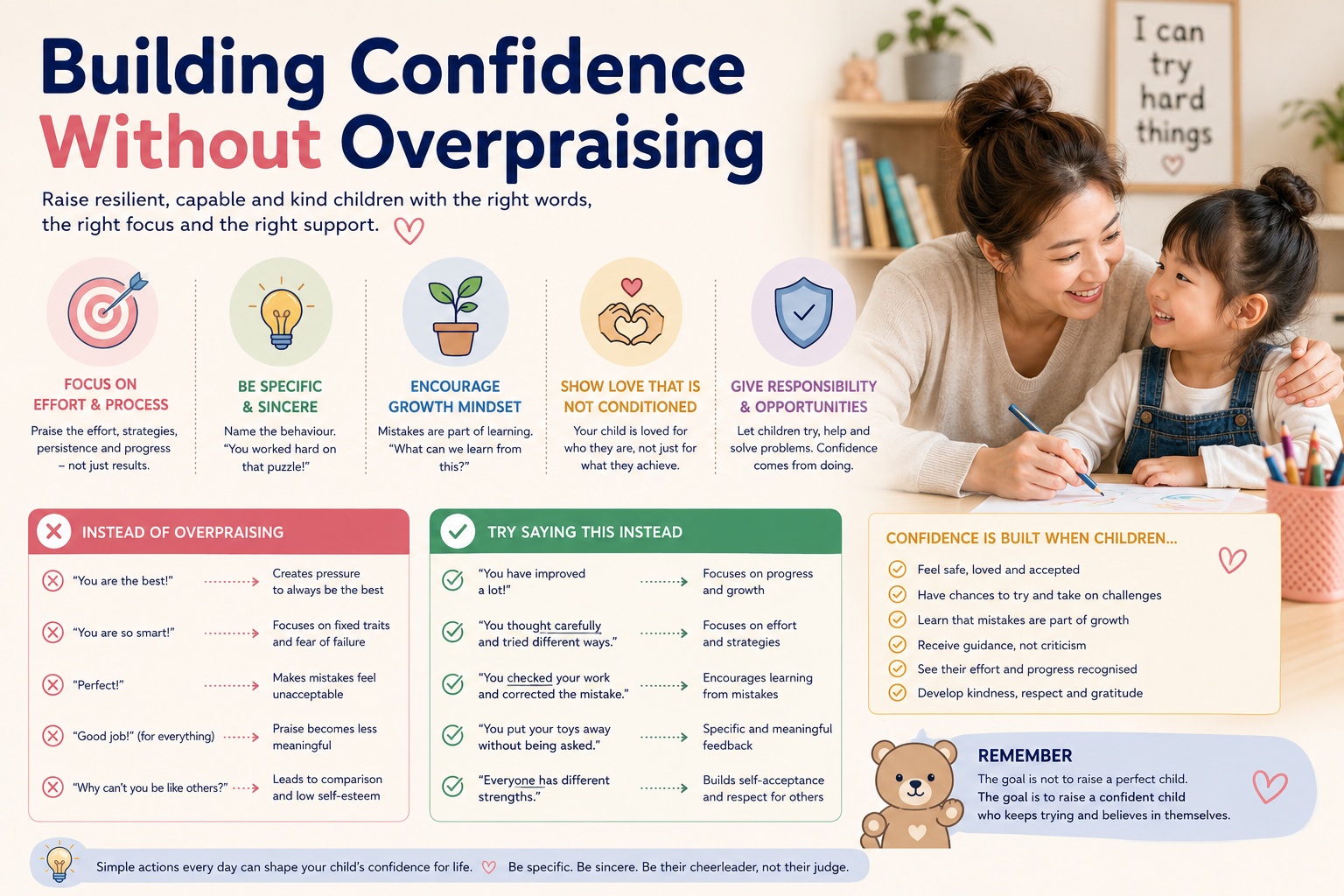
Building Confidence Without Overpraising: A Practical Guide for Parents
Meta description: Learn how to build your child’s confidence without overpraising. Discover evidence-based ways to use specific praise, encouragement, effort-focused feedback and healthy boundaries.
What Does It Mean to Build Confidence Without Overpraising?
Every parent wants their child to feel confident. We want our children to believe in themselves, try new things, recover from mistakes and feel loved even when they do not perform perfectly.
Praise can help. But when praise becomes too frequent, too vague or too exaggerated, it may lose its meaning. A child who constantly hears “You are the best!”, “You are so clever!” or “Perfect!” may start to feel pressure to keep proving themselves. Some children may also become afraid of making mistakes because they do not want to lose that “smart” or “perfect” image.
Building confidence without overpraising means helping children develop a realistic and secure sense of self. Instead of making them depend on constant compliments, parents can help them notice their own effort, progress, problem-solving, kindness and courage.
Quick Answer for Busy Parents
To build confidence without overpraising, use praise that is specific, sincere and focused on effort, strategy, progress or behaviour. Avoid exaggerated praise such as “You are the best in the world” or constant “Good job!” for everything. Children also build confidence through practice, responsibility, emotional support, healthy boundaries and learning from mistakes.
Why Overpraising Can Backfire
Praise is not bad. In fact, warm and specific praise can strengthen parent-child connection and encourage positive behaviour. The problem is not praise itself, but the way praise is used.
Overpraising may cause problems when it is:
- Too vague: “Good job!” does not tell the child what they did well.
- Too exaggerated: “That is the most amazing drawing ever!” may feel unrealistic.
- Too focused on traits: “You are so smart” may make children afraid to look “not smart” later.
- Too frequent: Constant praise for small actions may make praise feel less meaningful.
- Too outcome-focused: Praising only winning, grades or achievement may make children think their worth depends on results.
A more helpful approach is to praise what children can control, such as effort, practice, patience, honesty, courage, kindness and problem-solving.
What Type of Praise Builds Real Confidence?
Confidence grows when children feel capable, loved and able to improve. This is why many child development experts recommend using specific praise and process praise.
1. Specific Praise
Specific praise tells the child exactly what they did well. Instead of saying “Good job,” describe the behaviour.
- Instead of: “Good girl!”
- Say: “You packed your toys back into the box. That was helpful.”
- Instead of: “Well done!”
- Say: “You kept trying even when the puzzle was difficult.”
The CDC recommends making praise specific so children understand what behaviour parents want to encourage. :contentReference[oaicite:1]{index=1}
2. Effort-Focused Praise
Effort-focused praise helps children understand that improvement comes from practice, not just natural talent.
- “You practised reading that sentence many times.”
- “You tried a different way when the first method did not work.”
- “You stayed calm and asked for help.”
HealthHub Singapore similarly advises parents to encourage children and praise their efforts, while helping them think step by step about how to improve. :contentReference[oaicite:2]{index=2}
3. Strategy-Focused Praise
Strategy-focused praise highlights the method the child used. This teaches children that success is not magic; it comes from useful actions.
- “You checked your work carefully before handing it in.”
- “You sorted the blocks by size first. That made the tower stronger.”
- “You used your fingers to count slowly. That helped you get the answer.”
4. Character-Focused Encouragement
Parents can also notice values such as kindness, responsibility and courage.
- “You noticed your friend was sad and gave her space. That was thoughtful.”
- “You told the truth even though it was hard.”
- “You were nervous, but you still tried.”
Examples: What to Say Instead of Overpraising
| Instead of Saying | Try Saying | Why It Helps |
|---|---|---|
| You are so smart! | You thought carefully and tried different ways to solve it. | Focuses on effort and strategy. |
| You are the best! | You have improved a lot since last week. | Focuses on progress instead of comparison. |
| Perfect! | You checked your work and corrected the mistake. | Shows that mistakes can be part of learning. |
| Good job! | You put your shoes on by yourself. | Names the specific behaviour. |
| You are such a good boy/girl! | You waited for your turn even though it was hard. | Praises self-control and patience. |
How Children Build Confidence in Everyday Life
Confidence is not built only through praise. It is built through repeated experiences of trying, learning, helping, failing safely and trying again.
1. Let Children Do Age-Appropriate Tasks
Children feel capable when they are allowed to contribute. Even young children can help with simple tasks.
- Putting toys away
- Choosing clothes from two options
- Carrying their own small school bag
- Helping to set the table
- Packing simple items for preschool or childcare
The goal is not perfection. The goal is for the child to think, “I can do useful things.”
2. Allow Safe Struggle
If parents rush in too quickly, children may learn that difficulty means they need rescuing. When it is safe, give children a little time to try.
For example, if your child is trying to wear shoes, you can wait before helping. If they become frustrated, guide them with a small hint instead of doing everything for them.
3. Teach Children to Talk About Mistakes
Confident children are not children who never fail. They are children who believe they can recover from failure.
- “What did we learn from this?”
- “What can we try differently next time?”
- “This was hard, but hard does not mean impossible.”
4. Give Encouragement Before the Result
Do not wait until your child wins, scores full marks or performs well before you show support. Confidence grows when children know their parents are with them during the process.
- “I know this feels difficult. Let’s take it one step at a time.”
- “You do not have to get it right immediately.”
- “I am proud that you are willing to try.”
5. Show Love That Is Not Based on Performance
Children need to know they are loved even when they lose, make mistakes or behave imperfectly. This does not mean parents should accept all behaviour. It means the child’s worth is not tied to achievement.
You can say:
- “I love you even when you are upset.”
- “You made a mistake, and we will fix it together.”
- “The behaviour was not okay, but you are still loved.”
Confidence-Building Phrases Parents Can Use
- “You worked hard on that.”
- “You found another way to solve the problem.”
- “You were brave to try something new.”
- “You kept going even when it was frustrating.”
- “You asked for help instead of giving up.”
- “You made a mistake and corrected it.”
- “You were kind to your friend.”
- “You listened carefully.”
- “You are learning. It takes time.”
- “What part are you proud of?”
What Parents Should Avoid Saying Too Often
- “You are the smartest.”
- “You are better than everyone else.”
- “You always win.”
- “You are perfect.”
- “You are a genius.”
- “I knew you would be number one.”
- “Why can’t you be like your brother/sister?”
- “If you do not win, it means you did not try hard enough.”
These phrases may seem encouraging, but they can create pressure, comparison or fear of failure.
How to Respond When Your Child Fails
A child’s confidence is shaped strongly by how adults respond when things go wrong.
If your child says, “I am stupid.”
Try: “You are not stupid. You are learning something difficult. Let’s look at which part is confusing.”
If your child says, “I cannot do it.”
Try: “You cannot do it yet. Let’s try one small step first.”
If your child loses a game and cries.
Try: “It is disappointing to lose. I can see you really wanted to win. When you are ready, we can talk about what you want to try next time.”
If your child makes a mistake in homework.
Try: “Mistakes show us what to practise. Which question shall we look at first?”
How to Build Confidence in Shy or Sensitive Children
Some children are naturally cautious, quiet or sensitive to criticism. They may need more time to warm up before trying new things.
- Do not force them to perform in front of others before they are ready.
- Prepare them before new situations.
- Celebrate small brave steps, not only big achievements.
- Avoid labelling them as “shy” in front of others.
- Let them practise social scripts, such as saying hello or asking to join a game.
For example, instead of saying, “Don’t be shy,” try saying, “You can take your time. When you are ready, you can wave or say hello.”
How to Build Confidence Without Raising an Overconfident Child
Confidence is not the same as thinking “I am better than everyone.” Real confidence is balanced with humility, effort and respect for others.
Parents can teach this balance by saying:
- “You did well, and others worked hard too.”
- “Winning feels good, but kindness still matters.”
- “You are good at this, and you can still keep learning.”
- “Everyone has different strengths.”
- “It is okay to feel proud. It is also important to be respectful.”
For Singapore Parents: Common Situations
When Your Child Gets Good Marks
Instead of only saying, “You are so clever,” try:
- “You revised consistently, and it helped.”
- “You checked your careless mistakes this time.”
- “Which study method helped you most?”
When Your Child Does Not Do Well
Instead of saying, “Why so careless?” try:
- “Let’s find out which part was difficult.”
- “This result tells us what to practise next.”
- “One test does not define you.”
When Your Child Compares With Others
Instead of saying, “You must beat them next time,” try:
- “Let’s compare with your own previous work.”
- “What did you improve?”
- “What is one thing you want to work on next?”
FAQ: Building Confidence Without Overpraising
Is praising my child bad?
No. Praise can be helpful when it is sincere, specific and focused on behaviour, effort, strategy or progress. The concern is constant, vague or exaggerated praise.
What is overpraising?
Overpraising means giving praise too often, too broadly or too dramatically, especially when the praise is not connected to a specific behaviour. Examples include “You are perfect,” “You are the best at everything,” or saying “Good job” for every small action.
Should I praise effort even when the result is poor?
Yes, but be honest. You can praise the effort while still helping your child improve. For example: “You worked hard on this. Let’s look at the parts that still need practice.”
How do I build confidence in a child who gives up easily?
Break tasks into smaller steps, praise persistence, allow safe struggle and help your child notice progress. Avoid rescuing too quickly, but offer support when the child is overwhelmed.
What should I say instead of “You are so smart”?
Try saying, “You thought carefully,” “You tried a new strategy,” “You practised a lot,” or “You kept going even when it was hard.”
Can too much praise make a child arrogant?
It can, especially if praise focuses on being better than others. Confidence should be balanced with respect, gratitude, humility and awareness that everyone has different strengths.
How can I build confidence in a sensitive child?
Use gentle encouragement, prepare your child for new situations, praise small brave steps and avoid harsh criticism or public comparisons.
Key Takeaway
Children do not need endless praise to become confident. They need love, safety, practice, responsibility, realistic encouragement and adults who notice their effort and progress. The best praise is not the loudest praise. It is specific, sincere and helps the child understand, “I can learn, I can try, and I am loved even when I make mistakes.”
It takes a village to raise a child !
Join our WhatsApp Groups or Facebook Group to interact with parents about infant care/child care in Singapore..
Subscribe to Our Newsletter to get important information about pregnancy and parenting.