
Digital Milestones: Healthy Tech Use for Toddlers Backed by Research
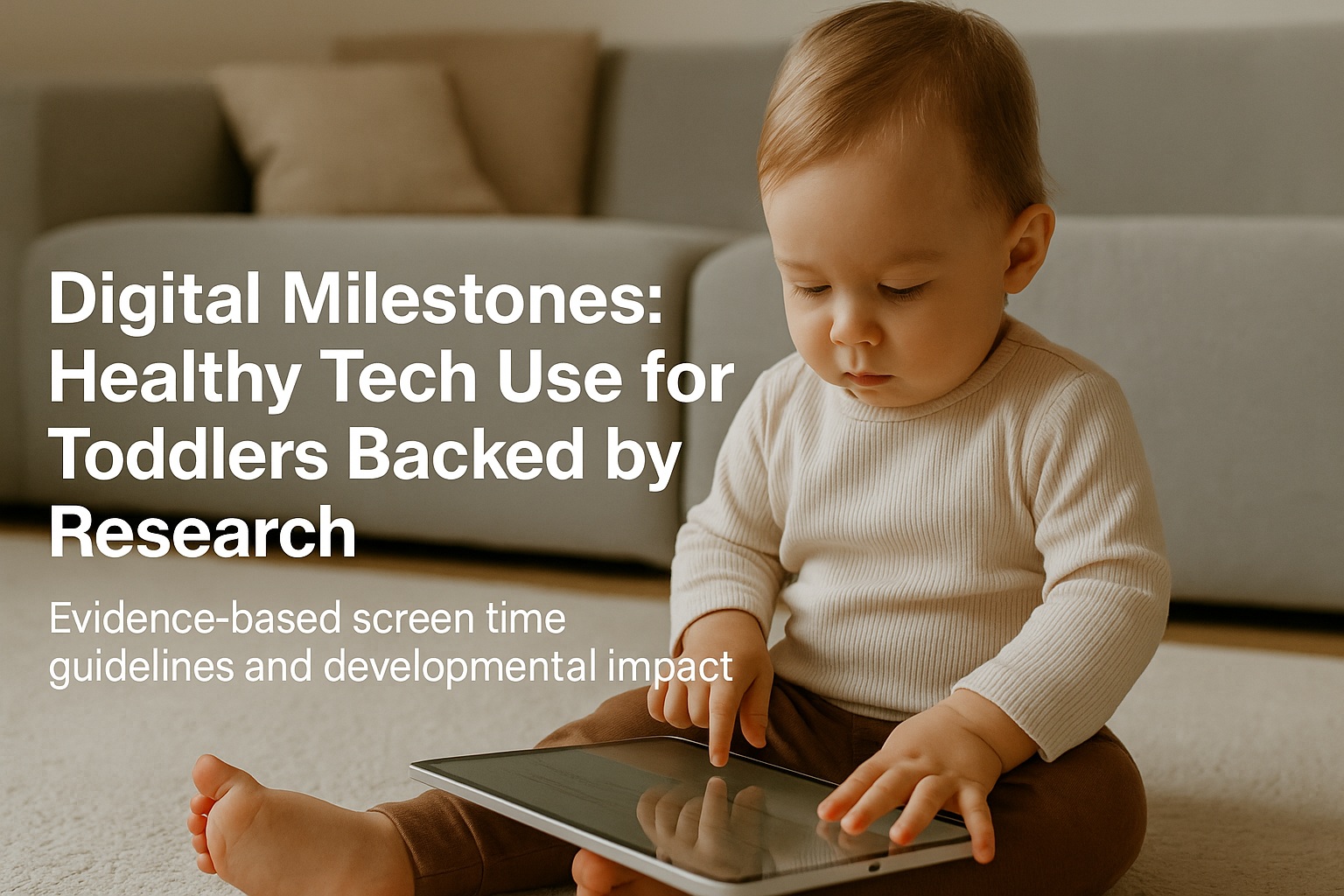
Digital Milestones: Healthy Tech Use for Toddlers Backed by Research
Why Digital Habits Matter Early
As digital devices become part of everyday family life, parents are increasingly asking: “How much screen time is safe for my toddler?” Research in developmental neuroscience and pediatrics now provides clear guidance on how screens can affect the growing brain—and how to create healthy digital habits from the start.
What Do Experts Recommend?
The American Academy of Pediatrics (AAP) recommends:
- No screen time (except video calls) for children under 18 months.
- Limited, high-quality programming for toddlers 18–24 months, always with adult co-viewing.
- Max 1 hour per day of high-quality screen time for children aged 2–5 years, with parental guidance.
These guidelines are rooted in concerns about language development, attention span, sleep quality, and social-emotional learning.
How Screen Time Affects Development
1. Brain Development
Excessive screen use in toddlers is linked to delayed white matter development, particularly in areas related to language and literacy. A 2019 study in JAMA Pediatrics found that higher screen time at age 2 was associated with lower scores on cognitive and behavioral assessments at age 3.
2. Language Skills
Passive watching does not support language acquisition like real-life interactions do. Children learn words best through serve-and-return exchanges—where an adult responds to their babble or questions.
3. Sleep Disruption
Blue light exposure suppresses melatonin and shifts circadian rhythms. Toddlers who use screens before bed often have shorter sleep durations and more frequent night wakings.
4. Behavior and Attention
High screen use (especially fast-paced or overstimulating content) has been linked to increased inattention and impulsivity. This may stem from less real-world play, reduced parent-child interaction, and overstimulation.
What Counts as “High-Quality” Content?
Research suggests that content matters more than quantity. High-quality digital media for toddlers should be:
- Age-appropriate and slow-paced (e.g., Sesame Street)
- Interactive or educational, encouraging participation
- Co-viewed with an adult to help connect digital experiences to the real world
Healthy Digital Habits for Toddlers
- Prioritize face-to-face interaction and physical play over screens
- Co-view and discuss what’s on screen—ask questions and make connections
- Turn off screens at least 60 minutes before bedtime
- Designate screen-free zones (e.g., dining table, bedroom)
- Use parental controls to limit content and duration
Conclusion
Digital exposure during toddlerhood is not inherently harmful—but it must be intentional. By understanding the research behind screen time and brain development, parents can make informed choices that support language, attention, sleep, and emotional connection. In the digital age, balance is key—and your presence matters more than any app.
Frequently Asked Questions (FAQ)
Is video calling considered screen time?
No. The AAP considers video chats (like with grandparents) as a valuable, interactive experience and does not count it as screen time.
What if I need to use screens to keep my toddler occupied?
Short, occasional use is okay—especially with high-quality content. Try to co-view or follow up with related real-life play to reinforce learning.
Can educational apps improve toddler learning?
Only if they are interactive and used with adult guidance. Passive apps have little benefit. Human interaction remains the most powerful teacher.
Does screen time affect attention span in toddlers?
Yes. High screen use (especially fast-moving content) may be linked to inattention later in childhood. Balanced use with plenty of real-world play helps mitigate this.
How can I reset our digital habits?
Start small: introduce screen-free routines (e.g., meals), replace screen time with play or books, and be a digital role model. Toddlers learn best by watching you.
Scientific and Professional Sources
- American Academy of Pediatrics (AAP) – Media Use Guidelines for Young Children
- World Health Organization (WHO) – Guidelines on Physical Activity, Sedentary Behaviour and Sleep for Children Under 5 Years
- Madigan, S., Browne, D., Racine, N., Mori, C., & Tough, S. (2019). Association Between Screen Time and Child Development in Preschool-Aged Children. JAMA Pediatrics.
- Christakis, D.A., & Zimmerman, F.J. (2018). Interactive Media and Early Childhood: A Call for Research. Pediatrics.
- Hutton, J.S., Dudley, J., Horowitz-Kraus, T., DeWitt, T., & Holland, S.K. (2019). Screen-Based Media Use and Structural Integrity of Brain White Matter in Preschool-Aged Children. JAMA Pediatrics.
It takes a village to raise a child !
Join our WhatsApp Groups or Facebook Group to interact with parents about infant care/child care in Singapore..
Subscribe to Our Newsletter to get important information about pregnancy and parenting.