Picky Eating vs Problem Feeding: How to Tell the Difference
Picky Eating vs Problem Feeding: How to Tell the Difference
Meta description: Learn how to tell the difference between normal picky eating and problem feeding in children. Includes red flags, practical mealtime tips and when parents should seek professional help.
What Is the Difference Between Picky Eating and Problem Feeding?
Many children go through a phase where they reject vegetables, ask for the same food every day, refuse new foods or eat very little at some meals. This can be frustrating, but it is often part of normal development, especially in toddlers.
However, not every feeding struggle is just “picky eating”. Some children have feeding difficulties that affect growth, nutrition, safety, oral-motor skills, sensory comfort or family life. These children may need support from a doctor, dietitian, speech therapist, occupational therapist or feeding therapist.
The key question is not simply, “Is my child fussy?” A better question is: Is my child growing well, eating enough variety over time, able to manage age-appropriate textures safely, and coping with mealtimes without extreme distress?
Quick Answer for Busy Parents
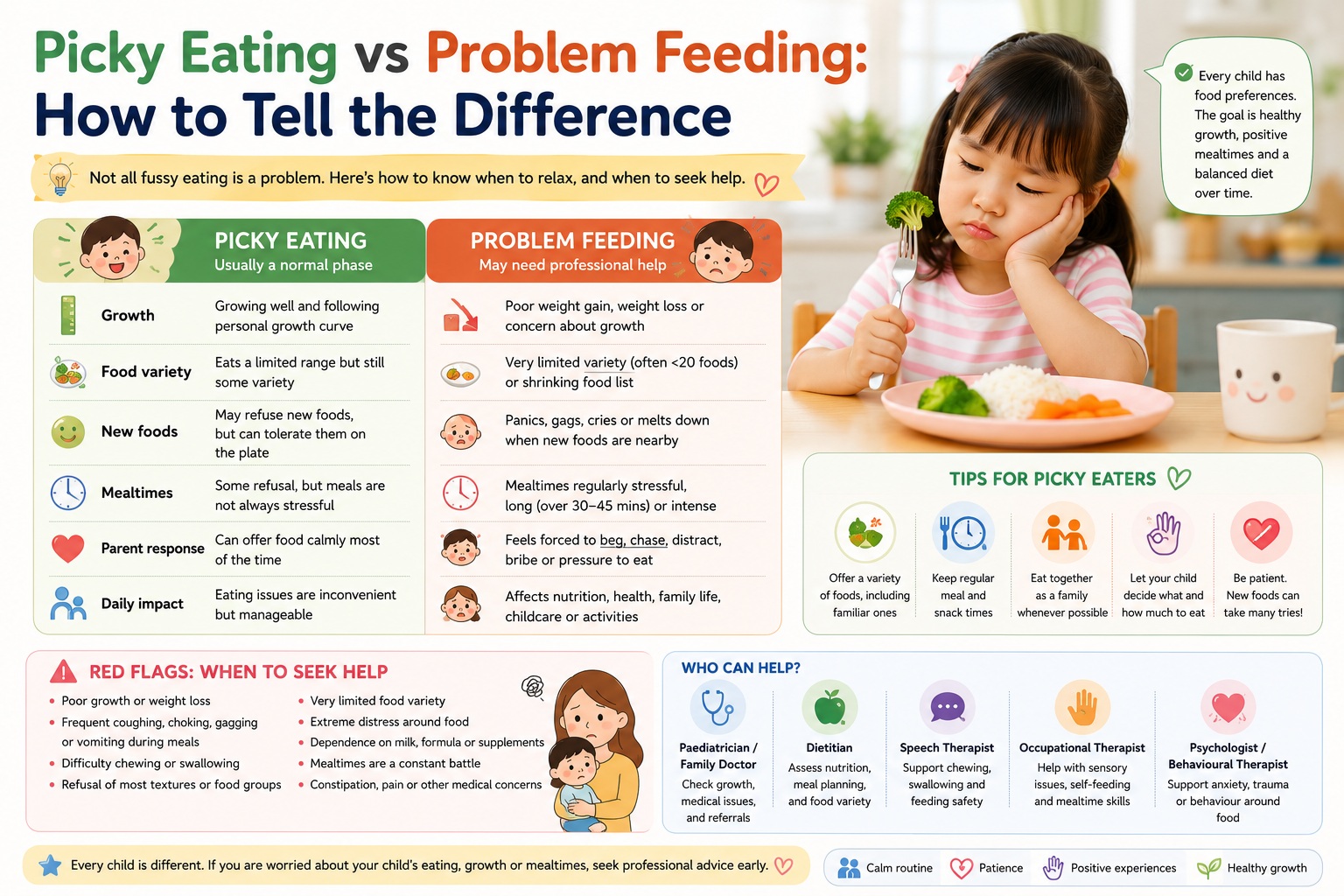
Picky eating is usually a temporary phase where a child has food preferences but is still growing well, eating some variety and able to join family meals. Problem feeding is more concerning when the child has poor growth, choking, gagging, vomiting, extreme distress, very few accepted foods, difficulty chewing or swallowing, refusal of whole food groups, or mealtimes that regularly become stressful battles.
What Normal Picky Eating Can Look Like
Normal picky eating can still look quite dramatic to parents. A toddler may love bananas one week and reject them the next. A preschooler may refuse food if it is cut differently. A child may eat more at breakfast and almost nothing at dinner.
Common signs of typical picky eating include:
- Rejecting some vegetables or new foods
- Preferring familiar foods
- Eating more on some days and less on other days
- Wanting food served in a certain way
- Refusing a food today but accepting it another day
- Eating better at childcare, with grandparents or with peers
- Needing repeated exposure before accepting a new food
- Still growing and gaining weight appropriately
Children’s appetite can vary from day to day. Parents may feel worried when a child eats very little at one meal, but it is often more useful to look at the child’s intake over a week rather than one meal.
What Problem Feeding Can Look Like
Problem feeding is more than a child saying “I don’t like broccoli”. It may involve physical difficulty, fear, sensory distress, medical issues, developmental delays or a pattern of very restricted eating.
Possible signs of problem feeding include:
- Frequently coughing, choking or gagging during meals
- Vomiting during or after meals
- Difficulty chewing foods that are suitable for the child’s age
- Holding food in the mouth for a long time without swallowing
- Refusing whole texture groups, such as all lumpy foods or all crunchy foods
- Eating fewer than about 20 different foods, especially if the list keeps shrinking
- Refusing entire food groups, such as almost all protein foods or all fruits and vegetables
- Strong distress, panic or meltdowns when new foods are near the child
- Mealtimes regularly lasting longer than 30 to 45 minutes
- Poor weight gain, weight loss or crossing down growth percentiles
- Dependence on milk, formula or supplements beyond what is expected for age
- Parent-child conflict around almost every meal
- Parents feeling they must distract, force, chase, bribe or pressure the child to eat
If several of these signs are present, it is better to seek guidance early rather than wait for the child to “grow out of it”.
Picky Eating vs Problem Feeding: Comparison Table
| Area | More Likely Picky Eating | More Likely Problem Feeding |
|---|---|---|
| Growth | Child is generally growing well. | There is poor weight gain, weight loss or concern about growth. |
| Food variety | Child eats a limited but still reasonable range of foods. | Child eats a very narrow range of foods, and the list may be shrinking. |
| New foods | Child may refuse new foods but can tolerate them on the plate. | Child panics, gags, cries or melts down when new foods are nearby. |
| Textures | Child has some preferences but can manage age-appropriate textures. | Child avoids or cannot manage textures expected for age, such as lumps, mixed textures or chewing foods. |
| Swallowing safety | No regular choking, coughing or breathing difficulty during meals. | Frequent coughing, choking, gagging, wet voice, breathing difficulty or vomiting during meals. |
| Mealtime behaviour | Some refusal, but meals are not always stressful. | Mealtimes are regularly stressful, prolonged or emotionally intense. |
| Parent response | Parents can offer food calmly most of the time. | Parents feel forced to beg, chase, distract, bribe or pressure the child to eat. |
| Daily function | Eating issues are inconvenient but manageable. | Eating affects childcare, school, travel, family meals or health. |
Why Picky Eating Happens
Picky eating can happen for many reasons. Some are developmental, while others are linked to routine, temperament or past experiences.
Common reasons include:
- Normal toddler independence: Toddlers like to say “no” and make choices.
- Food neophobia: Some children become wary of unfamiliar foods.
- Small appetite: Growth slows after infancy, so toddlers may eat less than parents expect.
- Too much milk or snacks: Frequent milk, snacks or sweet drinks can reduce appetite at meals.
- Pressure at mealtimes: Pushing, bribing or forcing can make children more resistant.
- Different sensory preferences: Some children are more sensitive to smell, texture, colour or mixed foods.
- Past unpleasant experiences: Choking, vomiting, reflux or painful swallowing can make a child fearful of eating.
What Parents Can Do for Typical Picky Eating
1. Keep Mealtimes Calm and Predictable
Children eat better when mealtimes feel safe and calm. Try to have regular meal and snack times instead of allowing grazing throughout the day.
2. Serve Small Portions
A big plate can overwhelm a child. Start with a small portion and allow more if the child wants it.
3. Offer Familiar Food With New Food
Do not serve only unfamiliar food. Put one accepted food on the plate together with a very small amount of the new food.
4. Avoid Pressure, Bribes and Threats
Try not to say, “Eat three bites or no dessert,” or “Mummy will be sad if you don’t eat.” Pressure can make children more anxious and resistant.
5. Let Children Learn by Watching
Eat together when possible. Children are more likely to try foods that they see parents and siblings eating regularly.
6. Repeat Exposure Without Forcing
Some children need to see, smell, touch or taste a food many times before accepting it. Repeated exposure works best when it is calm and low pressure.
7. Let the Child Have Some Control
Parents decide what food is offered, when it is offered and where meals happen. The child decides whether to eat and how much to eat from what is offered.
8. Watch Milk and Snack Intake
If a child fills up on milk, snacks or sweet drinks, they may not be hungry at meals. Speak to a healthcare professional if you are unsure how much milk is suitable for your child’s age.
When to Seek Professional Help
Parents should seek professional advice if they are worried, especially if feeding issues affect growth, safety, nutrition or family life.
Speak to a doctor if your child has:
- Poor weight gain or weight loss
- Frequent choking, coughing or gagging during meals
- Vomiting, reflux symptoms or pain during feeding
- Difficulty breathing during feeds
- Very limited food variety
- Refusal of most age-appropriate textures
- Extreme distress around food
- Developmental delays or known medical conditions affecting feeding
- Constipation, diarrhoea or suspected food allergies affecting diet
- Mealtimes that regularly become long, stressful battles
In Singapore, parents may start by speaking to a polyclinic doctor, family doctor or paediatrician. Depending on the concern, the child may be referred to a dietitian, speech therapist, occupational therapist or feeding team.
Who Can Help With Problem Feeding?
Paediatrician or Family Doctor
A doctor can check growth, medical history, reflux, constipation, allergies, oral issues, developmental concerns and whether further referral is needed.
Dietitian
A dietitian can assess whether the child is getting enough energy, protein, iron, calcium, fibre and other nutrients. They can also guide parents on safe food substitutions and meal planning.
Speech Therapist
A speech therapist may help when there are concerns about chewing, swallowing, choking, oral-motor skills or safe texture progression.
Occupational Therapist
An occupational therapist may help children with sensory sensitivities, posture, self-feeding skills and mealtime regulation.
Psychologist or Behavioural Therapist
Some children have strong anxiety, trauma or behavioural patterns around food. Psychological support may help when feeding issues are linked to fear, stress or family conflict.
What Parents Should Avoid
- Do not force-feed. This can increase fear and resistance.
- Do not chase the child around with food. Meals should happen in a safe eating place, not while running or playing.
- Do not use screens as the main way to get food in. This may reduce the child’s awareness of hunger, fullness and food textures.
- Do not remove all safe foods suddenly. For very limited eaters, this may reduce intake further.
- Do not shame the child. Comments such as “Why are you so difficult?” can increase anxiety.
- Do not ignore repeated choking or coughing. Swallowing safety should be assessed.
Helpful Phrases to Use at Mealtimes
- “You do not have to eat it, but it can stay on your plate.”
- “You can smell it, touch it or lick it if you want.”
- “This is what we are having for dinner. You can choose what to eat from the plate.”
- “It looks new to you. New foods can take time.”
- “You tried touching it today. That is a step.”
- “Your tummy knows how much it needs.”
- “We can try again another day.”
Sample Mealtime Plan for a Picky Eater
This is a general example for a healthy child with typical picky eating. If your child has medical issues, poor growth, allergies or severe feeding difficulties, seek personalised advice.
- Step 1: Set regular meal and snack times.
- Step 2: Serve one accepted food, one sometimes-accepted food and one small exposure food.
- Step 3: Keep the portion of the new food tiny, such as one pea-sized piece.
- Step 4: Do not pressure the child to eat it.
- Step 5: Eat the same food yourself and describe it neutrally: “This carrot is crunchy.”
- Step 6: End the meal calmly after a reasonable time.
- Step 7: Try again another day.
FAQ: Picky Eating vs Problem Feeding
Is picky eating normal in toddlers?
Yes. Picky eating is common in toddlers and is often a normal developmental stage. Many children become more cautious with new foods as they grow more independent.
How many times should I offer a new food?
Some children need repeated exposure before accepting a new food. Parents can offer the food many times in a calm, low-pressure way. The child does not need to eat it immediately for the exposure to count.
When is picky eating not normal?
It is more concerning if your child is losing weight, not growing well, choking, vomiting, gagging frequently, refusing most textures, eating very few foods or becoming extremely distressed around food.
Should I hide vegetables in food?
Hiding vegetables can sometimes increase nutrition, but it should not be the only strategy. Children also need chances to see, smell, touch and taste vegetables in a low-pressure way so they can learn to accept them.
Should I use dessert as a reward?
It is better not to use dessert as a reward for eating vegetables. This can make dessert seem more valuable and vegetables seem like a chore. Keep mealtimes neutral where possible.
My child eats well at childcare but not at home. Is that normal?
Yes, this can happen. Children may eat differently in different environments. Peer modelling, routine and less parental pressure may help children eat better outside the home.
Can sensory issues cause feeding problems?
Yes. Some children are very sensitive to smell, texture, temperature, appearance or mixed foods. If sensory distress is severe or affects nutrition and family life, professional support may help.
Who should I see if I am worried?
Start with a paediatrician, family doctor or polyclinic doctor. Depending on the issue, your child may need support from a dietitian, speech therapist, occupational therapist or feeding specialist.
It takes a village to raise a child !
Join our WhatsApp Groups or Facebook Group to interact with parents about infant care/child care in Singapore..
Subscribe to Our Newsletter to get important information about pregnancy and parenting.