
Screen Time and Brain Development: Realistic Boundaries for Babies and Children
Screen Time and Brain Development: Realistic Boundaries for Babies and Children
Screen time is one of the most argued-about parenting topics today. Some adults talk as if every screen is harmful. Others assume modern children can safely learn everything through apps and videos. The truth is less dramatic and more useful: screen use is not all the same, and the real question is not only how much, but also what kind, when, with whom, and what it replaces.
When people ask about screen time and “brain development,” they usually mean things like language, attention, sleep, emotional regulation, and learning. Current pediatric guidance does not say that every bit of screen exposure directly harms the brain in a simple one-to-one way. Instead, it consistently warns that too much or poorly timed screen use can crowd out the experiences young children most need for healthy development: talking with adults, being read to, moving their bodies, playing, sleeping well, and learning through real-life interaction.
What the evidence really suggests
The strongest concerns around screen use in younger children are not just about the screen itself, but about displacement. If a baby or toddler spends more time passively watching and less time babbling, pointing, moving, sleeping, and interacting with caregivers, that is where developmental concerns grow. The AAP notes that too much tech and too little talk can get in the way of parent-child interaction and communication development. Singapore’s HealthHub similarly emphasizes that excessive screen use can affect physical, mental, and emotional development, and recommends specific age-based limits.
Sleep is another major issue. Multiple pediatric sources advise avoiding screens for at least one hour before bedtime and keeping devices out of children’s bedrooms, because late screen use can interfere with sleep routines and sleep quality. Poor sleep then affects attention, mood, learning, and behaviour the next day.
There is also concern about sedentary time. WHO guidance for children under 5 links healthy development to a full 24-hour pattern that includes movement, sleep, and limited screen-based sedentary time. In other words, brain development is not built by “less screen time” alone; it is built by what fills the child’s day instead.
Age-based guidance: what current recommendations say
Under 18 months
For babies under 18 months, current guidance generally recommends avoiding passive screen use other than video chatting. The AAP says screen time other than video chatting is best avoided under 18 months, and Singapore HealthHub likewise recommends no screen use under 18 months except interactive video chatting, with no background TV.
18 months to 2 years
This is a transition stage. If parents do use screens, content quality and co-viewing matter. A child learns far more when an adult watches with them, talks about what is happening, labels objects, and connects the content to real life. Passive viewing without interaction is much less useful.
2 to 5 years
For this age group, major guidance sources continue to recommend keeping screen use limited and intentional. WHO guidance says sedentary screen time for 2-year-olds should be no more than 1 hour and less is better. CDC’s milestone guidance for 3-year-olds says to limit screen time to no more than 1 hour per day of a children’s program with an adult present. Singapore HealthHub recommends less than 1 hour a day outside school for children 18 months to 6 years, with no screens during meals and one hour before bedtime.
Older children
For school-age children, guidance is moving beyond one simple number and focusing more on balance, sleep, safety, school functioning, relationships, and emotional health. The AAP’s newer “5 Cs” approach emphasizes content, context, child, calm, and crowding out—meaning families should ask whether screens are replacing sleep, physical play, school work, or social connection. Singapore HealthHub recommends less than 2 hours a day outside of schoolwork for ages 7 to 12.
Why “educational” does not mean unlimited
Parents often feel less worried about screens when the content is labelled educational. That is understandable, but educational media still should not replace real-world learning. The AAP notes that online preschool activities and educational apps or shows should not take the place of face-to-face interactions and real-life experiences, especially in younger children. A child learns language, self-regulation, and social cues through responsive interaction, not only by absorbing information from a screen.
That does not mean all educational media is useless. Good content, especially when watched with an adult, can support vocabulary, curiosity, and shared conversation. But the benefit depends heavily on context. A five-minute co-viewed song session is different from hours of unsupervised autoplay.
What realistic boundaries look like in real family life
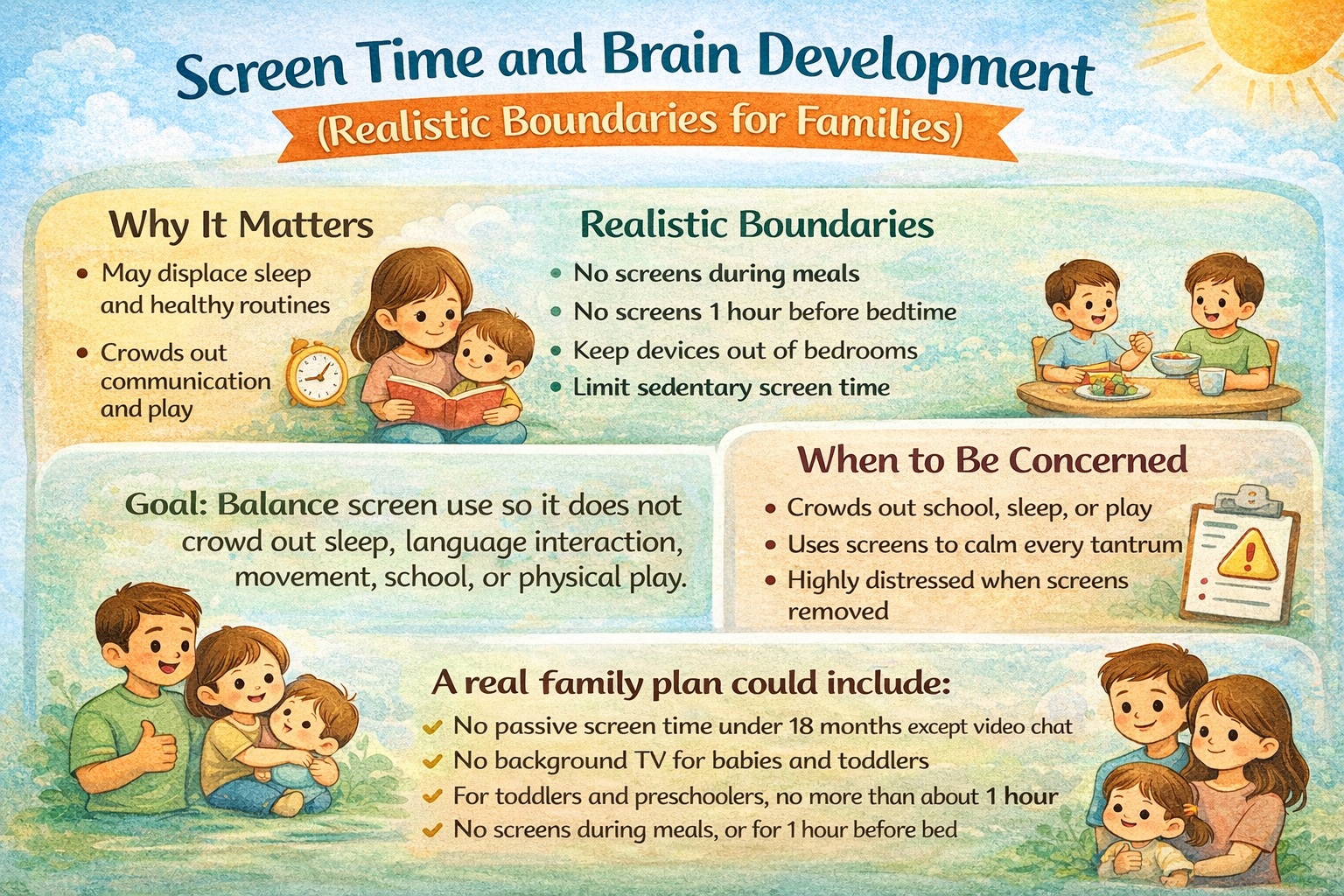
Perfect “no screen” parenting is unrealistic for many families, and current guidance increasingly recognizes that. The goal is not moral purity. The goal is to protect the parts of a child’s day and brain development that matter most. For many families, realistic boundaries work better than extreme rules that collapse after three days.
1. Protect sleep first
A strong starting rule is no screens for at least one hour before bedtime. Keep bedrooms screen-free when possible. This is one of the most practical and evidence-supported boundaries because sleep affects mood, behaviour, learning, and family functioning.
2. Protect meals and conversation
No screens during meals is another high-value rule. HealthHub recommends avoiding screens during meals, and this boundary protects conversation, appetite regulation, and the routine of sitting together without distraction.
3. Avoid background TV and constant passive media
Even when a child is “not really watching,” background television or constant videos can reduce the quality of play and adult-child interaction. For babies and toddlers especially, a quieter environment supports attention, babbling, and shared engagement. Singapore guidance specifically advises not turning on the TV in the background for children under 18 months.
4. Use regular screen windows instead of all-day access
The AAP’s toddler and preschool guidance suggests keeping screens for regular times of day rather than handing them over every time a child is bored or upset. Predictable screen windows are often easier to manage than constant negotiation.
5. Do not let screens become the main calming tool
It is understandable to use a device in a difficult moment, especially during travel or illness. The AAP explicitly says using screens on a long flight will not do harm even if you usually keep them minimal. But as a daily habit, using screens to stop every tantrum or boredom moment can crowd out practice in waiting, soothing, and coping.
6. Co-view when you can
Watch together, talk about what is happening, ask simple questions, repeat new words, and connect the content to real life. Co-viewing makes screen use more relational and more language-rich.
What “too much” screen use may look like
Parents do not need to panic over every extra cartoon. But screen habits deserve a closer look when they are clearly displacing healthy routines. Warning signs include sleep getting worse, mealtimes becoming device-dependent, less interest in play, distress whenever screens are removed, falling school attention, and reduced family interaction. HealthHub frames the issue similarly, noting that too much screen use can steal time from learning, sleeping, physical activity, and time with others.
In younger children, language is a particularly important lens. If a toddler is spending large amounts of time watching but getting relatively little back-and-forth talk, reading, or play, that is worth addressing. The AAP specifically warns that too much parent tech use and too little talk can interfere with communication development.
What about brain development specifically?
It is more accurate to say that healthy brain development depends on responsive relationships, language exposure, movement, sleep, and play. Screen use becomes a developmental problem when it pushes those things aside. For infants and toddlers especially, the best “brain-building” activities remain surprisingly basic: talking, singing, reading, cuddling, moving, exploring, and being with responsive adults. CDC milestone guidance even reminds parents that children learn by talking, playing, and interacting with others.
So the real question is often not, “Did this screen harm my child’s brain today?” It is, “Did screens take too much space away from the experiences my child needs most?” That is a much more practical question, and usually a more helpful one. This is an evidence-based inference from current pediatric guidance focused on quality, context, and displacement rather than simple screen counting alone.
A realistic family plan
For many families, a workable screen plan looks like this:
- No passive screen time under 18 months except video chat.
- No background TV for babies and toddlers.
- For toddlers and preschoolers, keep screen use under about 1 hour a day and use age-appropriate content with an adult when possible.
- No screens during meals.
- No screens one hour before bedtime.
- Keep devices out of bedrooms at night.
- Use screens intentionally, not automatically for every upset moment.
- Protect time for reading, outdoor play, conversation, and sleep.
This plan broadly matches current advice from the AAP, CDC, WHO, and Singapore HealthHub, while remaining realistic enough for daily life.
The bottom line
Screen time is not best understood as a simple “good” or “bad” force on the brain. What matters most is age, content, timing, co-use, and what screen use replaces. For babies and toddlers, the most protective approach is very limited screen exposure and lots of real-world interaction. For older children, the goal is balanced, intentional use that does not crowd out sleep, movement, school, play, and family connection. Realistic boundaries are usually more sustainable than extreme rules—and better for family life too.
FAQ
Does screen time damage a child’s brain?
Not in a simple all-or-nothing way. The bigger issue is that too much or poorly timed screen use can displace sleep, conversation, movement, and play that support healthy development.
How much screen time is recommended for toddlers?
Current guidance generally keeps toddler and preschooler screen use low and intentional, with around 1 hour a day or less often used as a practical upper boundary for younger children.
Are educational videos okay?
They can be better than random content, especially if watched with an adult, but they should not replace real interaction, reading, play, and sleep.
What are the most useful screen boundaries?
No screens during meals, no screens one hour before bedtime, no background TV for young children, and regular screen windows instead of all-day access are among the most practical boundaries.
When should parents worry?
Pay attention if screen use is clearly crowding out sleep, movement, play, conversation, school functioning, or emotional regulation.
It takes a village to raise a child !
Join our WhatsApp Groups or Facebook Group to interact with parents about infant care/child care in Singapore..
Subscribe to Our Newsletter to get important information about pregnancy and parenting.