Whining, Shouting, Backtalk: Practical Scripts for Parents
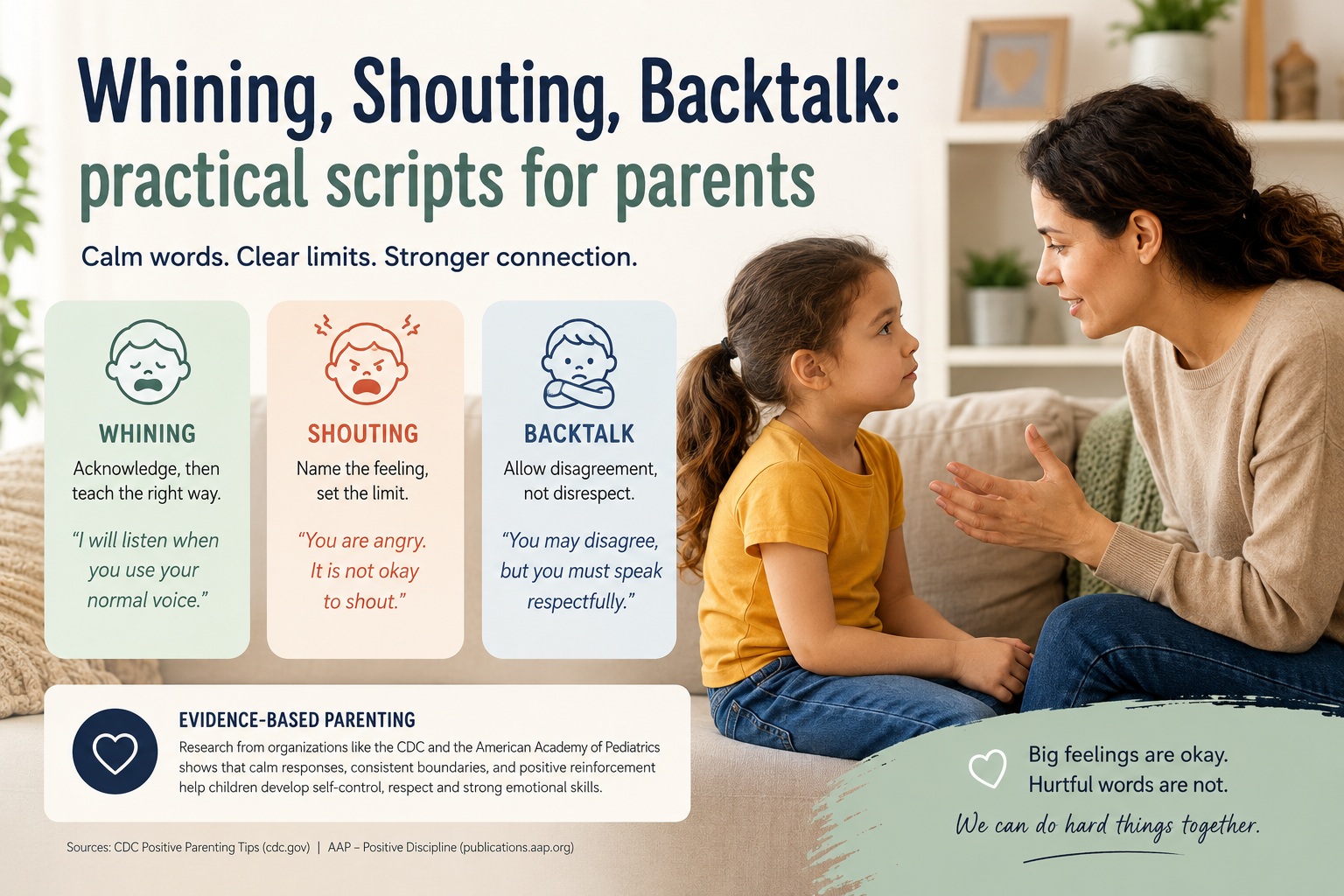
Whining, Shouting, Backtalk: Practical Scripts for Parents
Whining, shouting and backtalk are common in childhood, but they can be exhausting for parents. The good news is that these behaviours are not always signs of "bad attitude". Very often, they are signs that a child is tired, frustrated, seeking attention, struggling to express a need, or testing where the boundary is.
For parents, the goal is not to "win" the argument. The goal is to stay calm, teach better communication, and hold clear limits consistently. Evidence-based parenting guidance from the CDC and the American Academy of Pediatrics supports using calm words, clear expectations, positive reinforcement, redirection, and consistent consequences instead of yelling, shaming or physical punishment. :contentReference[oaicite:0]{index=0}
This article gives practical scripts parents can use when children whine, shout or talk back, especially for preschoolers and primary school children.
Why Children Whine, Shout or Talk Back
Before responding, it helps to understand what may be behind the behaviour. A child may whine because they do not yet know how to ask calmly. They may shout because their emotions are bigger than their coping skills. They may talk back because they want control, feel misunderstood, or are copying how adults or older children communicate.
Young children are still developing emotional regulation, language skills and impulse control. That does not mean parents should accept rude or aggressive behaviour. It means parents should respond in a way that teaches the child what to do instead.
A useful parenting principle is: connect with the feeling, correct the behaviour, and teach the replacement skill.
The Parent's First Job: Stay Calm Enough to Lead
When a child whines, shouts or talks back, many parents feel triggered. It is natural to want to say, "Stop it now!" or "Don't talk to me like that!" However, shouting back often turns the situation into a power struggle.
The American Academy of Pediatrics recommends positive discipline strategies that teach children to manage behaviour while promoting healthy development. It also advises against harsh verbal discipline such as shaming, threatening or humiliating. :contentReference[oaicite:1]{index=1}
Before speaking, try this simple parent reset:
- Pause for three seconds.
- Lower your voice instead of raising it.
- Use fewer words.
- Decide the boundary before you speak.
Parent script: "I want to help you, but I will speak when we both use calm voices."
Script 1: When Your Child Whines
Whining often works because it gets attention quickly. If parents give in after repeated whining, the child learns that whining is an effective strategy. Instead, parents can calmly teach the child the correct way to ask.
Instead of saying:
"Stop whining!"
Try saying:
"I can't understand your whining voice. Please use your normal voice and say, 'Mummy, may I have water please?'"
If the child continues whining:
"I will listen when you use your calm voice."
When the child asks properly:
"That was a much better way to ask. Thank you for using your normal voice."
This approach works because it does not reward the whining, but it gives the child a clear replacement behaviour. The CDC advises parents to be clear and consistent, and to show children the behaviour they expect rather than only telling them what not to do. :contentReference[oaicite:2]{index=2}
Script 2: When Your Child Shouts
Shouting is often a sign of big feelings. A child may be angry, disappointed, embarrassed, tired or overwhelmed. The parent's job is to set a limit on the shouting while helping the child express the feeling safely.
Try saying:
"You are angry. It is okay to be angry. It is not okay to shout at me."
Then offer a choice:
"You can tell me with a calm voice, or you can take two minutes to cool down and then tell me."
If the child shouts louder:
"I am not going to argue. I will be here when your voice is calm."
After the child calms down:
"Thank you for calming your body. Now tell me what you wanted to say."
This teaches the child that feelings are allowed, but disrespectful or aggressive behaviour is not. It also avoids turning the episode into a long lecture while the child is emotionally flooded.
Script 3: When Your Child Talks Back
Backtalk can be especially frustrating because it may feel disrespectful. However, parents need to separate two things: the child's opinion and the child's tone.
A child is allowed to disagree. A child is not allowed to be rude.
Try saying:
"You may disagree with me, but you must speak respectfully."
Then give the child the words to use:
"Try again: 'I don't agree because…'"
If the child says, "You are so unfair!"
"You feel this is unfair. You can explain your reason calmly, but the rule still stands."
If the child says, "I don't care!"
"You may feel upset. The task still needs to be done. You can do it now, or after five minutes. Which do you choose?"
This gives the child some control while keeping the boundary firm.
Script 4: When Your Child Keeps Repeating the Same Demand
Children often repeat the same request again and again: "Can I have it? Please? Please? Why not? But I want it!" This can wear parents down.
Try the "Asked and Answered" script:
"You asked for the tablet. I answered: not now. Asking again will not change the answer."
If the child continues:
"I have already answered. You may choose another activity."
If the child becomes upset:
"I know you are disappointed. It is hard to stop asking when you really want something. The answer is still no."
This avoids repeated negotiation. The parent acknowledges the feeling but does not reopen the decision.
Script 5: When Your Child Says "You Don't Love Me!"
Some children use emotional statements when they are upset. Parents may feel guilty and rush to give in. Instead, respond with warmth and firmness.
Try saying:
"I love you very much. That is why I am helping you learn limits."
Or:
"You are upset with my answer. I still love you, and the answer is still no."
This reassures the child without letting guilt change the boundary.
Script 6: When Your Child Refuses to Listen
When a child refuses to listen, parents often repeat instructions many times. Unfortunately, repeated nagging may teach the child that they do not need to act until the parent gets angry.
Use this sequence:
- Get close.
- Use the child's name.
- Give one clear instruction.
- Ask the child to repeat it.
- Follow through calmly.
Parent script:
"Ethan, shoes on now. Please repeat what you need to do."
If the child ignores:
"You can put on your shoes by yourself, or I will help you. We are leaving in two minutes."
If the child still refuses:
"You chose help. I will help you now."
This is not about threatening. It is about making the instruction clear and predictable.
Script 7: When Your Child Is Rude in Public
Public backtalk can feel embarrassing. Parents may feel pressured to punish immediately. However, public lectures often escalate the situation.
Try saying quietly:
"Pause. That tone is not okay. We will talk about this outside."
Move the child away if needed. Then say:
"You were upset, but speaking rudely is not acceptable. Try again respectfully."
If the child continues:
"We will leave if you cannot speak respectfully."
If you say this, be prepared to follow through. Consistency is important because children learn from what happens after their behaviour. The CDC notes that what parents do immediately after a child's behaviour can affect whether that behaviour happens more often. :contentReference[oaicite:3]{index=3}
Use Praise to Build the Behaviour You Want
Parents often give attention when children misbehave, but forget to notice when children speak nicely. Evidence-based parent training programmes commonly teach parents to reinforce the positive opposite of unwanted behaviour. Yale's Everyday Parenting course, for example, teaches behaviour-change techniques such as adjusting tone, phrasing and praise to improve cooperation. :contentReference[oaicite:4]{index=4}
Instead of only reacting to whining or backtalk, look for small moments of good communication.
Useful praise scripts:
- "You were upset, but you used your calm voice. That was respectful."
- "Thank you for asking properly."
- "I noticed you stopped yourself from shouting. That shows self-control."
- "You disagreed with me politely. I appreciate that."
Specific praise is more useful than general praise. Instead of only saying "Good boy" or "Good girl", name the behaviour you want repeated.
When to Use Consequences
Consequences can be useful when they are calm, related and predictable. They should not be used to scare or shame the child.
For example:
- If a child shouts during a game, the game pauses.
- If a child speaks rudely during screen-time negotiation, the discussion ends.
- If a child throws a toy while angry, the toy is kept away for a short period.
- If a child refuses to get ready, the child may have less time for play before leaving.
Parent script:
"Because you shouted and threw the toy, the toy will rest for 10 minutes. You can try again after that."
For younger children, consequences should be immediate and short. Long punishments often lose their teaching value.
What Parents Should Avoid
When parents are tired, it is easy to react harshly. However, some responses may make whining, shouting and backtalk worse over time.
- Avoid shouting back. It models the same behaviour you want to stop.
- Avoid long lectures during a meltdown. A dysregulated child cannot process much information.
- Avoid giving in after repeated whining. This teaches the child to keep going.
- Avoid insults or labels. Say "That tone is rude," not "You are rude."
- Avoid empty threats. If you cannot follow through, do not say it.
The AAP advises against discipline methods that involve hitting, insulting, humiliating or shaming children, and recommends positive discipline approaches instead. :contentReference[oaicite:5]{index=5}
A Simple 4-Step Formula Parents Can Use
When you do not know what to say, use this formula:
- Name the feeling: "You are upset."
- Set the limit: "You may not shout at me."
- Teach the replacement: "Say, 'I need help please.'"
- Follow through: "I will listen when your voice is calm."
Example:
"You are frustrated because I said no. You may not shout. Try saying, 'I feel angry because I still want to play.' I will listen when you use a calm voice."
Practical Script Table for Parents
| Child's Behaviour | What Parents Can Say | What It Teaches |
|---|---|---|
| Whining for something | "Use your normal voice and ask again." | How to ask properly |
| Shouting angrily | "You are angry. It is okay to be angry. It is not okay to shout." | Feelings are allowed; shouting is not |
| Backtalk | "You may disagree, but you must speak respectfully." | Respectful disagreement |
| Repeating a demand | "You asked, and I answered. Asking again will not change the answer." | Boundaries are firm |
| Refusing to listen | "You can do it yourself, or I will help you." | Choices have outcomes |
| Rude words in public | "Pause. That tone is not okay. We will talk outside." | Respect applies everywhere |
When Behaviour May Need Extra Support
Occasional whining, shouting and backtalk are common. However, parents may consider seeking professional support if the behaviour is intense, frequent, aggressive, affects school or friendships, or continues despite consistent parenting strategies.
Parents may speak with a paediatrician, school counsellor, psychologist or family support professional if they notice:
- frequent aggressive outbursts;
- self-harm talk or behaviour;
- extreme anxiety or sadness;
- major sleep problems;
- serious difficulties at school;
- behaviour that feels unsafe for the child or others.
Getting support does not mean parents have failed. It means the child may need more help building emotional and behavioural skills.
Conclusion
Whining, shouting and backtalk can test a parent's patience, but they are also opportunities to teach communication, emotional regulation and respect. The most effective responses are usually calm, short and consistent.
Parents do not need perfect scripts every time. A simple approach works well: acknowledge the feeling, set the boundary, teach the better words, and follow through. Over time, children learn that they can have big feelings without using hurtful or disrespectful behaviour.
Frequently Asked Questions
1. Is backtalk always disrespectful?
Not always. Sometimes children are trying to express disagreement but do not yet know how to do it respectfully. Parents can allow disagreement while correcting rude tone or words.
2. Should I ignore whining?
Parents can avoid rewarding whining, but should still teach the child what to do instead. A useful response is: "I will listen when you use your normal voice."
3. What should I do if my child shouts at me?
Stay calm, name the feeling, and set the limit. For example: "You are angry. It is okay to be angry. It is not okay to shout at me." Then invite the child to try again with a calmer voice.
4. Should I punish my child for backtalk?
Instead of harsh punishment, use calm correction and related consequences. For example, if a child speaks rudely during a request for screen time, pause the discussion until the child can speak respectfully.
5. Why does my child behave well outside but whine at home?
Home is often where children feel safest to release stress. This does not mean parents should accept rude behaviour, but it may explain why children show more emotional behaviour after school, childcare or a long day.
6. What if I shouted at my child?
Repair the moment. You can say, "I was frustrated and I shouted. I should have used a calmer voice. Let's try again." This models accountability and respectful communication.
7. At what age should children stop whining?
There is no fixed age. Whining usually reduces as children develop better language, patience and emotional regulation. Consistent responses from parents can help reduce the habit.
This article is for general parenting education and does not replace professional advice. If your child's behaviour is severe, persistent or unsafe, consider seeking help from a qualified healthcare or child development professional.
It takes a village to raise a child !
Join our WhatsApp Groups or Facebook Group to interact with parents about infant care/child care in Singapore..
Subscribe to Our Newsletter to get important information about pregnancy and parenting.