Baby Sleep Regression Periods: 4 Months, 8 to 10 Months and 18 Months
Meta description: Learn why babies and toddlers may suddenly wake more often at 4 months, 8–10 months and 18 months, what parents can do, and when to seek medical advice.
What Is a Sleep Regression?
A sleep regression is a period when a baby or toddler who was sleeping relatively well suddenly starts waking more often, resisting naps, crying at bedtime, taking shorter naps or needing more help to fall asleep.
It is not usually a sign that parents have done something wrong. In many cases, it happens because the child is going through normal development, learning new skills, becoming more aware of caregivers, changing nap needs, teething, feeling unwell or experiencing a disruption in routine.
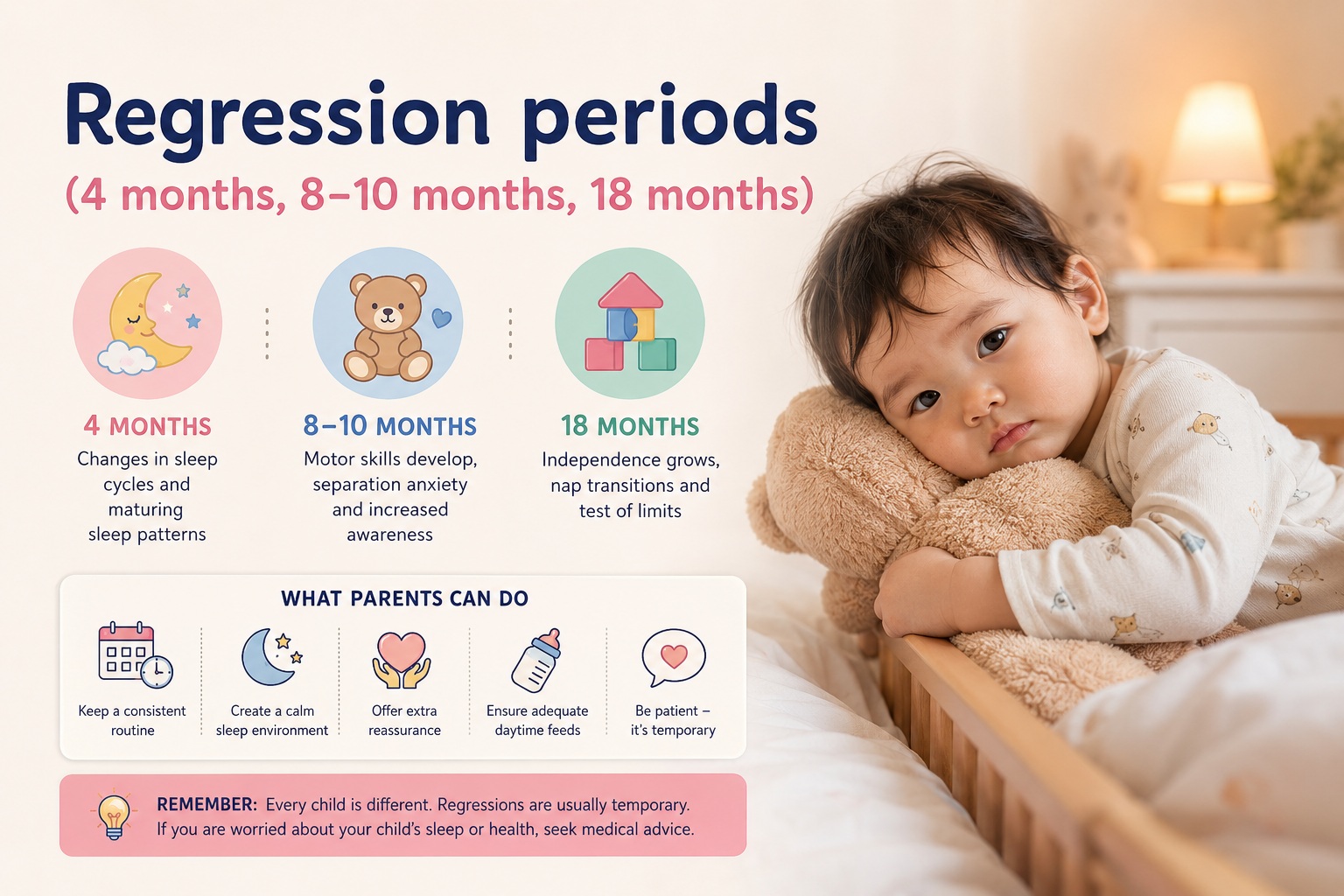
Common regression periods include around 4 months, 8–10 months and 18 months. However, not every child will go through all of them, and the timing can vary.
Quick Summary for Busy Parents
- 4-month regression: Often linked to maturing sleep cycles and changes in how babies move between light and deep sleep.
- 8–10-month regression: Often linked to crawling, pulling to stand, separation anxiety and increased awareness of parents leaving the room.
- 18-month regression: Often linked to toddler independence, language development, nap transitions, separation anxiety and bedtime resistance.
- Most regressions are temporary: Many improve with consistent routines, age-appropriate naps and calm reassurance.
- Seek medical advice: If poor sleep is accompanied by fever, breathing difficulty, poor feeding, poor weight gain, persistent vomiting, unusual lethargy or signs of pain.
4-Month Sleep Regression
Why It Happens
Around 4 months, many babies become more alert and their sleep begins to look more like adult sleep, with clearer cycles between lighter and deeper sleep. This means a baby may wake more fully between cycles and need help settling again.
At this age, babies may also become more interested in their surroundings, practise new physical skills, feed differently, or become more easily distracted during the day. All these can affect night sleep and naps.
Common Signs
- Sudden increase in night waking
- Short naps, often 30–45 minutes
- More fussiness before sleep
- Difficulty settling after waking
- Wanting to be rocked, fed or carried more often to sleep
- More distracted feeding during the day
What Parents Can Do
- Use a simple bedtime routine: For example, bath or wipe-down, milk feed, quiet song, cuddle and sleep.
- Watch wake windows: Many 4-month-old babies cannot stay awake for very long. An overtired baby may wake more often.
- Encourage daytime feeds: If your baby is too distracted to feed well in the day, they may wake more at night due to hunger.
- Put baby down drowsy when possible: This can help some babies practise falling asleep with less help, but do not force it if your baby is very upset.
- Keep night wakings calm: Use dim light, quiet voice and minimal stimulation.
Parents should remember that night waking at this age can still be normal. Some babies may not be ready to sleep long stretches consistently, especially if they are breastfed, growing rapidly or recovering from illness.
8–10-Month Sleep Regression
Why It Happens
Between 8 and 10 months, many babies are learning major physical skills such as crawling, sitting, pulling to stand or cruising. Their brains and bodies are busy practising these skills, sometimes even during sleep periods.
This is also a common age for separation anxiety. Babies begin to understand that parents still exist when they leave the room, but they may not yet feel secure about when the parent will return. As a result, bedtime and night wakings may become more emotional.
Common Signs
- Crying when a parent leaves the room
- Standing or sitting in the cot and not knowing how to lie back down
- More night waking after a period of better sleep
- Nap refusal or short naps
- Wanting more comfort at bedtime
- Waking early in the morning
What Parents Can Do
- Practise new skills during the day: Give your baby safe floor time to crawl, sit, stand and practise getting back down.
- Offer reassurance without creating a long play session: Comfort your baby, but keep night interactions boring and calm.
- Play peekaboo and short separation games: These help your baby learn that you leave and come back.
- Keep naps age-appropriate: Too little daytime sleep can cause overtiredness, while too much late sleep may reduce sleep pressure at bedtime.
- Avoid sudden big changes if possible: If your baby is already unsettled, this may not be the best time to remove all sleep supports abruptly.
For babies in infant care or with grandparents/helpers during the day, try to keep sleep routines broadly similar across caregivers. The routine does not need to be identical, but consistent cues can help.
18-Month Sleep Regression
Why It Happens
At around 18 months, toddlers are developing independence, stronger preferences and better language understanding. They may want to choose their pyjamas, delay bedtime, ask for more stories, or protest when limits are set.
Some toddlers are also moving from two naps to one nap, or adjusting to a different childcare schedule. If the nap is too long, too late or too short, bedtime can become difficult. Separation anxiety can also return during toddlerhood, especially during changes such as starting childcare, moving house, travel or a new sibling arriving.
Common Signs
- Refusing bedtime
- Asking for repeated water, milk, hugs or stories
- Crying when parents leave the room
- Waking at night and calling for parents
- Early morning waking
- Nap refusal or a messy nap schedule
- Climbing out of the cot or trying to leave the bed
What Parents Can Do
- Give limited choices: For example, “Do you want the blue pyjamas or yellow pyjamas?” This gives control without letting bedtime become negotiable.
- Use a predictable bedtime routine: Keep it short and repeatable: bath, pyjamas, brushing teeth, story, goodnight phrase.
- Set clear boundaries: Decide how many books, drinks or cuddles are allowed before bedtime.
- Check the nap schedule: Many toddlers this age do well with one nap. A very late nap may delay bedtime.
- Stay calm during protests: Toddlers often test boundaries. A calm, consistent response is usually more helpful than long negotiation.
- Make the sleep space safe: If your toddler climbs out of the cot, review safety and consider whether a bed transition is needed.
What Not to Do During a Sleep Regression
- Do not assume every waking is “bad behaviour”. Babies and toddlers may wake due to hunger, discomfort, teething, illness or developmental changes.
- Do not introduce too many new habits at once. For example, changing bedtime, dropping naps and removing night feeds all at the same time may make things harder.
- Do not ignore signs of illness. Sleep disruption with fever, cough, breathing issues, vomiting, diarrhoea or poor feeding should be treated differently from a normal regression.
- Do not compare your child too closely with others. Sleep development varies widely among healthy babies and toddlers.
When Should Parents Seek Medical Advice?
Most sleep regressions are temporary and can be managed at home. However, parents should seek medical advice if sleep problems are accompanied by:
- Fever or signs of infection
- Breathing difficulty, noisy breathing or pauses in breathing
- Poor feeding or signs of dehydration
- Persistent vomiting or diarrhoea
- Poor weight gain
- Unusual sleepiness, weakness or lethargy
- Persistent crying that sounds different from usual
- Signs of pain, such as ear pulling, arching, inconsolable crying or refusal to lie down
- Snoring with gasping, choking or restless sleep
In Singapore, parents can consult a polyclinic doctor, paediatrician or family doctor if they are unsure whether the sleep change is developmental or health-related.
How Long Does a Sleep Regression Last?
A sleep regression may last a few days to a few weeks. The exact duration depends on the child’s development, routine, health, temperament and how parents respond during the period.
If the regression continues for many weeks, it may no longer be only a developmental phase. It may be linked to sleep associations, inconsistent routines, unsuitable nap timing, illness, discomfort or environmental factors.
Practical Sleep Checklist for Parents
- Keep bedtime and wake-up time reasonably consistent.
- Use a calming bedtime routine every night.
- Make the room dark, quiet and comfortable.
- Avoid exciting play just before bedtime.
- Give enough daytime connection and physical activity.
- Check whether naps are too short, too long or too late.
- Respond calmly at night with minimal stimulation.
- Offer reassurance, but avoid turning night wakings into playtime.
- Review feeding, teething, illness and childcare routine changes.
- Speak to a doctor if there are worrying symptoms.
FAQ: Baby and Toddler Sleep Regression
Is sleep regression real?
“Sleep regression” is a common term used by parents to describe a sudden worsening of sleep. It is not usually a formal medical diagnosis, but the sleep changes parents notice are real and often linked to development, illness, teething, separation anxiety or routine changes.
Do all babies go through sleep regression?
No. Some babies show clear sleep changes at 4 months, 8–10 months or 18 months, while others have only mild changes or none at all. Both can be normal.
Should I sleep train during a regression?
It depends on your baby’s age, health, feeding needs and your parenting approach. It is usually better to first check for illness, hunger, teething, overtiredness and routine issues. If you choose sleep training, use an age-appropriate and safe method, and avoid doing it when your child is unwell.
Does a 4-month-old still need night feeds?
Some 4-month-old babies still need night feeds, especially if they are breastfed, smaller in size, going through a growth spurt or not feeding well during the day. Parents should speak to a doctor if unsure whether night feeds are still needed.
Why does my 9-month-old cry when I leave the room?
This may be separation anxiety, which is a normal part of development. Your baby is learning that you exist even when you are not visible, but may feel upset because they do not yet fully understand when you will return.
Why is my 18-month-old suddenly refusing bedtime?
At 18 months, toddlers may test limits, want more independence, struggle with separation, or be adjusting to a new nap pattern. A predictable routine, limited choices and calm boundaries can help.
Can teething cause sleep regression?
Teething discomfort can disturb sleep for some babies and toddlers. However, not all sleep problems are due to teething. If your child has fever, persistent crying, poor feeding or other worrying symptoms, seek medical advice.
When should I worry about my child’s sleep?
Seek medical advice if sleep issues come with breathing problems, fever, poor feeding, poor growth, unusual lethargy, persistent vomiting, severe snoring, suspected pain or prolonged distress.
Key Takeaway
Sleep regressions at 4 months, 8–10 months and 18 months can be exhausting, but they are often temporary and linked to normal development. Parents can help by keeping routines consistent, adjusting naps, offering calm reassurance and watching for signs of illness. If your child seems unwell or the sleep problem is severe or persistent, it is best to seek medical advice.
It takes a village to raise a child !
Join our WhatsApp Parenting Chat Groups By Area in Singapore.
Subscribe to Our Newsletter to get important information about pregnancy and parenting.