
Newborn Daily Routine: What is Normal, What is Not
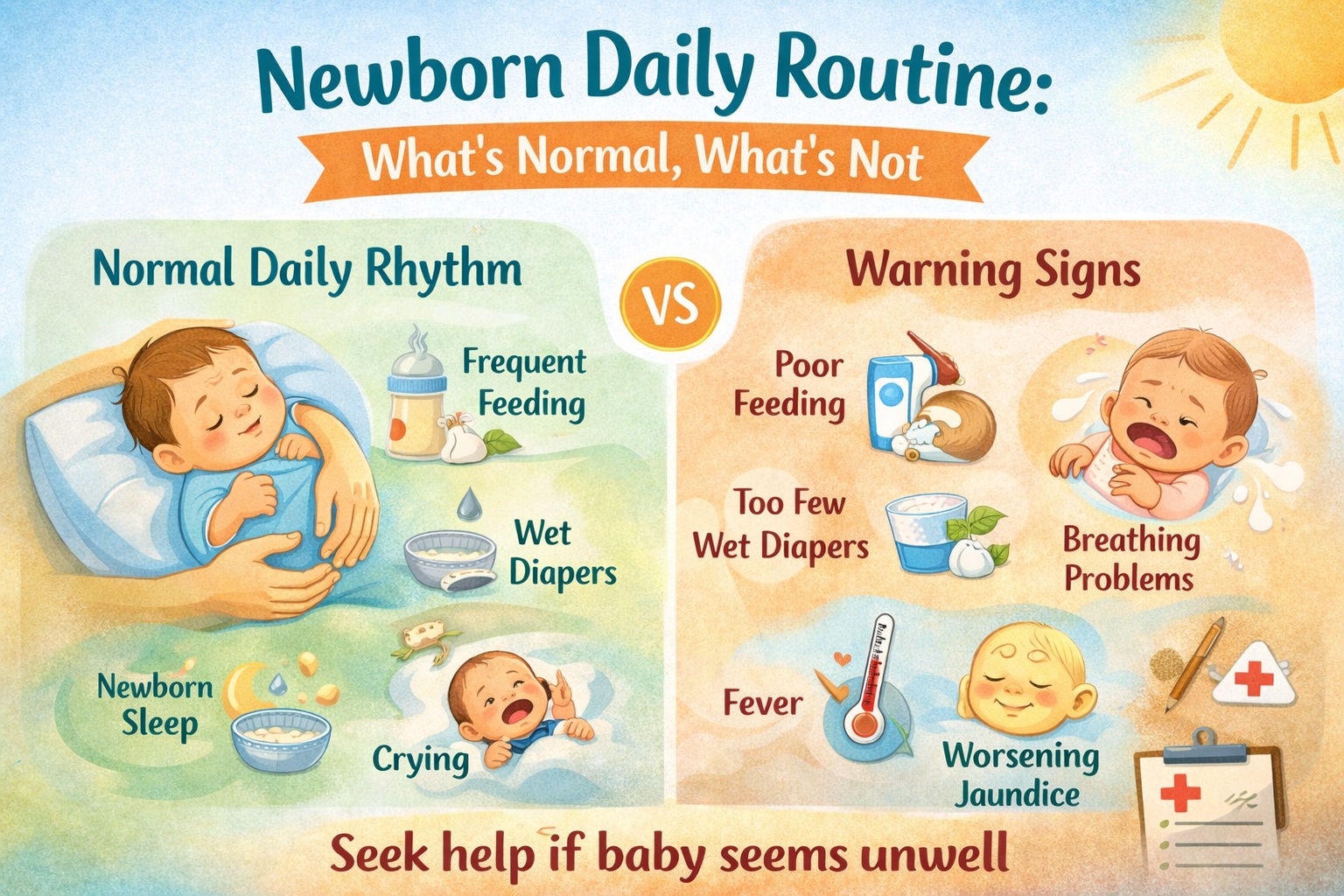
Newborn Daily Routine: What’s Normal, What’s Not
The first weeks with a newborn can feel confusing because the day rarely looks organised. One hour your baby is feeding again, the next they are asleep on your shoulder, and then suddenly they are crying, pooping, or wanting to feed again. Many parents worry that they are “doing it wrong” because there is no neat routine yet. In reality, newborn life is usually repetitive, messy, and biologically irregular at the start.
This guide explains what is normal in a newborn’s daily pattern, what can vary, and what signs mean you should not brush things off as “just newborn behaviour.”
The big picture: newborns usually have a rhythm, not a schedule
In the early weeks, most newborns do not follow a tidy timetable. Instead, they cycle through a pattern of:
- feeding
- burping and nappy changes
- a short awake period
- cuddling or soothing
- sleeping again
This pattern can repeat every 2 to 3 hours, sometimes even more often. Some babies cluster-feed and seem to want milk again just after a feed. Others take longer naps at certain times of day and shorter ones at others. That variation is common in the newborn stage.
What is normal for newborn feeding?
Newborn feeding is often more frequent than many first-time parents expect. In the first few weeks, babies commonly feed at least 8 to 12 times in 24 hours, and some feed more often than that. Breastfed babies in particular may feed very frequently in the first days and weeks. :contentReference[oaicite:1]{index=1}
What feeding may look like
- Wanting to feed every 2 to 3 hours, or sometimes sooner
- Cluster feeding, especially in the evening
- Short feeds at some times and longer feeds at others
- Falling asleep during feeds, especially in the early weeks
- Wanting to feed again soon after a previous feed
What is usually normal
It can be normal for a newborn to seem hungry again very soon, especially during growth-related feeding bursts. It can also be normal for feeds not to happen at exactly the same times every day.
What is not something to ignore
- Baby is too sleepy to feed regularly
- Baby is feeding very weakly or not sucking effectively
- Baby is hard to wake for feeds
- Baby has fewer wet diapers than expected
- Baby seems persistently unsatisfied and not settling between feeds
After the early days, diaper output becomes one of the most useful signs that feeding is going reasonably well. By about day 5 to 7, many babies should have 6 or more wet diapers a day, with pale urine, and stool patterns should begin transitioning away from the dark meconium stage. :contentReference[oaicite:2]{index=2}
What is normal for newborn sleep?
Newborn sleep is fragmented. Babies often sleep a lot overall, but usually not in long, predictable stretches. In practical terms, many newborns spend much of the day and night cycling between feeds and short sleep periods rather than giving parents a clear “day routine” and “night routine” immediately. :contentReference[oaicite:3]{index=3}
What is often normal
- Sleeping in short blocks
- Mixing up day and night
- Falling asleep during or after feeds
- Needing help to settle
- No predictable bedtime in the first weeks
What is not reassuring
- Extreme sleepiness with poor feeding
- Baby is difficult to rouse even when it is time to feed
- Baby seems floppy, unusually weak, or less responsive
For babies with jaundice or feeding concerns, some pediatric guidance advises not letting a newborn go too long without a feed in the early weeks. For example, some guidance suggests not letting a newborn sleep more than 4 hours at night without feeding during this stage. :contentReference[oaicite:4]{index=4}
What is normal for wet diapers and poop?
Nappies are one of the most practical windows into a newborn’s routine. The exact number can vary, but the general pattern should move upward after birth.
Wet diapers
In the first few days after birth, wet diapers usually increase day by day. In the first few days, 2 to 3 wet diapers per day may be expected, and after about day 4 or 5 many babies should have at least 5 to 6 wet diapers per day. :contentReference[oaicite:5]{index=5}
Poop changes
- Day 1 to early days: black or dark green meconium
- Then: transitional greenish or brownish stools
- Later in the first week: more yellow stools once feeding is established
Breastfed babies may poop very frequently in the early weeks, sometimes even after many feeds. Formula-fed babies may have a different pattern. Stool frequency varies more than wet diapers, so output must be interpreted with the whole picture of feeding and alertness. :contentReference[oaicite:6]{index=6}
What may need medical advice
- Too few wet diapers
- Dark urine after the early newborn phase
- Persistent meconium stools beyond when feeding should be established
- Blood in stool
- White, pale, or chalky stools
What is normal for crying and fussiness?
Newborns cry. They cry when hungry, overtired, uncomfortable, overstimulated, gassy, or simply needing contact. A newborn’s routine is not just eat-sleep-repeat. There are often short, unsettled periods between feeds and sleep, especially in the evening.
What is often normal
- Fussy periods at certain times of day
- Wanting to be held often
- Needing rocking, swaddling if used safely, feeding, or cuddling to settle
- Short wake windows before getting overtired again
What is less reassuring
- A very high-pitched or unusual cry
- Baby cannot be consoled at all and seems ill
- Crying with fever, breathing difficulty, vomiting, or poor feeding
What a sample newborn day might actually look like
Many parents imagine a routine as a clock-based plan. In reality, a normal newborn day might look more like this:
- Feed
- Burp and change diaper
- 5 to 30 minutes of awake time
- Back to sleep
- Wake and repeat 2 hours later
- Evening cluster feeding and extra fussiness
- Night waking for more feeds
That does not mean every baby follows this pattern exactly. It means irregular repetition is usually more realistic than a polished “routine” in the first weeks.
What is normal for jaundice, skin, and body changes?
Some yellowing of the skin and eyes can happen in newborns, but jaundice should be watched carefully, especially if it seems to worsen, spreads more, or comes with sleepiness and poor feeding. Health professionals often pay close attention to feeding frequency and hydration when jaundice is present. :contentReference[oaicite:7]{index=7}
Newborn skin can also look dry, blotchy, flaky, or delicate in the first days. NHS guidance notes that newborn skin is thin and sensitive, and plain water baths are often enough initially. :contentReference[oaicite:8]{index=8}
What is not normal and should not be brushed off
A newborn’s routine is allowed to be messy. But certain signs are not things to “wait and see” casually. Seek medical advice urgently if your baby has:
- fever
- breathing difficulty
- poor feeding or refusing feeds
- too few wet diapers or signs of dehydration
- lethargy or unusual difficulty waking
- worsening jaundice
- vomiting repeatedly or forcefully
- blue, grey, or very pale colour
Signs of dehydration in infants can include urinating less frequently, a dry mouth, fewer tears, and a sunken soft spot. :contentReference[oaicite:9]{index=9}
How parents can build a gentle routine without forcing one
In the newborn phase, the aim is usually not to impose a strict schedule. A better goal is to notice patterns and support a gentle rhythm.
- Feed on cue, while also keeping an eye on how long baby goes without feeding
- Watch diaper output
- Expect short awake windows
- Use a simple feed-change-sleep cycle as a guide
- Keep nights calm and dim, days brighter and interactive
- Ask for help early if feeding or settling feels off
Over time, many babies naturally become more predictable. But in the first weeks, “normal” often looks far less structured than social media suggests.
The bottom line
A normal newborn daily routine is usually not a real schedule. It is a repeating pattern of feeding, nappy changes, short wake periods, cuddling, and sleep in small chunks. Frequent feeds, night waking, changing poop patterns, and unpredictable timing are all common in the first weeks. What matters most is not perfect routine, but whether your baby is feeding effectively, producing enough wet diapers, waking reasonably for feeds, and looking well overall.
If something feels off, especially feeding, breathing, jaundice, hydration, or responsiveness, it is worth checking. In newborn care, early reassurance or early treatment is usually better than guessing.
FAQ
Is it normal for my newborn to feed all the time?
Yes. Many newborns feed at least 8 to 12 times in 24 hours, and cluster feeding can make it feel even more frequent.
Should my newborn have a routine already?
Not usually. In the early weeks, most babies have a rhythm rather than a fixed schedule.
How many wet diapers should a newborn have?
The number rises over the first days. After about day 4 or 5, many babies should have around 5 to 6 or more wet diapers daily.
Is it normal for my newborn to sleep during feeds?
It can be common in the early weeks, but if your baby is consistently too sleepy to feed well or is hard to wake, get advice.
When should I worry about my newborn’s routine?
Seek medical help if your baby has fever, poor feeding, dehydration signs, breathing problems, worsening jaundice, repeated vomiting, or seems unusually sleepy or unwell.
It takes a village to raise a child !
Join our WhatsApp Parenting Chat Groups By Area in Singapore.
Subscribe to Our Newsletter to get important information about pregnancy and parenting.