20 Independence Skills to Teach Before Primary 1
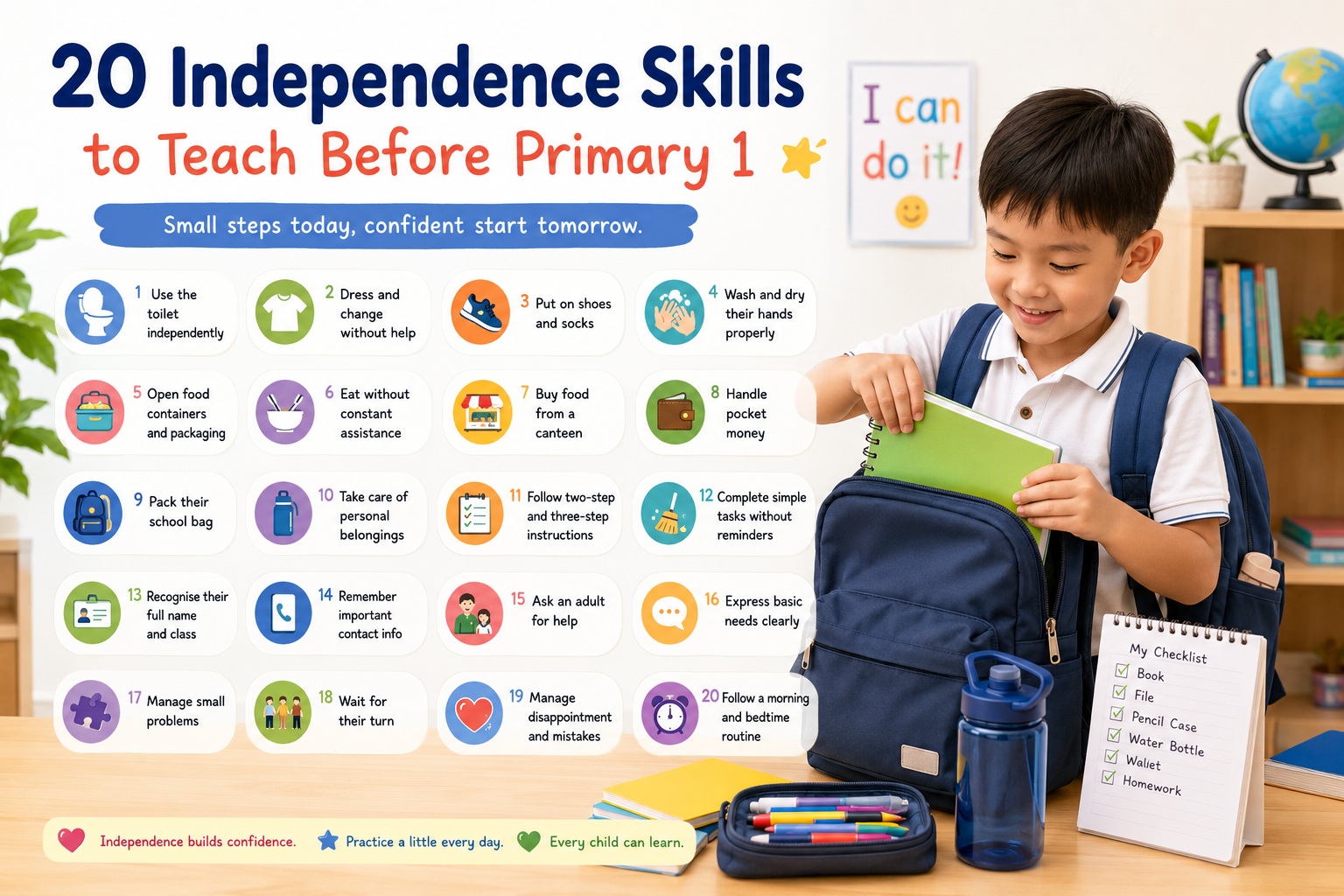
20 Independence Skills to Teach Before Primary 1
Starting Primary 1 is a major change for a child. Instead of having adults nearby to help with every small task, children will gradually be expected to manage their belongings, follow routines, buy food, communicate their needs and solve simple problems independently.
Academic preparation is useful, but being able to read advanced books or complete difficult worksheets does not necessarily mean that a child is ready for school. Practical independence can help a child feel safer, calmer and more confident during the transition.
Here are 20 useful independence skills that parents can teach before their child starts Primary 1.
1. Use the Toilet Independently
Your child should be able to use the toilet without needing an adult to accompany or assist them.
Practise how to:
- Recognise when they need to use the toilet
- Find and enter the correct toilet
- Manage buttons, zips and clothing
- Use toilet paper properly
- Flush the toilet
- Wash and dry their hands
Teach your child not to delay going to the toilet simply because they feel shy about asking the teacher for permission.
2. Dress and Change Without Help
Primary school children may need to change into PE attire or adjust their clothing after using the toilet.
Your child should practise:
- Putting on and removing a shirt
- Managing buttons and zips
- Putting on shorts or trousers correctly
- Turning clothes the right way around
- Folding or placing clothes neatly into a bag
Choose clothing and shoes that your child can manage confidently.
3. Put On Shoes and Socks
Your child should be able to put on and remove their shoes and socks independently.
If your child cannot tie shoelaces yet, consider shoes with simple fasteners while continuing to practise tying laces at home.
Teach your child to check that:
- The shoes are on the correct feet
- The socks are pulled up properly
- The straps or laces are secure
4. Wash and Dry Their Hands Properly
Good hand hygiene becomes especially important when children share classrooms, toilets, books and common spaces.
Teach your child to wash their hands:
- After using the toilet
- Before eating
- After coughing, sneezing or blowing their nose
- After touching something dirty
Your child should know how to use soap, rinse thoroughly and dry their hands without being reminded each time.
5. Open Food Containers and Packaging
During recess, children have limited time to queue, buy food and eat. A child who brings food from home should be able to open the lunch box and food packaging independently.
Practise opening:
- Lunch boxes
- Snack containers
- Water bottles
- Reusable food pouches
- Simple wrappers
Avoid giving your child containers that are difficult to open or close.
6. Eat Without Constant Assistance
Your child should be able to sit, eat and drink without needing an adult to feed or repeatedly remind them.
Practise how to:
- Use a spoon and fork
- Eat within a reasonable time
- Drink without spilling
- Keep the eating area reasonably clean
- Recognise when they have had enough
Try not to use videos or mobile devices to keep your child eating. In school, children will need to manage meals without screen entertainment.
7. Buy Food from a Canteen
Buying food independently can be challenging for a new Primary 1 pupil. The child may need to choose a stall, queue, place an order, pay and carry the food to a table.
Parents can practise this through pretend play or visits to a food court.
Teach your child to:
- Wait patiently in a queue
- Order clearly and politely
- Choose food within a budget
- Hand money to the stallholder
- Collect any change
- Carry a bowl or plate carefully
- Return the tray after eating
8. Handle Pocket Money
Your child should understand that pocket money must be kept safely and used carefully.
Teach your child to:
- Recognise common Singapore coins and notes
- Keep money inside a wallet
- Return the wallet to the same bag compartment
- Avoid displaying money unnecessarily
- Spend only within the amount provided
- Tell an adult if the wallet is lost
Start with small amounts and simple transactions before moving on to more complicated calculations.
9. Pack Their School Bag
Parents may need to supervise at first, but children should gradually learn to pack their own school bags.
Teach your child to use the school timetable or a simple checklist to pack:
- Required books
- Files and worksheets
- Pencil case
- Water bottle
- Wallet
- Homework
- PE attire, when required
Give each item a regular place inside the bag so that your child can find it easily.
10. Take Care of Personal Belongings
Water bottles, wallets, stationery and uniform items are commonly misplaced during the first year of primary school.
Help your child develop the habit of checking three places:
- The desk area
- The chair and floor
- The school bag
Label your child’s belongings, but avoid placing excessive personal information where strangers can see it.
11. Follow Two-Step and Three-Step Instructions
Teachers may give several instructions at once, such as, “Take out your English book, turn to page ten and write the date.”
Help your child practise following instructions in the correct order.
For example:
- “Put your cup in the sink and bring me a towel.”
- “Take your shoes, put them on and wait at the door.”
- “Pack your book, close your bag and place it beside the chair.”
Begin with two steps and gradually increase the number when your child is ready.
12. Complete Simple Tasks Without Repeated Reminders
A child may understand a task but still depend on adults to repeat the instruction many times.
Give your child small daily responsibilities such as:
- Putting dirty clothes into the laundry basket
- Returning books to the shelf
- Refilling the water bottle
- Placing shoes in the correct location
- Clearing the table after eating
Use a picture checklist when necessary, then gradually reduce reminders.
13. Recognise Their Full Name and Class
Your child should be able to recognise and say their full name clearly.
Once the class is known, help your child remember:
- The name of the school
- The class name
- The form teacher’s name
- The dismissal arrangement
This information can help if the child becomes separated from the class or is unsure where to go.
14. Remember Important Contact Information
Teach your child at least one parent’s or caregiver’s telephone number.
Your child should also know:
- The names of their parents or caregivers
- Who will pick them up
- Whether they take a school bus
- Whether they attend student care
Place an emergency information card in a secure compartment of the school bag as additional support.
15. Ask an Adult for Help
Some children remain silent when they are confused, frightened or unwell because they do not know how to approach an adult.
Explain that they can seek help from trusted adults such as:
- The form teacher
- A subject teacher
- School office staff
- A school counsellor
- A student care teacher
- A school bus attendant
Practise useful sentences such as:
- “I do not know where to go.”
- “I cannot find my wallet.”
- “I am not feeling well.”
- “I do not understand the instruction.”
- “Can you please help me?”
16. Express Basic Needs Clearly
Your child should be able to explain what they need instead of crying, shouting or waiting for an adult to guess.
Encourage your child to say:
- “I need to use the toilet.”
- “I am feeling thirsty.”
- “My stomach hurts.”
- “I need more time.”
- “I am worried because I cannot find my class.”
Do not immediately speak on your child’s behalf in every safe situation. Give the child time to answer and explain.
17. Manage Small Problems
Not every problem requires immediate adult intervention. Children can be taught to pause and think about a simple solution.
For example:
- If a pencil breaks, use another pencil
- If a bottle falls, pick it up and check for spills
- If an item is missing, check the desk, floor and bag
- If instructions are unclear, ask the teacher
- If a seat is occupied, calmly look for another suitable place
Praise your child for trying an appropriate solution, even when it does not work perfectly.
18. Wait for Their Turn
Primary school requires children to queue, take turns, listen while others speak and wait for a teacher’s attention.
Practise turn-taking through:
- Board games
- Family conversations
- Ordering food
- Using playground equipment
- Taking turns choosing an activity
Teach your child that waiting can feel frustrating, but pushing, shouting or interrupting is not the right response.
19. Manage Disappointment and Mistakes
Your child may lose a game, answer incorrectly, forget an item or fail to complete a task. These everyday difficulties are part of learning.
Teach your child to:
- Pause and take a slow breath
- Use words to describe the feeling
- Accept correction without giving up
- Try again
- Ask for help when necessary
Avoid solving every uncomfortable situation immediately. Give your child manageable opportunities to cope and recover.
20. Follow a Morning and Bedtime Routine
Children are more likely to manage school confidently when they are familiar with predictable daily routines.
A morning routine may include:
- Wake up and use the toilet
- Wash up and get dressed
- Eat breakfast
- Check the school bag
- Put on shoes
- Leave home on time
An evening routine may include:
- Complete schoolwork
- Pack the school bag
- Prepare the uniform
- Bathe and brush teeth
- Read or enjoy a quiet activity
- Go to bed at a consistent time
Practise the routine before the school year begins so that it does not feel completely new on the first day.
How Parents Can Build Independence
Independence develops through repeated practice. Children will not master every skill immediately, and occasional mistakes are normal.
Parents can support the process by:
- Demonstrating the task clearly
- Breaking difficult tasks into smaller steps
- Allowing enough time for the child to try
- Using visual checklists when helpful
- Praising effort and improvement
- Reducing assistance gradually
- Allowing safe and reasonable consequences
For example, instead of packing the entire school bag for your child, sit beside them and ask, “What is the first lesson tomorrow?” The child can then check the timetable and find the correct book.
What Parents Should Avoid
- Doing every task because it is faster
- Giving many instructions at the same time
- Criticising the child for being slow
- Expecting immediate perfection
- Comparing the child with siblings or classmates
- Using fear about Primary 1 to force cooperation
- Focusing only on worksheets and academic preparation
A child who is constantly corrected or rushed may become afraid of trying. Keep practice calm, regular and appropriate for the child’s development.
Primary 1 Independence Checklist
- ☐ Uses the toilet independently
- ☐ Changes clothes without adult help
- ☐ Puts on shoes and socks
- ☐ Washes and dries hands properly
- ☐ Opens food containers and a water bottle
- ☐ Eats independently
- ☐ Queues and buys food
- ☐ Handles pocket money
- ☐ Packs the school bag
- ☐ Looks after personal belongings
- ☐ Follows two-step and three-step instructions
- ☐ Completes simple responsibilities
- ☐ Recognises and says their full name and class
- ☐ Knows important contact information
- ☐ Asks a trusted adult for help
- ☐ Expresses basic needs clearly
- ☐ Attempts to solve small problems
- ☐ Waits for their turn
- ☐ Copes with mistakes and disappointment
- ☐ Follows morning and bedtime routines
Frequently Asked Questions
Does my child need to master all 20 skills before Primary 1?
No. Children develop at different rates. The checklist helps parents identify skills that need more practice. Schools will also guide children as they adjust to new routines.
What should I do if my child refuses to complete tasks independently?
Begin with one small task and offer limited assistance. For example, your child can put on a shirt while you help with one difficult button. Gradually reduce the help as confidence improves.
Should I reward my child for being independent?
Encouragement and specific praise can be helpful. Say, “You remembered to put your wallet back into your bag,” rather than giving a material reward for every task.
Is academic readiness more important than independence?
Both can support the transition, but independence affects many parts of the school day. A child must manage personal needs, belongings, routines and communication even when no academic lesson is taking place.
How early should parents start teaching these skills?
Parents can introduce age-appropriate responsibilities throughout the preschool years. For a child entering Primary 1 in 2027, begin regular practice now and gradually increase responsibility during the months before school starts.
What if my child has developmental or special educational needs?
Adjust expectations according to your child’s needs and abilities. Inform the school early about any support required and share relevant information with teachers or school personnel. Independence may look different for every child.
Final Thoughts
Preparing for Primary 1 is not about making a child completely self-sufficient. It is about helping the child manage age-appropriate tasks, communicate confidently and know when to seek help.
Begin with the skills your child already finds easiest. Practise one or two areas at a time and allow mistakes to become learning opportunities.
A child who can care for personal needs, follow routines and handle small challenges is more likely to enter Primary 1 feeling capable, secure and ready to learn.
This article provides general parenting information. Parents should consider their child’s individual development and follow instructions provided by their child’s school.
It takes a village to raise a child !
Join our WhatsApp Groups or Facebook Group to interact with parents about student care in Singapore..