A 12 Week Primary 1 Readiness Plan for Singapore Children
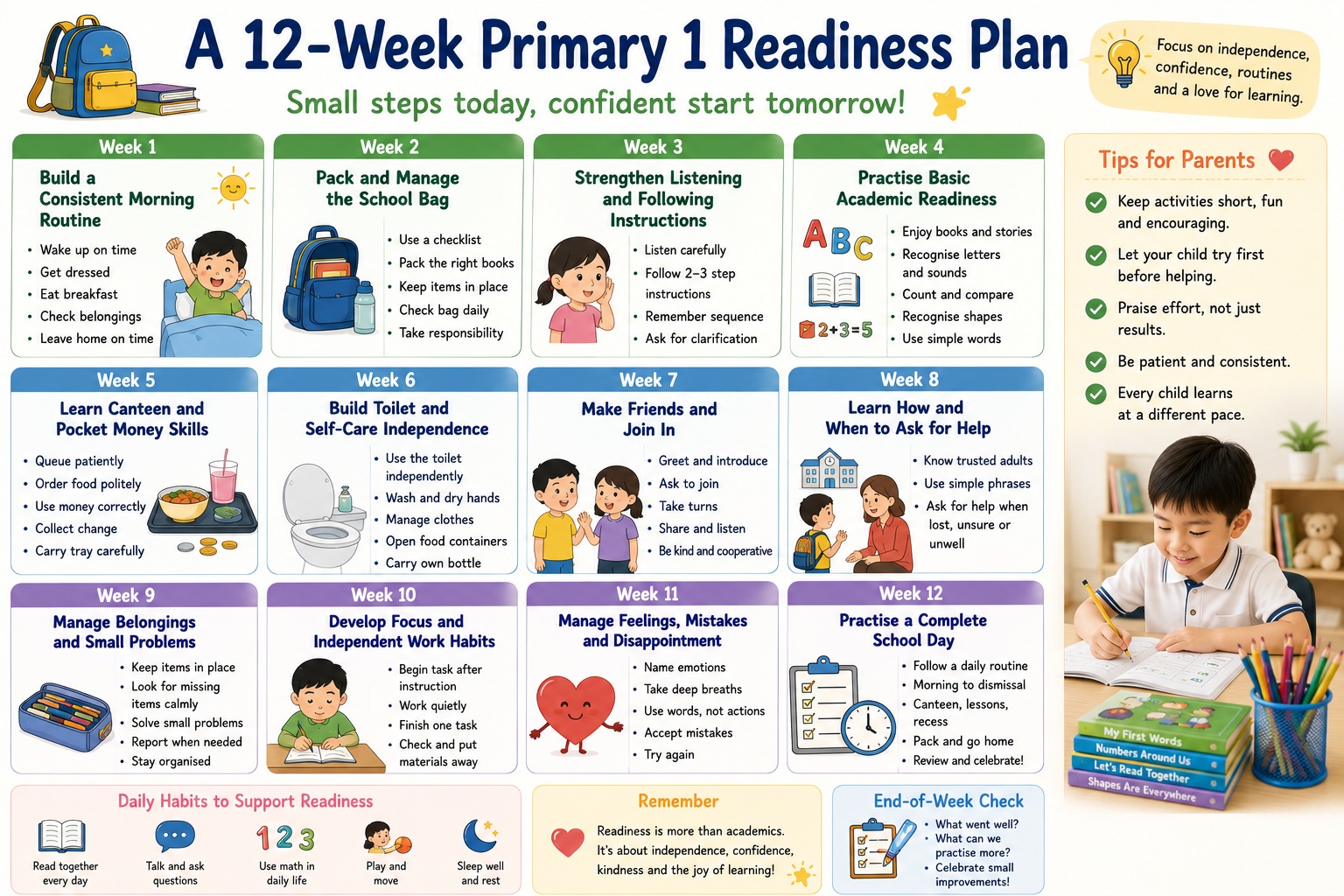
A 12-Week Primary 1 Readiness Plan for Singapore Children
Starting Primary 1 is an exciting milestone, but the transition can also feel overwhelming for both children and parents.
Children need to adjust to a larger school environment, earlier mornings, new teachers, longer periods of focused learning, canteen routines and greater responsibility for their belongings.
Parents may feel tempted to prepare by buying more assessment books or teaching the Primary 1 syllabus in advance. However, school readiness involves much more than academic knowledge.
A child also needs confidence, independence, communication skills, healthy routines and the ability to manage small problems.
This 12-week readiness plan gives families one manageable area to focus on each week. It can be started at any time during the months before Primary 1.
The activities do not need to feel like formal lessons. Keep them short, practical and encouraging.
How to Use This 12-Week Plan
Each week has one main focus and several suggested activities. Parents can adjust the activities according to their child’s abilities, school arrangements and family schedule.
There is no need to complete every activity perfectly. A useful routine may include:
- One short conversation about the weekly topic
- Two or three practical activities
- Regular opportunities for the child to practise independently
- A short review at the end of the week
When your child struggles, demonstrate the skill, practise it together and gradually reduce your help.
Week 1: Build a Consistent Morning Routine
Primary school often begins earlier than preschool. Children may need to wake up, get dressed, eat breakfast and leave home within a limited time.
This week, introduce a predictable morning routine.
Skills to practise
- Waking up when called or when an alarm sounds
- Using the toilet and washing up
- Putting on clothes independently
- Eating breakfast within a reasonable time
- Checking personal belongings
- Putting on shoes and socks
- Leaving home on time
Suggested activities
- Create a simple picture checklist showing each morning task.
- Ask your child to complete one more step independently each day.
- Practise getting ready by the expected school departure time.
- Prepare clothes and essential items the night before.
- Use a timer to help your child understand how long each task takes.
Parent tip
Avoid giving instructions repeatedly from another room. Ask your child to look at the checklist and identify the next step.
End-of-week goal
Your child can complete most of the morning routine with limited reminders.
Week 2: Pack and Manage the School Bag
Primary 1 pupils need to bring the correct books, worksheets, stationery and personal items to school.
Parents may supervise initially, but children should gradually learn to take responsibility for packing and checking their own bags.
Skills to practise
- Recognising the school bag and personal belongings
- Opening and closing all compartments
- Placing items in fixed locations
- Using a simple timetable or checklist
- Checking the bag before leaving home
- Removing unnecessary items
Suggested activities
- Assign one compartment for books, one for stationery and one for personal items.
- Create a pretend school timetable.
- Ask your child to pack the correct books for the next day.
- Practise placing the wallet and water bottle in the same location every time.
- Teach your child to conduct a final bag check.
Parent tip
Instead of packing everything yourself, ask guiding questions such as, “What do you need for the first lesson?”
End-of-week goal
Your child can pack a simple school bag using a checklist.
Week 3: Strengthen Listening and Following Instructions
Teachers may give instructions to the whole class rather than repeating them individually for every child.
Children benefit from learning to listen, remember and follow instructions in the correct order.
Skills to practise
- Looking towards the speaker
- Waiting until the instruction is complete
- Following two-step and three-step instructions
- Remembering the correct sequence
- Asking for clarification when unsure
Suggested activities
- Say, “Take your pencil, sit at the table and draw a circle.”
- Play games such as Simon Says.
- Ask your child to repeat an instruction before starting.
- Give directions while cooking or completing household tasks.
- Read a short story and ask your child to recall two or three events.
Parent tip
Begin with two-step instructions. Add more steps only when your child is ready.
End-of-week goal
Your child can follow common two-step instructions without repeated prompting.
Week 4: Practise Basic Academic Readiness
Children do not need to complete the Primary 1 syllabus before entering school. However, familiarity with basic language and number concepts can help them participate confidently.
English activities
- Read a picture book together.
- Ask your child to describe a picture.
- Practise recognising letters and common letter sounds.
- Help your child recognise and write their own name.
- Ask your child to retell the beginning, middle and end of a story.
Mathematics activities
- Count household objects accurately.
- Compare which group has more or fewer items.
- Practise recognising basic numbers.
- Use toys to demonstrate simple addition and subtraction.
- Identify shapes around the home.
Mother Tongue activities
- Use simple everyday instructions in the language.
- Read a picture book together.
- Sing familiar songs or rhymes.
- Talk about food, family, animals or daily routines.
- Practise recognising a few common words or characters.
Parent tip
Keep academic practice short and meaningful. Ten to fifteen minutes of focused activity may be enough for a young child.
End-of-week goal
Your child attempts simple language and number activities without being afraid of mistakes.
Week 5: Learn Canteen and Pocket Money Skills
Recess may be one of the biggest changes for a Primary 1 child. Pupils may need to queue, order food, pay, carry a tray and finish eating within a limited period.
Skills to practise
- Waiting in a queue
- Reading or recognising simple menu items
- Ordering food clearly and politely
- Using common Singapore coins and notes
- Collecting change
- Carrying a tray or bowl carefully
- Eating without constant assistance
- Returning the tray after eating
Suggested activities
- Create a pretend canteen at home.
- Give each food item a simple price.
- Allow your child to choose within a budget.
- Practise ordering at a food court with supervision.
- Teach your child to return the wallet to the same bag compartment.
Parent tip
Find out whether your child’s school uses cash, cashless payment or both before deciding how much pocket money to provide.
End-of-week goal
Your child can complete a simple food purchase with supervision.
Week 6: Build Toilet and Self-Care Independence
Children should be able to manage basic personal needs without depending on an adult for every step.
Skills to practise
- Recognising when they need the toilet
- Asking permission to use the toilet
- Managing buttons, zips and clothing
- Using toilet paper appropriately
- Flushing the toilet
- Washing and drying hands
- Managing a minor spill
- Opening and closing a water bottle
Suggested activities
- Allow your child to manage toilet routines independently at home.
- Choose clothing the child can fasten without help.
- Practise opening lunch boxes and food packaging.
- Teach your child how to use tissues and dispose of them properly.
- Show your child how to clean a small water spill safely.
Parent tip
Give your child enough time to complete self-care tasks. Constantly stepping in because the child is slow prevents practice.
End-of-week goal
Your child can manage common toilet, handwashing and clothing tasks independently.
Week 7: Practise Making Friends and Joining In
Children entering Primary 1 may not know anyone in their new class. Some children make friends easily, while others need simple phrases and repeated practice.
Skills to practise
- Greeting another child
- Introducing themselves
- Asking to join an activity
- Taking turns
- Sharing materials
- Listening while another person speaks
- Handling small disagreements calmly
Useful phrases to practise
- “Hello, my name is ______.”
- “What is your name?”
- “Can I play with you?”
- “Can I sit here?”
- “Would you like to share this?”
- “Can I have a turn after you?”
Suggested activities
- Role-play meeting a new classmate.
- Arrange play opportunities with other children.
- Play board games that require turn-taking.
- Practise responding when another child says no.
- Discuss what makes a kind and trustworthy friend.
Parent tip
Do not pressure your child to make many friends immediately. One comfortable connection can be a good beginning.
End-of-week goal
Your child can introduce themselves and use a simple phrase to join an activity.
Week 8: Learn How and When to Ask for Help
Some children remain silent when they are confused, lost, frightened or unwell. They may worry about disturbing the teacher or feel unsure about what to say.
Trusted adults may include
- The form teacher
- A subject teacher
- School office staff
- A school counsellor
- A student care teacher
- A school bus attendant
Useful phrases to practise
- “I do not know where to go.”
- “I cannot find my classroom.”
- “I am not feeling well.”
- “I do not understand the instruction.”
- “I cannot find my wallet.”
- “Someone is hurting or frightening me.”
- “Can you please help me?”
Suggested activities
- Role-play becoming lost in school.
- Practise telling a teacher about feeling unwell.
- Discuss what to do if the school bus is missed.
- Teach your child to identify adults wearing school staff identification.
- Prepare an emergency contact card for the school bag.
Parent tip
Explain the difference between a small problem the child can attempt to solve and a situation that requires immediate adult help.
End-of-week goal
Your child can identify a trusted adult and clearly ask for assistance.
Week 9: Manage Belongings and Small Problems
Primary 1 pupils commonly misplace pencils, water bottles, worksheets and wallets. Learning a simple checking routine can reduce panic.
Skills to practise
- Keeping belongings in fixed locations
- Checking the desk, chair, floor and bag
- Using a replacement pencil when one breaks
- Picking up dropped items
- Reporting a genuinely lost item
- Remaining calm when something goes wrong
Suggested activities
- Label important belongings.
- Give your child responsibility for carrying a water bottle during outings.
- Ask your child to check the area before leaving a restaurant or library.
- Role-play losing a pencil or worksheet.
- Teach the checking sequence: desk, chair, floor, bag, then ask for help.
Parent tip
When a child misplaces something at home, avoid immediately finding it for them. Guide them through the checking process.
End-of-week goal
Your child can look for a missing item calmly before asking for assistance.
Week 10: Develop Focus and Independent Work Habits
Primary 1 children will need to listen, begin a task and work independently for short periods.
The goal is not to make a child sit still for hours. It is to gradually build the ability to remain with an age-appropriate activity.
Skills to practise
- Beginning a task after an instruction
- Working independently for a short time
- Completing one task before starting another
- Checking work briefly
- Putting materials away afterwards
Suggested activities
- Complete a puzzle.
- Draw or colour for ten minutes.
- Finish a short matching or counting activity.
- Build a simple model by following instructions.
- Look through a book independently.
Parent tip
Prepare a quiet, well-lit area with limited distractions. Keep mobile devices away during the activity.
End-of-week goal
Your child can work on a manageable task independently for approximately ten to fifteen minutes.
Week 11: Manage Feelings, Mistakes and Disappointment
Children will make mistakes, receive correction, lose games, forget instructions and face friendship difficulties.
Emotional readiness helps a child recover and continue learning.
Skills to practise
- Naming basic emotions
- Taking a slow breath
- Using words instead of hitting or shouting
- Accepting that mistakes happen
- Trying again
- Asking for help after making an effort
Useful phrases to practise
- “I feel upset because ______.”
- “Can I try again?”
- “I made a mistake.”
- “I need a short break.”
- “Can you explain it again?”
Suggested activities
- Play games in which winning and losing are possible.
- Talk about a mistake you made and how you handled it.
- Read stories about characters facing difficulties.
- Practise taking three slow breaths.
- Ask your child to think of two possible solutions to a small problem.
Parent tip
Praise the process rather than only the result. For example, say, “You kept trying even when it was difficult.”
End-of-week goal
Your child can use at least one calming or problem-solving strategy when frustrated.
Week 12: Practise a Complete School Day
The final week brings the skills together through a realistic practice day.
This does not need to copy every detail of actual school. The purpose is to help your child understand the sequence of a school day.
Suggested practice-day schedule
- Wake up at the expected school-day time.
- Complete the morning routine.
- Put on suitable clothes and shoes.
- Eat breakfast.
- Check the school bag.
- Leave home at the expected time.
- Practise the journey to school if possible.
- Complete a short listening or learning activity.
- Have a pretend recess involving food and money.
- Complete a second short activity.
- Practise packing belongings before dismissal.
- Follow the expected after-school arrangement.
Discuss afterwards
- Which part felt easy?
- Which part was difficult?
- Was there enough time in the morning?
- Did anything get forgotten?
- What should be practised again?
Parent tip
Keep the practice positive. It is intended to build familiarity, not to test or frighten the child.
End-of-week goal
Your child understands the general sequence of a school day and feels more familiar with what to expect.
Suggested Weekly Schedule
| Day | Suggested Activity |
|---|---|
| Monday | Introduce the weekly skill and explain why it is useful. |
| Tuesday | Demonstrate the skill and practise it together. |
| Wednesday | Let the child attempt the skill with limited help. |
| Thursday | Use a game, role-play or real-life situation. |
| Friday | Repeat the activity and reduce reminders. |
| Weekend | Review progress and practise in a different setting. |
How Long Should Each Activity Take?
Readiness practice does not need to occupy the entire day.
As a general guide:
- Practical self-care activities can be included in normal routines.
- Reading together may take 10 to 15 minutes.
- Academic activities may take 10 to 15 minutes.
- Role-play may take 5 to 10 minutes.
- A complete practice morning can be done occasionally.
Stop or shorten an activity if your child becomes excessively tired or distressed.
What Parents Should Avoid
- Trying to complete all 12 weeks at once
- Expecting immediate mastery
- Comparing the child with siblings or classmates
- Turning every activity into a test
- Correcting every small mistake
- Teaching the entire Primary 1 syllabus in advance
- Removing time for sleep, free play and family interaction
- Using frightening statements about primary school
The purpose of preparation is to increase confidence, not create fear.
How to Adapt the Plan for Different Children
For a shy child
- Spend more time on greeting others and asking for help.
- Use role-play before practising with unfamiliar people.
- Avoid forcing immediate participation in large groups.
For a highly active child
- Use short activities with movement breaks.
- Practise completing one task before changing activities.
- Use visual schedules and clear instructions.
For a child who is academically confident but less independent
- Spend more time on packing, self-care and problem-solving.
- Allow the child to complete daily responsibilities.
- Reduce unnecessary adult assistance.
For a child who needs more academic support
- Use short, concrete activities.
- Practise with objects, pictures and stories.
- Focus on understanding rather than speed.
- Speak with the preschool teacher about suitable support.
For a child with developmental or special educational needs
- Adapt each activity to the child’s abilities.
- Use visual schedules and repeated routines.
- Practise in smaller steps.
- Communicate with the future school early.
- Share relevant support needs and professional reports where appropriate.
12-Week Primary 1 Readiness Checklist
- ☐ Week 1: Follows a morning routine
- ☐ Week 2: Packs and checks a school bag
- ☐ Week 3: Follows two-step and three-step instructions
- ☐ Week 4: Attempts basic literacy and number activities
- ☐ Week 5: Practises canteen and pocket money skills
- ☐ Week 6: Manages basic toilet and self-care needs
- ☐ Week 7: Introduces themselves and joins an activity
- ☐ Week 8: Asks a trusted adult for help
- ☐ Week 9: Looks after belongings and solves small problems
- ☐ Week 10: Works independently for a short period
- ☐ Week 11: Manages mistakes and disappointment
- ☐ Week 12: Completes a practice school-day routine
Frequently Asked Questions
When should parents start this 12-week plan?
Parents can begin approximately three months before Primary 1 starts. However, the plan can also be started earlier or shortened according to the family’s schedule.
Must parents follow the weeks in this exact order?
No. Parents may change the order based on their child’s needs. For example, a child who is anxious about making friends may benefit from practising social skills earlier.
Does my child need to master every skill?
No. The aim is familiarity and gradual improvement. Children will continue developing these skills after starting Primary 1.
How much academic preparation should be included?
Keep academic preparation balanced and age-appropriate. Focus on language, basic number sense, listening, communication and willingness to learn rather than completing the Primary 1 syllabus in advance.
What if my child refuses to practise?
Make the activity smaller and more playful. Offer limited choices, such as choosing whether to practise packing the bag before or after dinner. Avoid using primary school as a threat.
Should parents reward children for completing the plan?
Specific praise, encouragement and shared activities are usually sufficient. Parents do not need to offer a material reward for every completed task.
What if my child is still not ready after 12 weeks?
Children develop at different rates. Identify the areas that remain difficult and speak with the child’s preschool teacher or an appropriate professional if you have ongoing concerns. Inform the future primary school early when additional support may be required.
Should preparation continue after Primary 1 starts?
Yes, but expectations should remain manageable. Continue supporting sleep, routines, communication and independence while allowing your child time to adjust to the new school environment.
Final Thoughts
A successful transition to Primary 1 does not depend on finishing the most worksheets or learning the syllabus earlier than everyone else.
Readiness develops when children are given regular opportunities to manage themselves, communicate their needs, interact with others and try age-appropriate tasks independently.
Use this 12-week plan as a flexible guide rather than a test. Celebrate small improvements, repeat skills when necessary and keep the experience positive.
The goal is not to create a perfectly prepared child. It is to help your child begin Primary 1 feeling secure, capable and ready to learn.
This article provides general educational and parenting information. Parents should consider their child’s individual development and follow the latest instructions provided by their child’s primary school.
It takes a village to raise a child !
Join our WhatsApp Groups or Facebook Group to interact with parents about student care in Singapore..