How to Choose a Primary School in Singapore: A Practical Parent Guide
How to Choose a Primary School in Singapore: A Practical Parent Guide
Last updated: 11 May 2026
Choosing a primary school is one of the biggest decisions parents make before their child enters Primary 1. For parents whose children are entering Primary 1 in 2027, the decision is closely linked to the 2026 Primary One Registration Exercise.
Many parents naturally ask, “Which is the best primary school?” However, a better question may be: Which primary school is the best fit for my child and my family?
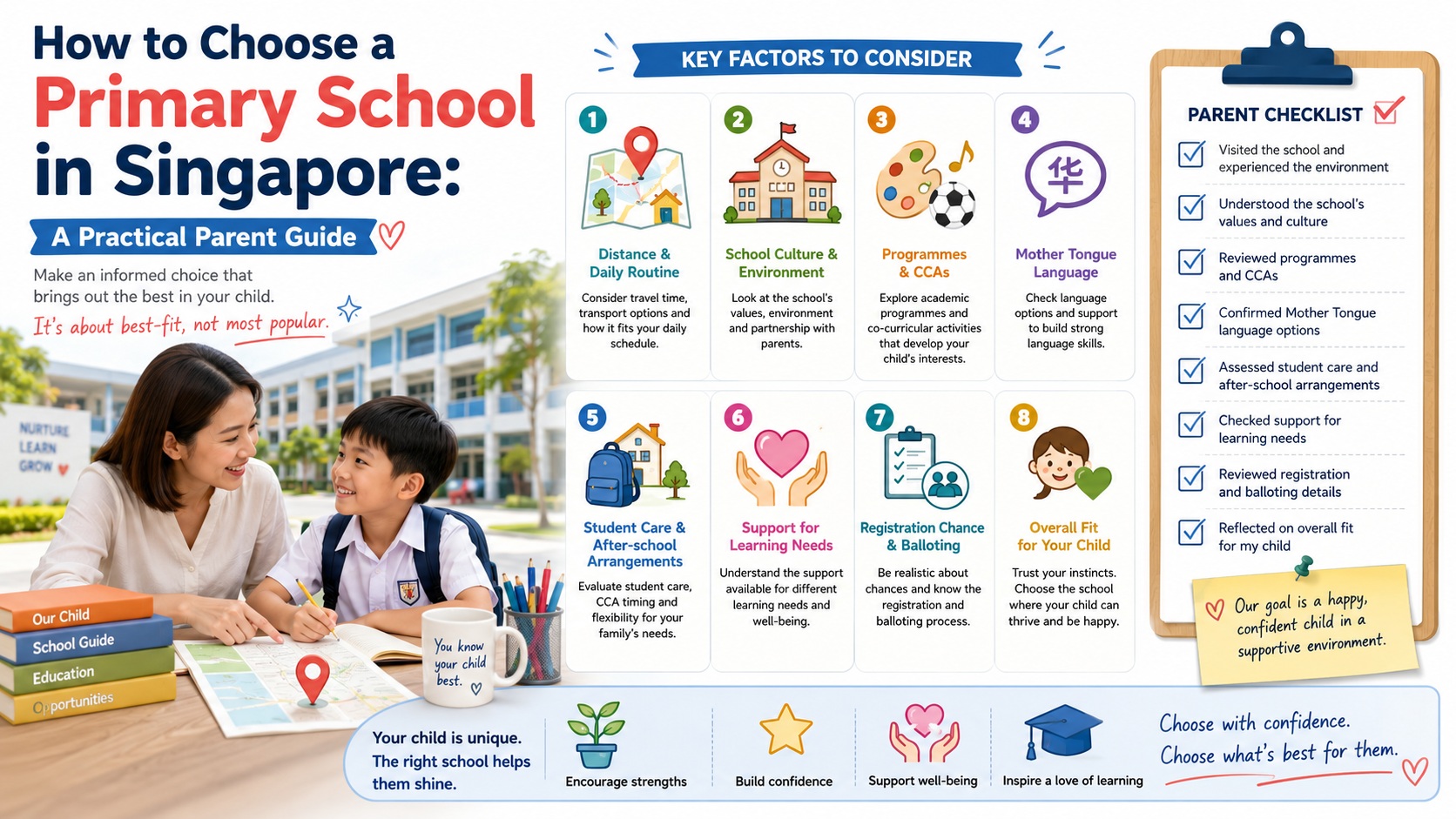
A suitable school is not only about reputation. Parents should also consider distance, daily routine, school culture, Mother Tongue options, CCAs, student care arrangements, your child’s personality, and the chance of getting a place during P1 Registration.
Quick Answer: To choose a primary school in Singapore, parents should consider home-school distance, travel time, school culture, programmes, CCAs, Mother Tongue Language options, student care arrangements, support for learning needs, vacancies and balloting history. The most suitable school is one that supports your child’s learning, well-being and daily routine, not simply the most popular school.
Connect with parents who are interested in the same primary school, exchange useful updates, and prepare for P1 together. Join here: WhatsApp Groups for Primary 1 in 2027
Who Is This Guide For?
This guide is useful for:
- Parents registering a child for Primary 1 in 2026 for the 2027 intake
- Parents comparing nearby primary schools
- Parents deciding between a popular school and a neighbourhood school
- Parents worried about distance, balloting and vacancies
- Parents who want a practical checklist before P1 Registration
1. Start With Your Child, Not the School Name
Before comparing schools, think about your child’s personality, strengths and needs.
Ask yourself:
- Is my child confident in new environments, or does he or she need more emotional support?
- Does my child enjoy sports, music, art, language, science or hands-on activities?
- Does my child cope well with long days and early mornings?
- Does my child need a calmer school environment?
- Does my child need additional learning, social or emotional support?
A school that works well for one child may not be the best fit for another. Some children thrive in a large, high-energy school. Others may do better in a smaller or more familiar environment.
2. Consider Home-School Distance Carefully
Distance is one of the most practical factors in choosing a primary school. A shorter commute can help your child get more rest, have more time for meals and homework, and feel less tired after school.
For P1 Registration, home-school distance can also affect priority admission when a school has more applicants than vacancies.
The common Home-School Distance categories are:
- Within 1km of the school
- Between 1km and 2km of the school
- Outside 2km of the school
Parents should check their home-school distance using the official OneMap School Query service in the year of registration. For the 2026 P1 Registration Exercise, MOE advises parents to check the distance before the exercise starts on 30 June 2026.
3. Understand Balloting Risk Before Choosing a School
A school may require balloting if the number of applicants is more than the number of vacancies in a registration phase.
For P1 Registration, balloting may happen from Phase 2A to Phase 2C Supplementary. When balloting is required, priority is based on citizenship and Home-School Distance.
The priority order is generally:
- Singapore Citizens living within 1km of the school
- Singapore Citizens living between 1km and 2km of the school
- Singapore Citizens living outside 2km of the school
- Permanent Residents living within 1km of the school
- Permanent Residents living between 1km and 2km of the school
- Permanent Residents living outside 2km of the school
This means that choosing a very popular school may involve a higher chance of balloting. Parents should check the latest vacancies and balloting updates during the P1 Registration Exercise.
4. Look at School Culture and Environment
School culture matters because your child will spend many important years in that environment.
When researching a school, consider:
- Is the school environment warm and supportive?
- Does the school focus strongly on character development?
- How does the school communicate with parents?
- Does the school seem suitable for your child’s personality?
- Do parents and children feel comfortable with the school’s values and expectations?
Parents can learn more by visiting the school website, attending open houses where available, reading official school information, and speaking to parents with children currently studying in the school.
5. Compare Programmes and CCAs
Each primary school may offer different programmes, learning experiences and Co-Curricular Activities. These can include sports, performing arts, clubs, uniformed groups and other school-based activities.
Parents may wish to ask:
- What are the school’s distinctive programmes?
- What CCAs are available?
- Are there opportunities in sports, arts, music, science, coding or leadership?
- Does the school offer activities that match my child’s interests?
- Does the school provide a balanced approach to academics and non-academic development?
A school with programmes that match your child’s interests may help your child feel more motivated and confident.
6. Check Mother Tongue Language Options
Mother Tongue Language is another important consideration. Parents should check whether the school offers the Mother Tongue Language your child needs.
Common Mother Tongue Languages include:
- Chinese Language
- Malay Language
- Tamil Language
If your child requires a specific language arrangement, parents should confirm the school’s offering before registration.
7. Consider Student Care and After-School Arrangements
For working parents, after-school arrangements can strongly affect school choice.
Parents should check:
- Does the school have school-based student care?
- Is there enough capacity for Primary 1 students?
- What are the operating hours?
- What are the fees?
- What activities and homework support are provided?
- Are there nearby student care centres if school-based care is full?
A school that is academically attractive may still be difficult for the family if transport and after-school care are not manageable.
8. Think About Your Child’s Daily Routine
Primary 1 is a major adjustment. Children may need to wake up earlier, travel to school, manage recess, follow classroom routines, complete homework and adjust to a larger school environment.
Before choosing a school, imagine a normal weekday:
- What time must your child wake up?
- How long is the journey to school?
- Will your child take the school bus, public transport or be sent by a parent?
- Where will your child go after school?
- Will your child still have enough rest and play time?
For young children, a realistic routine is often more important than choosing a school based only on reputation.
9. Check Support for Learning Needs or Special Educational Needs
If your child has learning, developmental, social, emotional or medical needs, school support becomes especially important.
Parents may wish to ask:
- Does the school have experience supporting children with similar needs?
- Are there teachers or allied educators who can provide support?
- How does the school help children adjust to Primary 1?
- How does the school communicate with parents about learning or behavioural concerns?
- Would a mainstream school or Special Education school better support the child?
Parents who are unsure should speak to professionals involved in the child’s care and contact schools early to understand available support.
10. Do Not Rely Only on Rankings or Reputation
Singapore does not publish an official ranking of primary schools. While parents may hear about “popular” schools, popularity does not always mean the school is the best match for every child.
Instead of asking only “Is this a top school?”, parents can ask:
- Will my child feel safe and supported here?
- Is the school close enough for a manageable daily routine?
- Does the school offer programmes that suit my child?
- Is the learning environment suitable for my child’s temperament?
- What is the likelihood of getting a place based on our registration phase and distance?
A good school choice should support both learning and well-being.
11. Use MOE SchoolFinder and Official School Information
MOE’s SchoolFinder allows parents to explore primary schools based on distance from home, location, CCAs, subjects and programmes.
Parents can also check each school’s official website for:
- School vision, mission and values
- Principal’s message
- School programmes
- CCA offerings
- Mother Tongue Language options
- Student care information
- Open house details, if available
During the P1 Registration Exercise, parents should also check MOE’s official vacancies and balloting updates.
12. Be Aware of Changes from 2027
Parents of children entering Primary 1 in 2027 should be aware that MOE has announced changes to better support primary school students with different strengths and talents from 2027.
From 2027, MOE will implement a refreshed approach to support primary school students with academic strengths and talents, and the current Gifted Education Programme will be discontinued in its present form.
This means parents should look beyond whether a school has traditionally been associated with certain programmes. Instead, they should focus on how the school supports students’ overall learning, strengths and development.
Primary School Selection Checklist for Parents
| Factor | Questions to Ask |
|---|---|
| Distance | Is the school within 1km, 1km to 2km, or outside 2km? Is daily travel manageable? |
| Registration Chance | Which phase is my child eligible for? Is the school likely to require balloting? |
| School Culture | Does the school environment suit my child’s personality and learning style? |
| Programmes | Does the school offer programmes that match my child’s strengths and interests? |
| CCAs | Are there CCAs that my child may enjoy in future? |
| Mother Tongue | Does the school offer the Mother Tongue Language my child needs? |
| Student Care | Is school-based or nearby student care available and practical for the family? |
| Support Needs | Can the school support my child’s learning, social, emotional or developmental needs? |
| Daily Routine | Will my child have enough time for rest, meals, homework and play? |
Common Mistakes Parents Should Avoid
- Choosing a school based only on popularity
- Ignoring travel time and morning fatigue
- Assuming living nearby guarantees admission
- Not checking Home-School Distance officially
- Not understanding balloting risk
- Forgetting to check Mother Tongue Language options
- Choosing a school before considering student care arrangements
- Comparing children too much with neighbours, relatives or friends
Sample Step-by-Step Method to Shortlist Schools
- List all primary schools near your home.
- Check the official Home-School Distance category.
- Remove schools that are too far for daily travel.
- Check Mother Tongue Language options.
- Review school programmes and CCAs.
- Check student care and transport arrangements.
- Review past vacancies and balloting information where available.
- Attend open houses or read school information online.
- Shortlist 2 to 4 realistic choices.
- Choose the school that best fits your child and family routine.
Frequently Asked Questions About Choosing a Primary School in Singapore
What is the most important factor when choosing a primary school?
There is no single most important factor for every family. Parents should consider distance, school culture, programmes, CCAs, Mother Tongue options, student care, balloting risk and their child’s personality and needs.
Is the nearest primary school always the best choice?
Not always, but a nearby school can reduce travel time and help a young child have more time for rest, meals, homework and family activities. Parents should balance distance with school suitability.
Does living within 1km guarantee a place in a primary school?
No. Living within 1km may give priority during balloting, but it does not guarantee admission if the school is oversubscribed.
Should I choose a popular primary school?
A popular school may have strong programmes or a good reputation, but it may also have higher balloting risk. Parents should choose based on fit, distance, school culture and the child’s needs, not popularity alone.
How can I compare primary schools in Singapore?
Parents can use MOE SchoolFinder to explore schools by distance, location, CCAs, subjects and programmes. Parents can also visit school websites, attend open houses and check MOE vacancies and balloting updates during P1 Registration.
What should I ask during a primary school open house?
Parents can ask about school culture, Primary 1 transition support, CCAs, Mother Tongue Language options, student care, communication with parents, homework expectations and support for children who need extra help.
Should I choose a school based on PSLE results?
Parents should avoid choosing a primary school based only on academic reputation. A child’s well-being, learning environment, daily routine and long-term confidence are also important.
What if my child has special educational needs?
Parents should contact schools early to understand available support. They may also consult professionals involved in the child’s care to decide whether a mainstream school or Special Education school is more suitable.
Final Thoughts
Choosing a primary school in Singapore is not about finding the “perfect” school. It is about finding a school where your child can learn well, feel safe, build confidence and manage daily school life without unnecessary stress.
For many families, the best choice is a school that is reasonably near home, offers suitable programmes, has a supportive environment and fits the family’s daily routine. Parents should check official MOE information before making a final decision, especially during the P1 Registration period.
Important: P1 Registration rules, vacancies, school information and balloting updates may change. Parents should always refer to MOE’s official website, MOE SchoolFinder and the P1 Registration Portal for the latest information.
Connect with parents who are interested in the same primary school, exchange useful updates, and prepare for P1 together. Join here: WhatsApp Groups for Primary 1 in 2027
It takes a village to raise a child !
Join our WhatsApp Groups or Facebook Group to interact with parents about student care in Singapore..