How to Prepare Your Child Emotionally for Primary 1
How to Prepare Your Child Emotionally for Primary 1
Last updated: 11 May 2026
Starting Primary 1 is an exciting milestone, but it can also feel overwhelming for a young child. Your child may be leaving a familiar preschool environment and entering a larger school with new teachers, new classmates, a canteen, school rules, homework, morning routines and longer hours.
Many parents focus on academic preparation before Primary 1. However, emotional preparation is just as important. A child who feels safe, confident and supported is more likely to adjust well, ask for help, make friends and develop a positive attitude towards school.
In Singapore, the Ministry of Education encourages parents to support children holistically during the transition to Primary 1. This includes building routines, developing values and skills, strengthening parent-child support and helping children feel positive about learning and school life.
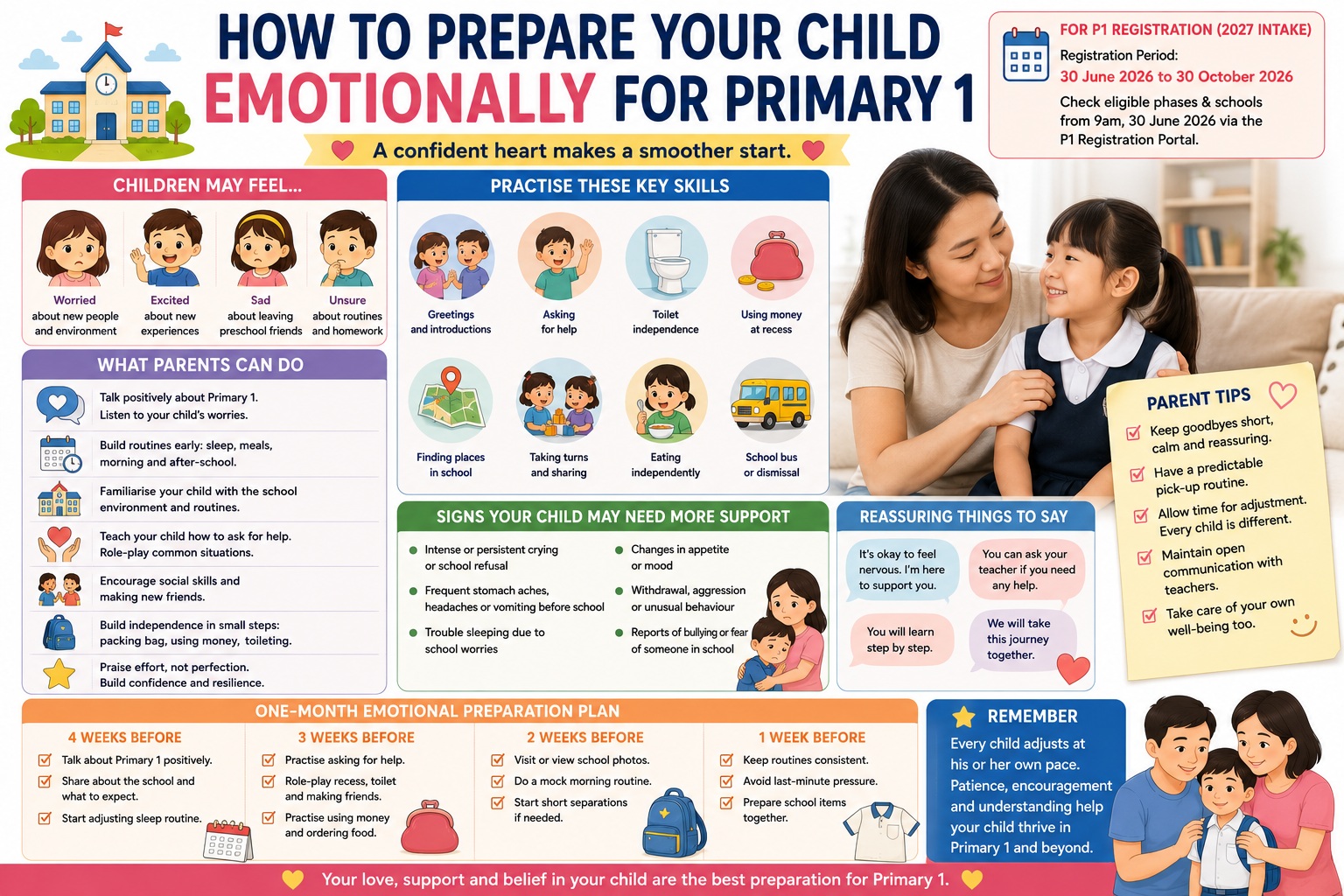
Quick Answer: To prepare your child emotionally for Primary 1, talk positively about school, acknowledge your child’s worries, practise new routines, build independence, visit or familiarise your child with the school environment, role-play common school situations, teach your child how to ask for help, and keep home routines calm and predictable. The goal is not to remove every worry, but to help your child feel capable and supported.
Who Is This Guide For?
This guide is useful for:
- Parents of K2 children entering Primary 1 soon
- Parents preparing for the 2027 Primary 1 intake in Singapore
- Parents whose child is anxious, shy or slow to warm up
- Parents whose child cries easily during separation
- Parents who want to support their child beyond academic preparation
Why Emotional Readiness Matters for Primary 1
Primary 1 is not just a change in classroom. It is a change in daily life. A child may need to:
- Wake up earlier
- Enter a bigger school compound
- Follow more structured routines
- Buy food or manage recess
- Meet many new children
- Ask unfamiliar adults for help
- Manage homework and school belongings
- Adjust to new expectations from teachers and parents
These changes can bring mixed feelings. Your child may feel excited one day and worried the next. This is normal. Emotional preparation helps children understand what to expect and gives them simple coping tools.
Common Emotions Children May Feel Before Primary 1
Before starting Primary 1, children may feel:
- Excited about wearing a new uniform, using a school bag or meeting new friends
- Worried about not knowing anyone
- Afraid of getting lost in a bigger school
- Nervous about recess, toilets or school bus routines
- Sad about leaving preschool teachers and friends
- Unsure about homework, spelling or classroom rules
- Tired from earlier mornings and longer days
Instead of dismissing these feelings, parents can help children name them and learn what to do when they arise.
Connect with parents who are interested in the same primary school, exchange useful updates, and prepare for P1 together. Join here: WhatsApp Groups for Primary 1 in 2027
1. Talk About Primary 1 in a Calm and Positive Way
Children often pick up their parents’ emotions. If parents talk about Primary 1 as something frightening, competitive or stressful, children may become more anxious.
Helpful things to say:
- "Primary 1 is a new place, and you will learn step by step."
- "It is normal to feel nervous when something is new."
- "Your teacher will help you if you are unsure."
- "You do not need to know everything on the first day."
- "We will practise together before school starts."
Try to avoid saying:
- "Primary school teachers will scold you if you are naughty."
- "You must not cry in Primary 1."
- "If you do not study hard, you will fall behind everyone."
- "Big school is very serious, not like preschool."
The aim is to be realistic but reassuring. Primary 1 is a new challenge, but your child does not have to face it alone.
2. Acknowledge Your Child’s Worries
When children say they are scared, adults may be tempted to reply, "Don’t be scared." While well-intentioned, this may make the child feel that the worry is wrong or silly.
A more helpful approach is to acknowledge the feeling first, then offer support.
| Child Says | Parent Can Say |
|---|---|
| "I don’t want to go to Primary 1." | "You sound worried. A new school can feel scary at first. Let’s talk about what you are worried about." |
| "What if I cannot find my classroom?" | "That can feel confusing. On the first few days, teachers and older students will help. We can also look at the school map together." |
| "What if I have no friends?" | "Making friends takes time. You can start by saying hello or asking someone to play." |
| "What if I cannot buy food?" | "We can practise ordering food and using money before school starts." |
3. Familiarise Your Child With the School Environment
New places feel less frightening when children know what to expect. MOE guidance for children needing transition support also highlights familiarising the child with the school environment, attending orientation where possible, and helping the child adjust to the new school. :contentReference[oaicite:2]{index=2}
You can help your child by:
- Attending the school orientation if available
- Showing your child the school website or photos
- Pointing out the school gate, general office, canteen and classrooms where possible
- Practising the journey to school
- Talking about where your child will go after school
- Explaining who will pick your child up
For some children, seeing the school building or wearing the uniform before the first day can make the transition feel more real and less uncertain.
4. Build Predictable Routines Before School Starts
Routines help children feel safe. A child who knows what happens next may feel less anxious.
Important routines to practise include:
- Waking up at the school-day time
- Getting dressed independently
- Eating breakfast before school
- Packing the school bag the night before
- Going to bed early enough
- Following an after-school routine
Start adjusting bedtime and wake-up time gradually before school begins. Avoid making the first school week the first time your child wakes up early.
5. Teach Your Child How to Ask for Help
One of the most important emotional readiness skills is knowing that help is available.
Practise these useful phrases:
- "Teacher, I need help."
- "I cannot find my classroom."
- "I feel sick."
- "May I go to the toilet?"
- "I cannot find my wallet."
- "I missed my school bus."
- "I do not understand."
Role-play these situations at home. For example, pretend to be the teacher and let your child practise asking politely.
6. Practise Separation Calmly
Some children find separation from parents difficult. If your child is very attached, start practising short separations before Primary 1 begins.
Helpful strategies include:
- Use a short and predictable goodbye routine.
- Tell your child clearly when you will return.
- Avoid sneaking away without saying goodbye.
- Stay calm even if your child cries.
- Remind your child of the next safe adult, such as the teacher.
- Praise your child for small steps of bravery.
A goodbye routine can be as simple as: hug, high-five, "I will see you after school," and then leave calmly. Long emotional goodbyes may make separation harder.
7. Prepare Your Child for Recess and Toilets
Many children are not afraid of lessons; they are afraid of practical things such as recess, money, toilets and getting lost.
Practise recess skills:
- Queuing and waiting
- Ordering simple food
- Using coins and small notes
- Opening a wallet or coin pouch
- Carrying food safely
- Finishing food within a reasonable time
- Returning to class after recess
Practise toilet skills:
- Asking to go to the toilet
- Using the toilet independently
- Washing hands properly
- Managing uniform buttons, zips or belts if needed
When children feel capable in these daily tasks, they often feel more emotionally secure.
8. Help Your Child Make Friends Gradually
Friendship is a common worry for new Primary 1 children. Reassure your child that making friends takes time.
Teach simple friendship phrases:
- "Hello, my name is..."
- "Can I sit here?"
- "Do you want to play?"
- "Can I join you?"
- "Let’s take turns."
- "Please stop. I don’t like that."
Also teach your child that it is normal not to become close friends with everyone immediately. A simple first goal is to greet classmates and learn a few names.
9. Encourage Independence Without Expecting Perfection
Primary 1 children are still young. They will forget things, lose stationery, spill water, feel tired, cry, or make mistakes. This does not mean they are not ready.
Help your child practise independence in small steps:
- Let your child pack part of the school bag.
- Let your child carry the bag at home.
- Let your child open the lunch box and water bottle.
- Let your child choose simple school supplies.
- Let your child practise wearing shoes and uniform.
Praise effort and progress. Say, "You remembered to pack your file today," instead of focusing only on what was forgotten.
10. Keep the First Few Weeks Gentle
The first few weeks of Primary 1 can be tiring. Even children who are excited may come home emotional, quiet or easily upset.
During the first few weeks, parents can:
- Keep after-school activities light
- Allow more rest time
- Prepare simple meals and snacks
- Avoid asking too many questions immediately after school
- Let the child talk when ready
- Maintain a predictable bedtime routine
Instead of asking, "Did you make friends? Did you finish your work? Did you get scolded?", try gentler questions:
- "What was one nice thing that happened today?"
- "What was something new you tried?"
- "Was anything confusing today?"
- "Who helped you today?"
11. Watch for Signs Your Child Needs More Support
Some worry is normal. However, parents should monitor if distress is intense, long-lasting or affects daily functioning.
Your child may need more support if he or she:
- Cries intensely every school morning for many weeks
- Has frequent stomach aches, headaches or vomiting linked to school anxiety
- Refuses to enter school repeatedly
- Cannot sleep because of school worries
- Has major changes in appetite or mood
- Becomes unusually withdrawn or aggressive
- Reports repeated bullying or fear of a specific person or place
- Has developmental, learning, speech or sensory needs that make transition harder
If concerns continue, speak to your child’s teacher, school counsellor or a healthcare professional. Early support can help children settle better.
12. Work With the School
Teachers are important partners in your child’s transition. If your child has strong anxiety, medical needs, toileting concerns, speech delay, learning needs or family circumstances that may affect adjustment, inform the school early.
Parents can share:
- What helps calm the child
- Any separation anxiety concerns
- Medical or allergy information
- Toileting or eating concerns
- Transport and dismissal arrangements
- Any learning or developmental support history
Good communication helps the school understand how best to support your child.
Emotional Preparation Checklist for Primary 1
| Readiness Area | What to Practise | Parent Tip |
|---|---|---|
| School Confidence | Talk about school, visit or view school photos, attend orientation | Make the new environment feel familiar |
| Emotional Expression | Name feelings such as worried, excited, sad or confused | Acknowledge feelings before offering solutions |
| Separation | Practise short goodbyes and predictable pick-up routines | Keep goodbyes calm and brief |
| Asking for Help | Practise saying "Teacher, I need help" | Role-play common school situations |
| Recess Confidence | Practise buying food, using money and opening containers | Reduce fear of practical school routines |
| Friendship | Practise greetings, joining play and taking turns | Remind your child friendships take time |
| Independence | Practise packing, toileting, wearing shoes and managing belongings | Praise effort, not perfection |
| Home Routine | Adjust bedtime, wake-up time and morning routine | Predictable routines reduce anxiety |
One-Month Emotional Preparation Plan
4 weeks before school starts
- Talk about Primary 1 in a positive and realistic way.
- Show your child the school website or photos.
- Start naming feelings such as excited, nervous and proud.
- Begin adjusting bedtime and wake-up time gradually.
3 weeks before school starts
- Practise asking for help using simple phrases.
- Role-play recess, toilet breaks and meeting new friends.
- Let your child practise opening the water bottle, wallet and lunch box.
- Talk about who will pick your child up after school.
2 weeks before school starts
- Practise the journey to school if possible.
- Do a mock school morning routine.
- Let your child pack part of the school bag.
- Practise short separations if your child is anxious.
1 week before school starts
- Keep the home environment calm and predictable.
- Avoid overloading your child with last-minute academic drilling.
- Prepare school items together.
- Reassure your child that it is okay to feel nervous.
Frequently Asked Questions About Emotional Readiness for Primary 1
What if my child cries on the first day of Primary 1?
Some crying is normal. Stay calm, keep the goodbye short and reassuring, and remind your child that teachers are there to help. If crying continues for many weeks or becomes intense, speak with the teacher.
How can I help my child who is scared of Primary 1?
Acknowledge the fear, talk through specific worries, familiarise your child with the school, practise routines and role-play common situations such as asking for help, buying food and meeting classmates.
Should I tell my child that Primary 1 is strict?
It is better to explain that Primary 1 has routines and rules to help everyone learn safely. Avoid using school or teachers as a threat, as this may increase anxiety.
How do I prepare my child to make friends?
Teach simple friendship phrases, practise taking turns, arrange social opportunities when possible and remind your child that friendships take time. The first goal can simply be saying hello and learning classmates’ names.
What if my child says he or she does not want to go to school?
Ask gently what the child is worried about. Avoid dismissing the feeling. Work on the specific fear, such as recess, toilets, friends or separation. If refusal continues, speak with the school.
How can I make my child more independent before Primary 1?
Let your child practise packing the school bag, opening containers, using the toilet, wearing shoes, managing a wallet and asking for help. Build independence step by step.
How long does it take for children to adjust to Primary 1?
Every child is different. Some settle within days, while others need weeks or months. Parents should focus on steady progress rather than expecting perfect adjustment immediately.
When should I seek help for school anxiety?
Seek help if anxiety is intense, lasts for many weeks, causes repeated school refusal, affects sleep or appetite, or comes with frequent physical complaints such as stomach aches or headaches.
Final Thoughts
Preparing your child emotionally for Primary 1 is not about removing every worry. It is about helping your child feel safe enough to try, brave enough to ask for help, and supported enough to recover from mistakes.
Parents can make a big difference by speaking calmly about school, building routines, practising independence and listening to their child’s feelings. With reassurance and preparation, Primary 1 can become a positive new chapter rather than a frightening leap.
Important: This article is for general parenting information. Parents should refer to MOE and their child’s school for official transition information. If your child has persistent anxiety, developmental concerns or difficulty adjusting, seek advice from the school, preschool teacher, doctor or relevant professional.
Connect with parents who are interested in the same primary school, exchange useful updates, and prepare for P1 together. Join here: WhatsApp Groups for Primary 1 in 2027
It takes a village to raise a child !
Join our WhatsApp Groups or Facebook Group to interact with parents about student care in Singapore..