How to Help a Shy Child Make Friends in Primary 1
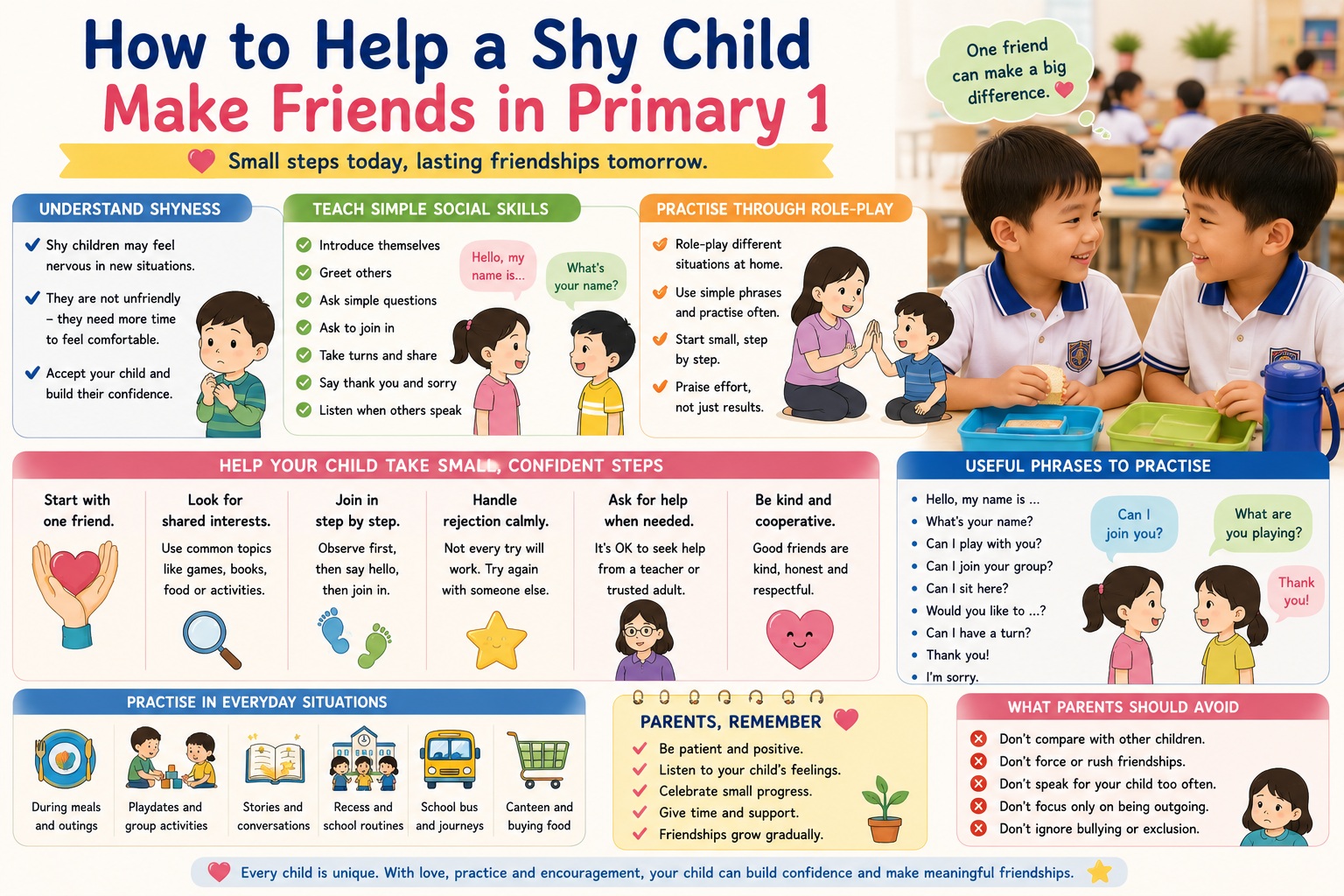
How to Help a Shy Child Make Friends in Primary 1
Starting Primary 1 means entering a larger school, meeting unfamiliar teachers and spending each day with many new classmates.
For a shy child, this transition can feel especially challenging. The child may want to make friends but feel unsure about starting a conversation, joining a game or speaking in front of others.
Shyness does not mean that a child is unfriendly, unhappy or unable to form meaningful friendships. Some children simply need more time to observe a new environment and feel comfortable with unfamiliar people.
Parents can help by teaching simple social skills, practising useful phrases and giving the child manageable opportunities to connect with others.
What Does It Mean When a Child Is Shy?
A shy child may feel nervous or cautious in unfamiliar social situations.
The child may:
- Speak freely at home but remain quiet around unfamiliar people
- Watch other children before joining an activity
- Avoid answering questions in a group
- Stay close to a familiar adult
- Feel uncomfortable introducing themselves
- Need more time to become comfortable with classmates
Shyness is not necessarily a problem that needs to be removed. The goal is not to turn a quiet child into the most outgoing person in the class.
The goal is to help the child communicate important needs, participate when ready and develop one or two comfortable friendships.
Why Primary 1 Can Feel Difficult for a Shy Child
Primary 1 introduces several changes at the same time.
A child may need to:
- Enter a larger and busier school environment
- Meet many unfamiliar classmates
- Interact with different subject teachers
- Ask adults for help
- Find someone to sit with during recess
- Join group activities
- Speak loudly enough to be heard
- Manage problems without a parent nearby
A shy child may understand what to do but find it difficult to take the first social step.
Preparation can make these situations feel more familiar and manageable.
1. Accept Your Child’s Temperament
Avoid describing your child negatively as “too shy”, “antisocial” or “afraid of everyone”.
Children may begin to believe these labels and see shyness as something they cannot change.
Instead, use neutral and encouraging language such as:
- “You like to observe before joining.”
- “You sometimes need more time to feel comfortable.”
- “It can be difficult to talk to someone new.”
- “You can begin with one small step.”
Let your child know that being quiet is acceptable while also explaining that some social skills can be practised.
2. Talk About What Is Causing the Worry
Do not assume that every shy child is worried about the same thing.
Your child may be concerned about:
- Not knowing what to say
- Being rejected by another child
- Speaking incorrectly
- Not understanding a game
- Being laughed at
- Not knowing where to sit during recess
- Having to speak loudly
- Being separated from a familiar friend
Ask gentle and specific questions such as:
- “Which part of meeting new classmates feels difficult?”
- “What do you worry might happen?”
- “Is it easier to talk to one child or a group?”
- “What would help you feel more comfortable?”
Listen without immediately correcting, dismissing or solving the concern.
3. Explain That One Friend Is a Good Start
Children do not need to become friends with everyone immediately.
A shy child may feel overwhelmed when told to “go and make lots of friends”.
A smaller and more realistic goal may be:
- Say hello to one classmate
- Learn one person’s name
- Sit beside one friendly child
- Join one short activity
- Speak to the same classmate again the next day
One comfortable friendship can help a child feel safer and gradually become more confident within the wider class.
4. Teach Simple Conversation Starters
A shy child may want to speak but have difficulty thinking of the first sentence.
Practise short conversation starters that are easy to remember.
Introducing themselves
- “Hello, my name is ______.”
- “What is your name?”
- “Which class were you from before this?”
Starting a conversation
- “What book are you reading?”
- “Which game do you like?”
- “What did you buy for recess?”
- “Do you take the school bus?”
- “Which colour do you like?”
Joining an activity
- “Can I play with you?”
- “Can I join your group?”
- “What are you playing?”
- “Can I have a turn after you?”
Offering friendship
- “Would you like to sit together?”
- “Do you want to walk to the canteen together?”
- “Would you like to share my coloured pencils?”
The child does not need to memorise every phrase. Choose two or three that feel natural.
5. Practise Through Role-Play
Role-play allows a child to practise social situations in a safe environment.
Parents can pretend to be:
- A new classmate
- A child playing during recess
- A classmate sitting alone
- A child who says no
- A teacher organising group work
Example role-play
Parent: “I am playing with some building blocks.”
Child: “Can I play with you?”
Parent: “Yes. You can help me build this side.”
Repeat the activity while changing the response. The parent may sometimes say:
“We have finished this game, but you can join us for the next one.”
This helps the child understand that not every hesitation or refusal means personal rejection.
6. Practise Speaking Clearly and Loudly Enough
Some shy children speak so softly that classmates cannot hear them.
Practise using a clear classroom voice without criticising the child for being quiet.
Helpful activities include:
- Ordering food at a stall with supervision
- Greeting a familiar neighbour
- Asking a librarian a simple question
- Reading one sentence aloud at home
- Playing a game that requires calling another person’s name
You can say, “Try saying it loudly enough for the person across the table to hear.”
7. Arrange Low-Pressure Social Opportunities
Large groups may overwhelm a shy child. Begin with smaller and more predictable situations.
Parents may arrange:
- A short playdate with one child
- A visit to a playground during a quieter period
- A simple board game with a cousin
- A craft activity with another family
- A meal with one familiar peer
Choose activities that give children something to do together. Conversation often develops more naturally when children are drawing, building or playing.
8. Let Your Child Answer for Themselves
Parents may automatically answer when someone asks the child a question.
For example:
Adult: “What is your name?”
Parent: “His name is Daniel. He is starting Primary 1.”
Although this may feel helpful, repeatedly answering for the child can reduce opportunities to practise.
Instead:
- Pause for several seconds
- Look at the child encouragingly
- Repeat the question gently if needed
- Offer only the beginning of the answer
For example, say, “You can tell Auntie your name.”
Step in only when the child is genuinely overwhelmed or the situation requires it.
9. Teach the Child How to Join a Group
Joining a group is more difficult than approaching one child.
Teach your child to follow these steps:
- Stand nearby and observe what the children are doing.
- Wait for a suitable pause.
- Ask what they are playing.
- Ask whether they can join.
- Follow the game’s rules.
You can also teach the child to make a relevant offer:
- “I can help build the road.”
- “I have an extra pencil.”
- “Can I be on this team?”
10. Prepare for the Possibility of Rejection
Not every attempt to join another child will be successful.
The other child may already be waiting for a friend, the game may be ending or the group may not have space.
Teach your child not to assume that one refusal means nobody likes them.
Useful responses include:
- “Okay, maybe next time.”
- “Can I join the next game?”
- “I will ask someone else.”
- “I can do another activity first.”
Explain that friendship involves finding people who enjoy spending time together. It may take several attempts.
11. Teach Your Child How to Show Friendliness
Children sometimes focus only on what to say. Non-verbal behaviour also matters.
Practise:
- Looking towards the other child
- Using a gentle smile
- Standing at a comfortable distance
- Listening without interrupting
- Nodding or responding to what the other child says
- Using a calm tone of voice
Do not demand constant eye contact, especially if it makes the child uncomfortable. Looking towards the person and showing attention may be enough.
12. Help Your Child Notice Shared Interests
Friendships often begin through shared interests.
Encourage your child to notice whether a classmate:
- Reads the same type of books
- Enjoys drawing
- Likes the same games
- Takes the same school bus
- Attends the same student care centre
- Enjoys similar food
Your child can then begin with a related question or comment.
For example:
- “I like dinosaurs too.”
- “I also take Bus 3.”
- “That is my favourite story.”
13. Encourage Kind and Cooperative Behaviour
Friendship skills are not only about starting conversations.
Teach your child to:
- Take turns
- Share when appropriate
- Listen to another child’s ideas
- Say thank you
- Apologise after making a mistake
- Respect another child’s belongings
- Include others when possible
Children are often drawn to classmates who are kind, fair and enjoyable to be around.
14. Do Not Force Immediate Social Interaction
Telling a shy child, “Go and talk to everyone now,” may increase anxiety.
Use gradual steps instead.
For example:
- Smile at another child.
- Say hello.
- Ask one simple question.
- Sit near the child.
- Join a short activity.
Progress may look small to an adult, but each successful step builds confidence.
15. Avoid Comparing Your Child with Outgoing Children
Avoid comments such as:
- “Why can’t you be like your cousin?”
- “Everyone else is talking except you.”
- “Your sister was never this shy.”
- “You will have no friends if you stay quiet.”
These comments can create shame without teaching the child what to do differently.
Compare progress with the child’s own previous behaviour instead.
For example:
“Last week you found it difficult to say hello. Today you introduced yourself.”
16. Praise Specific Social Efforts
Avoid praising only successful outcomes such as making a new friend.
Praise the effort involved:
- “You said hello even though you felt nervous.”
- “You asked whether you could join the game.”
- “You spoke loudly enough for your classmate to hear.”
- “You tried again after the first child was busy.”
- “You noticed that someone was sitting alone.”
This teaches the child that courage means taking action even when nervous.
17. Talk Positively About the First Weeks of School
Do not create the expectation that the child must have a best friend immediately.
Explain that:
- Everyone will be getting used to the new class
- Some children may also feel nervous
- Friendships often develop gradually
- The first person they meet may not become their closest friend
- It is normal to take time to feel comfortable
A realistic expectation reduces pressure.
18. Help Your Child Prepare for Recess
Recess can be socially challenging because children must decide where to sit and whom to spend time with.
Discuss possible plans such as:
- Ask a classmate to walk to the canteen together
- Sit near children from the same class
- Join a classmate after buying food
- Approach a familiar buddy
- Ask the teacher or buddy for guidance if unsure
Practise saying:
- “Shall we go to the canteen together?”
- “Can I sit here?”
- “What did you buy?”
19. Keep After-School Conversations Gentle
Repeatedly asking, “Did you make a friend today?” may make the child feel tested.
Try broader and more specific conversation starters:
- “Who sat near you today?”
- “Did anyone make you smile?”
- “Who did you speak to during recess?”
- “Was there someone you would like to know better?”
- “Did anyone help you today?”
- “What might you say to that person tomorrow?”
Accept brief answers. Some children need time to process the school day before talking.
20. Communicate with the Form Teacher When Needed
Parents do not need to ask the teacher to create a friendship for the child. However, it can be useful to share that the child takes time to warm up in unfamiliar settings.
You may ask whether the teacher has observed:
- Who the child sits with
- Whether the child participates in group work
- Whether the child speaks to classmates
- How the child behaves during recess
- Whether another child has similar interests
The teacher may be able to provide natural opportunities through seating arrangements, partner activities or small-group tasks.
Useful Friendship Scripts for Primary 1
Meeting someone new
- “Hello, my name is ______. What is your name?”
- “Are you also in Class ______?”
Joining an activity
- “What are you playing?”
- “Can I join?”
- “Can I have a turn after you?”
Starting a recess conversation
- “Can I sit here?”
- “What did you buy?”
- “Which stall do you like?”
Offering help
- “Do you need a pencil?”
- “I can help you carry this.”
- “The teacher said to go this way.”
Handling a disagreement
- “Can we take turns?”
- “I do not like that. Please stop.”
- “Let us ask the teacher.”
Responding to rejection
- “Okay, maybe next time.”
- “Can I join the next round?”
- “I will find another activity.”
A One-Week Friendship Practice Plan
| Day | Practice Activity |
|---|---|
| Monday | Practise saying hello and introducing oneself. |
| Tuesday | Practise asking one simple question. |
| Wednesday | Role-play asking to join a game. |
| Thursday | Practise responding when another child says no. |
| Friday | Practise inviting someone to sit or walk together. |
| Weekend | Arrange a low-pressure activity with one familiar child. |
What Parents Should Avoid
- Labelling the child negatively
- Speaking for the child in every situation
- Forcing the child into a large group without preparation
- Demanding that the child make many friends immediately
- Comparing the child with outgoing siblings or classmates
- Making fun of the child’s nervousness
- Contacting other parents to arrange friendships without involving the child
- Interrogating the child every day about whether they made friends
- Ignoring repeated signs of distress or exclusion
When Shyness May Need Additional Support
Some nervousness during the transition to Primary 1 is understandable. However, parents may need to seek further guidance if the child consistently:
- Cannot speak to teachers even when help is urgently needed
- Becomes extremely distressed before school
- Frequently complains of physical discomfort before social situations
- Refuses school because of social fears
- Has no interaction with classmates over an extended period
- Appears persistently lonely or unhappy
- Is being excluded, teased or bullied
- Stops speaking in settings where speech is normally expected
- Experiences anxiety that interferes with everyday activities
Parents can begin by speaking with the form teacher or school counsellor. Where concerns are persistent or severe, consider seeking advice from an appropriate healthcare or child-development professional.
Friendship Readiness Checklist
- ☐ My child can say their name clearly.
- ☐ My child can greet another child.
- ☐ My child can ask one simple question.
- ☐ My child can ask to join an activity.
- ☐ My child can wait for a turn.
- ☐ My child can listen while another child speaks.
- ☐ My child can offer or accept simple help.
- ☐ My child can cope when another child is unavailable.
- ☐ My child knows how to ask a trusted adult for help.
- ☐ My child can say when another person’s behaviour feels uncomfortable.
Frequently Asked Questions
Is it normal for a child to be shy when starting Primary 1?
Yes. Many children need time to become comfortable in a new school environment. Meeting new classmates and teachers can feel overwhelming, especially during the first few weeks.
Should parents tell the teacher that their child is shy?
Parents may briefly explain that the child takes time to warm up in unfamiliar settings. This can help the teacher understand the child’s behaviour and provide suitable opportunities for participation.
Should I arrange playdates with my child’s classmates?
A short playdate with one suitable classmate may help, especially if both children are comfortable. Keep the activity simple and avoid pressuring the children to become close friends.
What if my child says nobody wants to play with them?
Listen and ask what happened before deciding what the statement means. The child may have experienced one unsuccessful attempt rather than ongoing exclusion. Help the child think of another classmate or approach to try, and speak with the teacher if the problem continues.
Should I reward my child for talking to classmates?
Specific encouragement is usually more helpful than regular material rewards. Praise the child for attempting a difficult social step, regardless of the outcome.
How many friends does a child need?
There is no correct number. Some children enjoy having many classmates to play with, while others prefer one or two close friends. The quality and safety of the relationships are more important than the number.
What if my child prefers playing alone?
Occasional solitary play is not necessarily a concern. Observe whether the child is choosing to be alone contentedly or remaining alone because they feel unable to connect with others.
How long should parents wait before becoming concerned?
Children adjust at different rates. Look at the child’s overall well-being and whether there is gradual progress. Seek support earlier when the child shows severe distress, persistent loneliness, school refusal or an inability to ask adults for necessary help.
Final Thoughts
A shy child does not need to become highly outgoing to enjoy Primary 1 or form good friendships.
Parents can help by accepting the child’s temperament while teaching practical skills such as introducing themselves, asking to join an activity, handling rejection and seeking help.
Begin with small goals. Saying hello, learning one classmate’s name or sitting beside someone during recess can be meaningful progress.
With patient practice, encouragement and support from trusted adults, a shy child can gradually build confidence and find friendships that feel safe and genuine.
This article provides general parenting and educational information. Parents should consider their child’s individual needs and speak with the school or an appropriate professional when social anxiety or distress affects everyday functioning.
It takes a village to raise a child !
Join our WhatsApp Groups or Facebook Group to interact with parents about student care in Singapore..