Primary 1 Academic Readiness: English, Math and Mother Tongue Skills
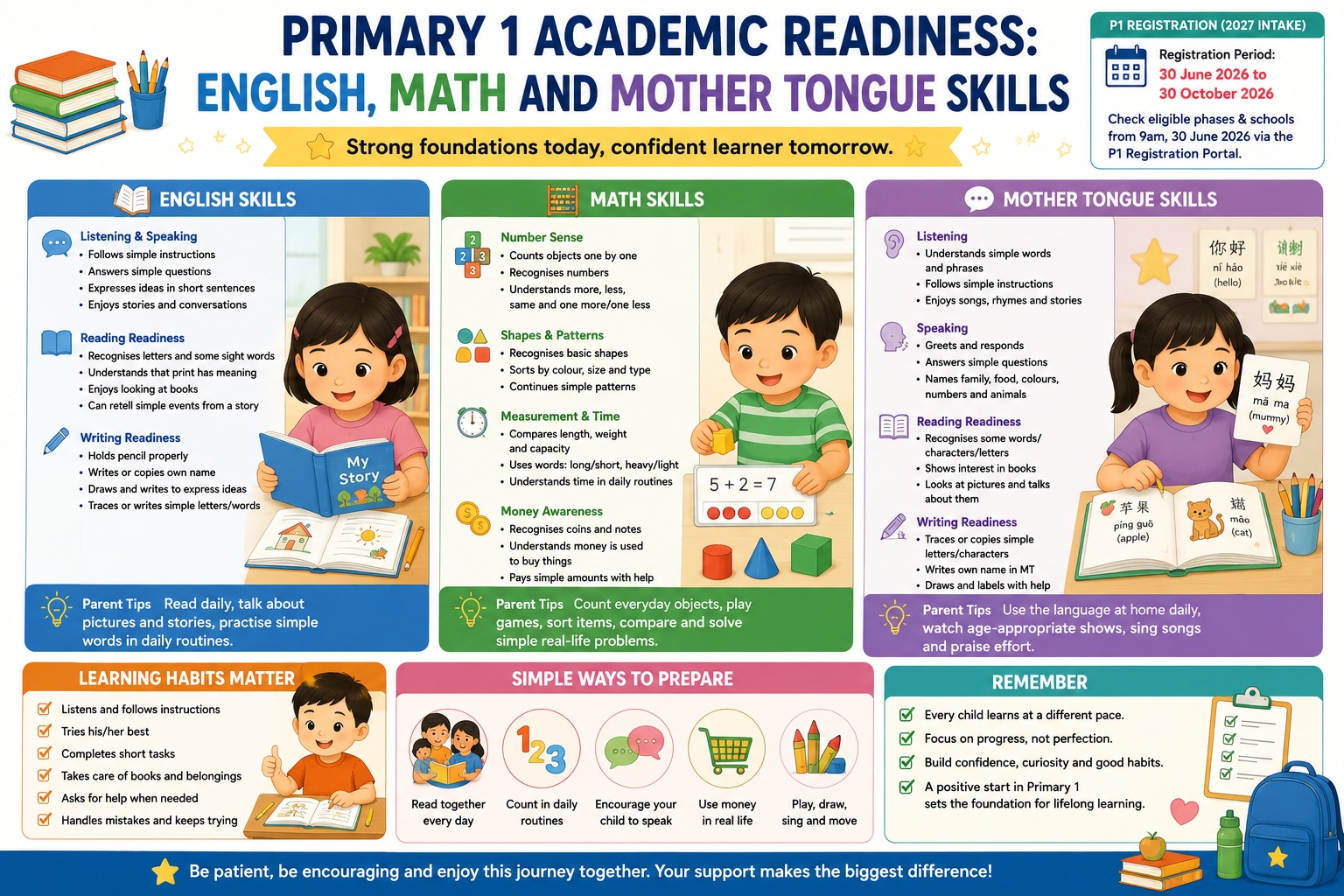
Primary 1 Academic Readiness: English, Math and Mother Tongue Skills
Last updated: 11 May 2026
When a child is about to enter Primary 1, many Singapore parents naturally worry about academics. Common questions include: “Must my child be able to read before P1?”, “How much Math should my child know?” and “What if my child is weak in Mother Tongue?”
Academic readiness is important, but it does not mean your child must master the Primary 1 syllabus before school starts. A child who enters P1 with curiosity, confidence, listening skills, basic literacy and numeracy exposure, and a positive attitude towards learning is often better prepared than a child who has been over-drilled.
In Singapore, Primary 1 children will learn subjects such as English Language, Mother Tongue Language and Mathematics, as well as other areas such as Art, Music, Physical Education, Social Studies and Character and Citizenship Education. This guide focuses on the three core academic areas that parents commonly worry about: English, Math and Mother Tongue.
Quick Answer: A child is academically ready for Primary 1 when he or she has basic listening and speaking skills, enjoys books and stories, recognises some letters and numbers, can count and compare simple quantities, can hold a pencil with reasonable control, understands simple instructions, and has regular exposure to the Mother Tongue Language. Parents should focus on confidence, routines and daily-life learning, not rushing through the P1 syllabus.
Who Is This Guide For?
This guide is useful for:
- Parents of K2 children preparing for Primary 1 in Singapore
- Parents whose child is entering P1 in 2027
- Parents worried about English, Math or Mother Tongue readiness
- Parents deciding whether their child needs tuition before Primary 1
- Parents looking for a practical and non-stressful preparation checklist
Academic Readiness Does Not Mean Learning the P1 Syllabus Early
Some parents feel pressured to teach spelling, composition, problem sums or Chinese characters before Primary 1. However, Primary 1 is designed as a starting point for formal primary school learning.
Before P1, the more useful goal is to build foundational learning habits and everyday skills, such as:
- Listening to instructions
- Asking questions when unsure
- Enjoying books, stories and conversations
- Trying again after mistakes
- Counting objects in daily life
- Using language to express needs and ideas
- Sitting for short learning activities
- Taking care of books, stationery and schoolwork
These foundations help children cope better when formal lessons begin.
1. English Readiness for Primary 1
English is the main language of instruction in Singapore primary schools. P1 English readiness is not only about reading words. It includes listening, speaking, vocabulary, story understanding, early reading and early writing.
Listening and speaking skills
Your child may be more ready for P1 English if he or she can:
- Listen to a short story or explanation
- Follow simple one-step and two-step instructions
- Answer simple questions about daily life
- Speak in short complete sentences
- Describe a simple event, object or picture
- Ask for help when confused
- Take turns in conversation
Reading readiness
Your child does not need to read fluently before P1, but it helps if he or she can:
- Enjoy listening to stories
- Recognise some or most letters of the alphabet
- Recognise his or her own name
- Understand that print carries meaning
- Know that English words are usually read from left to right
- Identify some common words in daily life, such as signs, labels or familiar names
- Talk about what happened in a story
Writing readiness
Your child may be ready for early P1 writing if he or she can:
- Hold a pencil with reasonable control
- Write or copy his or her name
- Draw simple pictures to express ideas
- Copy simple letters or words
- Use basic fine motor skills such as colouring, tracing, cutting and pasting
Connect with parents who are interested in the same primary school, exchange useful updates, and prepare for P1 together. Join here: WhatsApp Groups for Primary 1 in 2027
How parents can support English readiness
- Read aloud to your child daily, even for 10 minutes.
- Ask simple questions after a story: “Who was in the story?” “What happened next?”
- Encourage your child to describe pictures, meals, outings and feelings.
- Visit the library and let your child choose age-appropriate books.
- Play sound games, rhyming games and alphabet games naturally.
- Let your child practise writing through cards, labels, shopping lists or simple notes.
2. Math Readiness for Primary 1
P1 Math is not just about memorising numbers. It is about understanding quantities, patterns, shapes, comparison, simple problem-solving and using Math in everyday life.
MOE’s Primary Mathematics curriculum emphasises mathematical concepts, skills and processes, with problem-solving as a central focus. For children entering P1, parents can support this by making Math meaningful and concrete.
Number readiness
Your child may be more ready for P1 Math if he or she can:
- Count objects one by one
- Recognise numbers in daily life
- Count forwards to at least 20, and possibly beyond
- Understand that the last number counted tells “how many”
- Compare which group has more or fewer items
- Understand simple ideas such as one more and one less
Shapes, patterns and measurement readiness
Useful early Math skills include being able to:
- Recognise simple shapes such as circle, square, triangle and rectangle
- Sort objects by colour, size, shape or type
- Continue simple patterns, such as red-blue-red-blue
- Compare objects using words such as longer, shorter, taller, heavier and lighter
- Use position words such as above, below, beside, before and after
Money and time awareness
Before P1, your child can start learning to:
- Recognise common Singapore coins and notes
- Understand that money is used to buy things
- Use simple amounts such as 50 cents, $1 and $2 during pretend play
- Understand daily time words such as morning, afternoon, evening, yesterday and tomorrow
- Follow daily routines such as breakfast time, school time and bedtime
How parents can support Math readiness
- Count real objects such as toys, fruits, steps and plates.
- Ask simple comparison questions: “Which plate has more grapes?”
- Sort laundry, blocks or stationery by colour or size.
- Let your child help set the table: “We need 4 spoons for 4 people.”
- Practise simple money use at a canteen, hawker centre or food court.
- Use board games, dice games and card games to build number sense.
3. Mother Tongue Readiness for Primary 1
Mother Tongue Language is a compulsory subject in Singapore primary schools. The three official Mother Tongue Languages offered are Chinese, Malay and Tamil.
Many parents worry because their child speaks mostly English at home. The aim before P1 is not to force memorisation or make the child fear Mother Tongue. It is more helpful to build familiarity, listening confidence, simple speaking ability and positive exposure.
Listening readiness
Your child may be more ready for Mother Tongue if he or she can:
- Listen to simple phrases or instructions in the Mother Tongue Language
- Recognise familiar words used at home
- Respond to simple daily-life questions
- Enjoy songs, rhymes or stories in the language
- Understand common greetings and polite expressions
Speaking readiness
Your child may benefit from being able to say simple phrases such as:
- Greetings
- Self-introduction
- Names of family members
- Names of common foods, colours, numbers and animals
- Simple needs such as wanting water, food or help
Reading and writing readiness
For Mother Tongue, children enter Primary 1 with different levels of exposure. Some children may already recognise characters, letters or words, while others may still be building confidence.
Useful readiness skills include:
- Recognising some familiar words, characters or letters, depending on the language
- Showing interest in picture books, songs or stories
- Being willing to repeat words or phrases
- Trying to speak even if pronunciation is not perfect
- Having a positive attitude towards the language
How parents can support Mother Tongue readiness
- Use the language naturally during daily routines.
- Start with simple phrases instead of long lessons.
- Read picture books or listen to songs in the language.
- Watch age-appropriate programmes in the Mother Tongue Language with discussion.
- Encourage grandparents or relatives to speak simple phrases with the child.
- Praise effort instead of correcting every mistake immediately.
4. Learning Habits That Matter Before Primary 1
Academic readiness also depends on how your child approaches learning.
Useful learning habits include:
- Listening when an adult is speaking
- Trying a task before saying “I cannot”
- Completing short activities
- Taking care of books and stationery
- Asking for help appropriately
- Accepting corrections without giving up immediately
- Being willing to practise
These habits support English, Math and Mother Tongue learning better than last-minute drilling.
5. Should Parents Start Tuition Before Primary 1?
Not every child needs tuition before Primary 1. Some children may benefit more from reading, conversation, routines, play-based learning and practical independence.
Tuition or extra classes may not be necessary if your child:
- Enjoys learning through daily activities
- Can follow simple instructions
- Has regular exposure to books and conversation
- Has basic number sense
- Is emotionally adjusting well to the idea of Primary 1
Parents may consider extra support if the child:
- Struggles significantly with language understanding
- Cannot follow simple instructions close to school entry
- Shows strong anxiety around learning
- Has speech, learning, attention or developmental concerns
- Needs structured support recommended by preschool teachers or professionals
If extra support is used, it should be age-appropriate and confidence-building, not overly stressful.
Primary 1 Academic Readiness Checklist
| Area | Useful Readiness Skills | Parent Support Ideas |
|---|---|---|
| English Listening and Speaking | Can listen to stories, answer simple questions and speak in short sentences | Read aloud, talk about daily events, ask open-ended questions |
| English Reading | Recognises letters, own name and some familiar words; enjoys books | Visit library, read picture books, point out signs and labels |
| English Writing | Can hold a pencil, copy simple letters and write or copy own name | Practise drawing, colouring, tracing, cards and simple notes |
| Math Numbers | Can count objects, recognise numbers and compare more or fewer | Count toys, fruits, steps and everyday items |
| Math Concepts | Recognises simple shapes, patterns, sizes and positions | Sort laundry, compare objects, play pattern and shape games |
| Money Awareness | Recognises simple coins and notes; understands money is used to buy things | Practise at food court, canteen or pretend shop |
| Mother Tongue Listening | Understands simple phrases, greetings and daily-life words | Use simple phrases at home, play songs and rhymes |
| Mother Tongue Speaking | Can say simple words or phrases and respond to basic questions | Practise greetings, food names, family words and daily routines |
| Learning Habits | Can try short tasks, ask for help and accept mistakes as part of learning | Praise effort, keep practice short and positive |
Simple Weekly Plan to Build Academic Readiness
Parents do not need long worksheets every day. Short, consistent and enjoyable activities are often more useful.
| Day | Simple Activity | Skill Built |
|---|---|---|
| Monday | Read one English picture book together | Listening, vocabulary, story understanding |
| Tuesday | Count household items and compare more or fewer | Number sense and comparison |
| Wednesday | Use 5 simple Mother Tongue phrases during dinner | Listening and speaking confidence |
| Thursday | Draw a picture and ask your child to describe it | Oral expression and early writing ideas |
| Friday | Play a board game, dice game or card game | Counting, turn-taking and problem-solving |
| Weekend | Let your child buy a simple snack with supervision | Money awareness, communication and independence |
Common Mistakes Parents Should Avoid
- Trying to complete the Primary 1 syllabus before school starts
- Using too many worksheets and too little conversation or reading
- Making Mother Tongue feel like punishment
- Comparing the child with siblings, cousins or classmates
- Focusing only on correct answers instead of effort and thinking
- Ignoring sleep, routine, emotional readiness and independence
- Scolding the child for normal mistakes during early learning
Frequently Asked Questions About Primary 1 Academic Readiness
Must my child know how to read before Primary 1?
Your child does not need to be a fluent reader before Primary 1. It is helpful if your child enjoys books, recognises some letters and familiar words, listens to stories and can talk about simple events or pictures.
How much Math should my child know before Primary 1?
Your child should ideally have basic number sense, such as counting objects, recognising numbers, comparing more and fewer, recognising simple shapes and understanding everyday Math ideas. Parents do not need to teach advanced problem sums before P1.
What if my child is weak in Mother Tongue?
Start with daily exposure and simple phrases. Use songs, picture books, greetings, food words and family conversations. The aim is to build confidence and familiarity instead of fear.
Does my child need tuition before Primary 1?
Not every child needs tuition before Primary 1. Many children benefit more from reading, play-based learning, routines, conversation, independence and positive learning habits. Extra support may be useful if there are significant language, learning, attention or developmental concerns.
Should I teach spelling before Primary 1?
You can introduce simple words naturally, but avoid turning spelling into a stressful daily drill too early. Reading, phonics awareness, vocabulary and listening skills are also important foundations.
Should I teach Chinese characters, Malay words or Tamil words before P1?
Some exposure is helpful, especially through songs, stories, labels and simple daily phrases. However, children enter P1 with different levels of Mother Tongue exposure, so parents should focus on building interest and confidence.
What is the best way to prepare academically for P1?
Read daily, talk often, count real objects, play simple thinking games, use Mother Tongue in daily life, build routines and praise effort. Short, enjoyable practice is better than long stressful drilling.
What if my child refuses to learn?
Reduce pressure and make learning playful. Use stories, games, cooking, shopping, drawing, songs and daily routines. If refusal is linked to anxiety, attention difficulties or developmental concerns, speak to the preschool teacher or a professional for advice.
Final Thoughts
Primary 1 academic readiness is not about making your child “ahead” of everyone else. It is about helping your child start school with confidence, curiosity and basic learning foundations.
For English, focus on stories, conversation, vocabulary and early reading habits. For Math, build number sense through real-life counting, sorting and comparing. For Mother Tongue, create regular and positive exposure through simple daily use.
Most importantly, keep learning warm and encouraging. A child who feels safe to try, make mistakes and ask questions is building one of the most important skills for Primary 1 and beyond.
Important: This article is for general parenting information. Parents should refer to MOE and their child’s school for official curriculum information and speak to preschool teachers or professionals if they have concerns about their child’s learning, speech, attention or development.
Connect with parents who are interested in the same primary school, exchange useful updates, and prepare for P1 together. Join here: WhatsApp Groups for Primary 1 in 2027
It takes a village to raise a child !
Join our WhatsApp Groups or Facebook Group to interact with parents about student care in Singapore..