Primary 1 Transition Problems and How Parents Can Help
Primary 1 Transition Problems and How Parents Can Help
Last updated: 11 May 2026
Starting Primary 1 is a major milestone. For many children, it is exciting. They get a new uniform, new school bag, new teachers, new classmates and a bigger school environment.
At the same time, the transition from preschool to primary school can also be stressful. Some children cry at drop-off. Some become tired and cranky after school. Some worry about recess, toilets, homework, spelling, making friends or getting lost in school.
These adjustment problems are common, especially during the first few weeks. Most children settle gradually with patience, routines and support. However, parents should also know when a child may need extra help.
Quick Answer: Common Primary 1 transition problems include crying at drop-off, separation anxiety, tiredness, recess worries, toilet anxiety, difficulty making friends, homework stress, lost belongings, school refusal and emotional meltdowns after school. Parents can help by staying calm, building predictable routines, listening to the child’s feelings, practising practical skills, communicating with teachers and seeking help if anxiety or distress is persistent or severe.
Who Is This Guide For?
This guide is useful for:
- Parents whose child is entering Primary 1 in Singapore
- Parents of children preparing for the 2027 P1 intake
- Parents whose child cries, worries or resists school
- Parents whose child feels tired, overwhelmed or emotional after school
- Parents who want practical ways to support the P1 transition
Why Primary 1 Transition Can Be Difficult
Primary 1 is not just a change of school. It is a change in daily rhythm, expectations and independence.
A child may suddenly need to:
- Wake up earlier
- Wear a uniform and follow school rules
- Move around a bigger school compound
- Buy food during recess
- Use a school toilet independently
- Follow a timetable
- Manage books, files, stationery and homework
- Interact with many new classmates
- Ask unfamiliar adults for help
- Cope with a longer and more structured day
For a six-year-old child, these changes can feel big. A child may be academically ready but still need emotional, social and practical support.
Connect with parents who are interested in the same primary school, exchange useful updates, and prepare for P1 together. Join here: WhatsApp Groups for Primary 1 in 2027
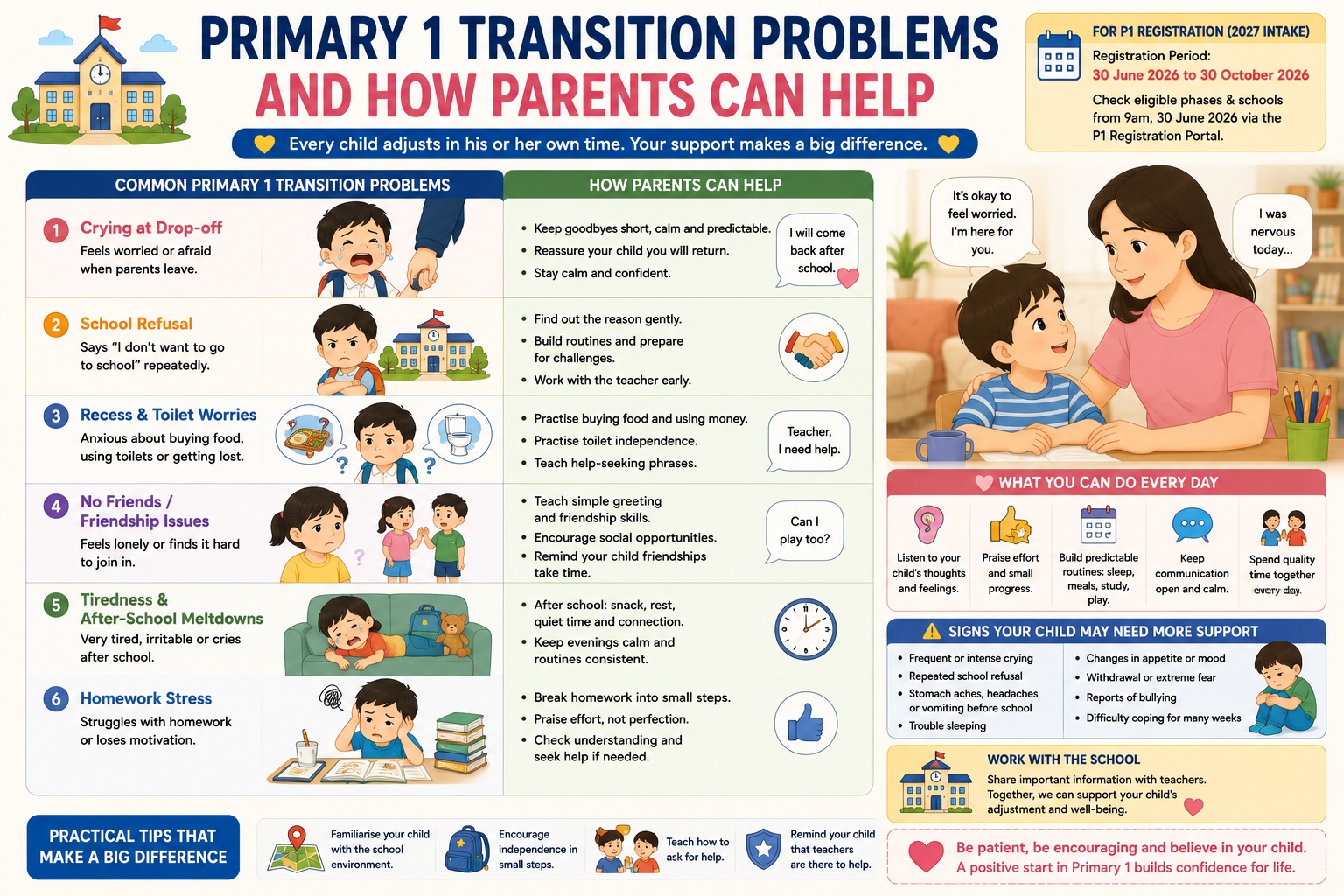
1. Problem: Crying at Drop-Off
Some children cry when parents leave them at the school gate or classroom. This may happen because the child is anxious, tired, unsure of the new environment or worried that the parent will not return.
How parents can help
- Keep goodbyes short, calm and predictable.
- Use a simple goodbye routine, such as hug, high-five and "I will see you after school".
- Avoid sneaking away without saying goodbye.
- Avoid long negotiations at the gate.
- Remind your child who will pick him or her up after school.
- Praise small steps of bravery after school.
If your child cries, try to stay calm. A worried parent can unintentionally make the child feel that school is unsafe.
2. Problem: School Refusal
School refusal means a child strongly resists going to school. The child may cry, complain of stomach aches, say "I don’t want to go", or become very distressed in the morning.
Occasional reluctance is common. However, repeated or intense school refusal should be taken seriously.
How parents can help
- Ask gently what the child is worried about.
- Look for patterns: Is it worse on certain days, after weekends or before spelling?
- Check whether the issue is separation, recess, bullying, homework, transport or tiredness.
- Inform the teacher early so the school can observe and support.
- Keep the morning routine calm and consistent.
- Avoid allowing repeated school absence unless the child is genuinely unwell.
If school refusal continues, affects sleep or appetite, or causes strong physical complaints, parents should speak with the school and consider professional advice.
3. Problem: Recess Anxiety
Recess is one of the biggest changes for many Primary 1 children. Some children worry about buying food, using money, queuing, finding a seat, eating quickly or returning to class on time.
How parents can help
- Practise buying food at a food court or hawker centre before school starts.
- Teach your child to recognise simple coins and notes.
- Start with simple food choices your child can order easily.
- Use a simple wallet or coin pouch.
- Pack a snack during the first few days if the school allows.
- Teach your child to ask a teacher, buddy or canteen helper for help.
Useful phrase to practise: "Teacher, I don’t know where to buy food. Can you help me?"
4. Problem: Toilet Worries
Some P1 children worry about using a bigger school toilet. They may be afraid of asking to go, unable to manage their uniform, or worried about dirty toilets.
How parents can help
- Practise using public toilets independently before school starts.
- Teach your child to ask, "May I go to the toilet?"
- Choose uniforms and shoes the child can manage.
- Remind your child not to hold urine for too long.
- Pack tissue if needed.
- Inform the teacher if your child has toileting difficulties or medical concerns.
Avoid shaming a child for toilet accidents. Respond calmly and work with the school if extra support is needed.
5. Problem: Tiredness and After-School Meltdowns
Some children behave well in school but cry, throw tantrums or become irritable at home. This can happen because they have used a lot of energy coping with the new school day.
How parents can help
- Keep the first few weeks after school as light as possible.
- Offer a snack, drink and quiet rest time after school.
- Avoid asking too many questions immediately after dismissal.
- Reduce unnecessary enrichment during the adjustment period.
- Maintain an early and consistent bedtime.
- Use calm words: "You had a long day. Let’s rest first."
A tired child may not be "naughty". The child may simply be overwhelmed and still learning to cope.
6. Problem: Difficulty Making Friends
Friendship worries are common. A child may say, "Nobody wants to play with me" or "I have no friends". Sometimes this means the child is lonely. Sometimes it simply means friendships are still forming.
How parents can help
- Teach simple friendship phrases.
- Role-play how to join a game or ask to sit with someone.
- Remind your child that friendships take time.
- Encourage your child to learn classmates’ names.
- Ask the teacher if your child seems isolated in class.
- Arrange simple playdates if appropriate and comfortable for both families.
Useful phrases to practise:
- "Can I play too?"
- "Can I sit here?"
- "Do you want to play together?"
- "Let’s take turns."
7. Problem: Conflicts, Teasing or Bullying
Small conflicts are common when young children are learning social rules. However, repeated teasing, exclusion, threats or physical aggression should not be ignored.
How parents can help
- Listen calmly and gather details.
- Ask what happened, who was involved, where it happened and how often it happens.
- Teach your child to say clearly, "Please stop. I don’t like that."
- Encourage your child to seek help from a teacher.
- Inform the school if the issue is repeated or serious.
- Avoid telling your child simply to "fight back".
Parents should work with the school to understand the situation and support safe, respectful behaviour.
8. Problem: Homework Stress
Some children struggle with homework because they are tired, unsure of instructions, slow in writing or still learning how to manage schoolwork.
How parents can help
- Create a short and predictable homework routine.
- Allow a short rest before homework.
- Break work into small parts.
- Use encouragement instead of scolding.
- Check whether the child understands the instruction.
- Tell the teacher if homework regularly takes too long.
For P1 children, the aim is to build a healthy homework habit, not to create fear of schoolwork.
9. Problem: Losing Belongings
Primary 1 children often lose pencils, erasers, water bottles, jackets, books or wallets. This is common because they are still developing organisation skills.
How parents can help
- Label all important belongings clearly.
- Use a simple pencil case with only necessary items.
- Pack the school bag together at first.
- Teach your child where each item belongs.
- Use a fixed homework folder.
- Avoid sending expensive stationery or accessories to school.
Instead of scolding harshly, teach a routine: "Before leaving class, check your bottle, wallet, file and pencil case."
10. Problem: Not Asking for Help
Some children stay silent when they are lost, confused, unwell or unsure. They may be shy, afraid of being scolded or unsure who to approach.
How parents can help
- Practise help-seeking phrases at home.
- Explain that teachers, general office staff and school helpers are safe adults.
- Role-play common situations such as losing a wallet or missing the school bus.
- Remind your child that asking for help is brave, not embarrassing.
Useful phrases:
- "Teacher, I need help."
- "I cannot find my classroom."
- "I feel sick."
- "I do not understand."
- "I cannot find my wallet."
11. Problem: Difficulty Adjusting to Student Care
Some children attend student care after school and may feel tired, overstimulated or homesick.
How parents can help
- Explain the student care routine before school starts.
- Tell your child clearly who will pick him or her up and when.
- Speak to the student care staff about your child’s needs.
- Check whether your child has enough rest, food and quiet time.
- Review the arrangement if your child remains highly distressed.
A good student care routine should make the child feel safe and supported, not constantly exhausted.
12. Problem: Parent Anxiety
Sometimes the child is coping better than the parent. Parents may worry about school choice, homework, friends, canteen food, teacher expectations or whether the child is falling behind.
How parents can help themselves
- Avoid comparing your child with other children.
- Give your child time to adjust.
- Check facts with the school instead of relying only on group chat rumours.
- Focus on progress, not perfection.
- Keep home calm during the first few weeks.
- Remember that P1 is a transition, not a test of parenting success.
Your calmness helps your child feel safer.
When Should Parents Seek Extra Help?
Some adjustment problems are normal. However, parents should seek support if the problem is intense, repeated or affects the child’s daily life.
Speak to the teacher, school counsellor, doctor or relevant professional if your child:
- Refuses school repeatedly
- Cries intensely for many weeks
- Has frequent stomach aches, headaches or vomiting linked to school anxiety
- Cannot sleep because of school worries
- Has major changes in appetite or mood
- Becomes withdrawn, aggressive or unusually fearful
- Reports repeated bullying or fear of someone in school
- Cannot manage basic toileting or self-care close to school entry
- Has learning, speech, developmental, sensory or attention concerns
HealthHub advises parents to work closely with the school if they are concerned about anxiety, and schools may help monitor the child’s well-being or facilitate further support when needed.
Primary 1 Transition Problems: Parent Action Checklist
| Problem | Possible Reason | What Parents Can Do |
|---|---|---|
| Crying at drop-off | Separation anxiety, unfamiliar environment | Use short goodbyes, reassure calmly, keep routine predictable |
| Refusing school | Anxiety, tiredness, bullying, fear of recess or homework | Identify the trigger, inform teacher, seek help if persistent |
| Recess worries | Unsure how to buy food or use money | Practise ordering food and using coins before school starts |
| Toilet worries | Fear of school toilet or difficulty managing uniform | Practise public toilet use and help-seeking phrases |
| After-school meltdowns | Tiredness or overstimulation | Offer food, rest and quiet time before homework |
| No friends | Still adjusting socially | Teach simple friendship phrases and check with teacher if needed |
| Homework stress | Tiredness, unclear instructions, slow writing | Break work into small parts and speak to teacher if it takes too long |
| Losing belongings | Still developing organisation skills | Label items, use simple packing routines, avoid expensive items |
| Not asking for help | Shyness or uncertainty | Role-play common situations and practise help-seeking phrases |
Simple Scripts Parents Can Use
When your child says, "I don’t want to go to school."
"You sound worried. Let’s find out what is making school feel hard. I will help you, and your teacher can help too."
When your child cries at drop-off
"I know goodbye feels hard. I will come back after school. Your teacher will take care of you. Hug, high-five, see you later."
When your child says, "I have no friends."
"Making friends can take time. Tomorrow, you can try saying hello to one classmate or ask, ‘Can I play too?’"
When your child loses something
"Things can get lost when we are learning new routines. Let’s think where it might be and practise checking your bag."
When your child has homework stress
"Let’s take it one small part at a time. You do not need to finish everything in one minute. I can sit with you while you start."
Frequently Asked Questions About Primary 1 Transition Problems
Is it normal for my child to cry during the first week of Primary 1?
Yes, some children cry during the first few days or weeks as they adjust to a new school environment. Parents can help by staying calm, keeping goodbyes short and reassuring the child that teachers are there to help.
How long does it take for children to adjust to Primary 1?
Every child is different. Some children settle within days, while others need weeks or months. Parents should look for steady progress rather than perfect adjustment immediately.
What should I do if my child refuses to go to school?
Ask what the child is worried about, check for triggers such as recess, separation, homework, tiredness or bullying, and inform the teacher early. If school refusal is repeated or intense, seek further support.
What if my child has no friends in Primary 1?
Friendships take time. Teach simple phrases for greeting, joining play and taking turns. If your child seems isolated for a long period, speak with the teacher to understand what is happening in school.
Why does my child melt down after school?
A child may be tired or overstimulated after managing a long school day. Offer food, water, quiet time and emotional connection before asking many questions or starting homework.
Should I contact the teacher about every problem?
Not every small issue needs immediate teacher involvement. However, parents should contact the teacher if the issue is repeated, serious, affects safety or well-being, or if the child cannot explain what is happening.
How can I help my child become more independent in Primary 1?
Let your child practise packing the school bag, using the toilet, managing recess money, opening containers, asking for help and checking belongings. Build independence step by step.
When should I seek professional help?
Seek help if anxiety, school refusal, sleep problems, appetite changes, frequent physical complaints or mood changes are intense, persistent or affecting daily life.
Final Thoughts
Primary 1 transition problems are common and do not mean your child is failing. A young child is learning many new skills at the same time: independence, friendship, routines, self-care, learning habits and emotional regulation.
Parents can help by staying calm, listening carefully, building routines, practising practical skills and working with the school. With time and support, most children grow more confident and comfortable in their new Primary 1 environment.
Important: This article is for general parenting information. Parents should refer to their child’s school, MOE and healthcare professionals for specific advice if their child shows persistent anxiety, school refusal, developmental concerns or difficulty adjusting.
Connect with parents who are interested in the same primary school, exchange useful updates, and prepare for P1 together. Join here: WhatsApp Groups for Primary 1 in 2027
It takes a village to raise a child !
Join our WhatsApp Groups or Facebook Group to interact with parents about student care in Singapore..