
Student Care After Primary School: What P1 Parents Should Consider
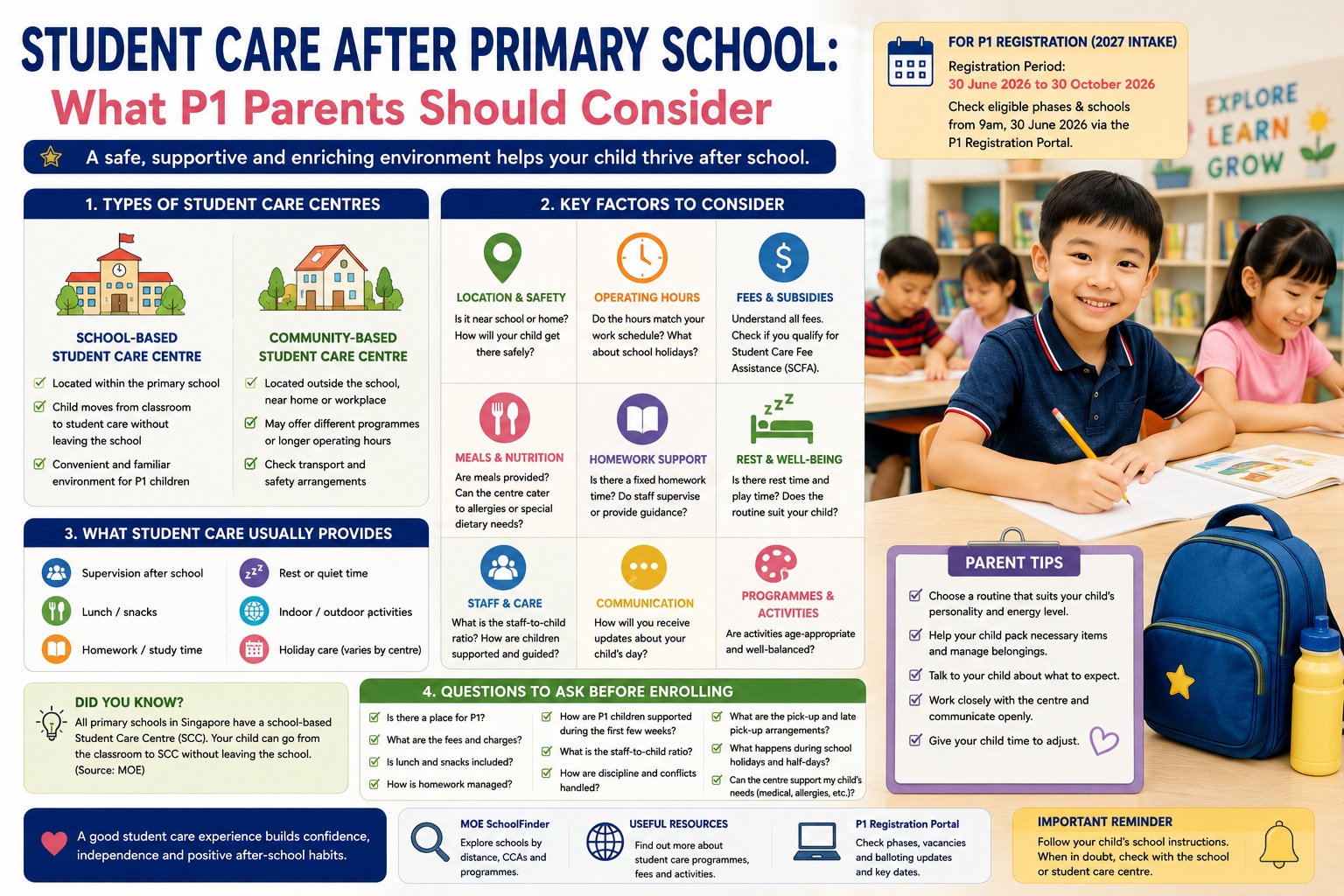
Student Care After Primary School: What P1 Parents Should Consider
Last updated: 11 May 2026
Starting Primary 1 is a major change for children and parents. For many Singapore families, one important question is: “Where should my child go after school?”
If both parents are working, or if there is no caregiver available at home in the afternoon, student care can provide supervision, meals, rest time, homework support and a safer after-school routine.
However, not every student care arrangement is suitable for every child. Some children adjust well to a structured group environment, while others may need more rest, quiet time or emotional support after a long school day.
Quick Answer: When choosing student care for a Primary 1 child in Singapore, parents should consider location, safety, fees, operating hours, meals, homework supervision, rest time, staff-child interaction, holiday arrangements, communication with parents, subsidies and whether the routine suits the child’s personality and energy level.
Who Is This Guide For?
This guide is useful for:
- Parents whose child is entering Primary 1 in Singapore
- Working parents who need after-school care
- Parents comparing school-based and community-based student care
- Parents deciding between student care, grandparents, helper or after-school enrichment
- Parents worried about whether their P1 child can cope with a long day
What Is a Student Care Centre?
Student Care Centres, often called SCCs, provide care and supervision for school-going children outside school hours. They may be located within a primary school or in the community.
Student care centres usually provide:
- Supervision after school
- Lunch or snacks
- Homework or study time
- Rest or quiet time
- Indoor or outdoor activities
- Holiday care arrangements, depending on the centre
- Basic guidance on routines and behaviour
For Primary 1 children, the main benefit is that they have a structured and supervised place to go after school, especially when parents are still at work.
School-Based Student Care vs Community-Based Student Care
In Singapore, parents generally consider two main types of student care: school-based student care and community-based student care.
| Type | What It Means | Possible Advantages | Possible Considerations |
|---|---|---|---|
| School-Based Student Care Centre | Located within the primary school | Child does not need to leave school after lessons; convenient for P1 children; easier transition from class to care | Places may be limited; operating model and fees depend on the centre operator |
| Community-Based Student Care Centre | Located outside the school, usually near home, school or workplace | May be closer to home; may offer different programmes or longer operating hours | Transport or walking arrangement is needed; parents should check safety and pick-up arrangements carefully |
MOE states that all primary schools have a school-based SCC, and the child can move from classroom to SCC without leaving the school. This can be especially helpful for younger Primary 1 children who are still learning school routines.
1. Location and Safety
Location is one of the most important factors. For Primary 1 children, a simple and safe transition after school can reduce stress.
Questions to ask:
- Is the student care centre located inside the school or outside the school?
- If outside the school, how will my child get there?
- Will an adult pick the child up from school?
- Is the walking route safe and sheltered?
- What happens if school ends early?
- What happens if my child has CCA, remedial class or enrichment later?
- Who is allowed to pick up my child?
For P1 children, convenience and safety may matter more than extra enrichment features.
2. Operating Hours and Holiday Care
Parents should check whether the centre’s operating hours match the family’s work schedule.
Ask about:
- Regular operating hours on school days
- Opening hours during school holidays
- Care arrangements on half-days or school event days
- Closure dates
- Late pick-up policy
- Extra charges for extended hours, if any
Do not assume that all centres operate the same way during school holidays. Some centres may offer full-day holiday programmes, while others may have different hours or additional fees.
3. Fees and Subsidies
Student care fees vary depending on the centre, operator, location and programme. Parents should ask for a clear breakdown of all fees before enrolling.
Fees to check may include:
- Monthly fee
- Registration fee
- Deposit
- Material fee
- Holiday programme fee
- Meal charges, if not included
- Late pick-up charges
- Withdrawal notice period
Eligible families may apply for the Government Student Care Fee Assistance scheme. MSF states that Student Care Fee Assistance provides fee assistance for children attending Student Care Centres whose parents are working and whose gross household income is $4,500 or less for families with 4 or fewer members, or whose per capita income is $1,125 or less for families with 5 or more members. Parents should check MSF for the latest eligibility details before applying.
Connect with parents who are interested in the same primary school, exchange useful updates, and prepare for P1 together. Join here: WhatsApp Groups for Primary 1 in 2027
4. Meals and Nutrition
After school, many P1 children are tired and hungry. A proper lunch and snack routine can affect mood, attention and energy.
Ask the centre:
- Is lunch provided?
- Are snacks provided?
- What does a typical menu look like?
- Can the centre handle food allergies?
- Can parents pack food from home if needed?
- How does the centre encourage children who eat slowly?
If your child is a picky eater or eats slowly, speak to the centre before the first day. Primary 1 children may need time to adjust to eating in a group setting.
5. Homework Supervision
Many parents choose student care because they want homework to be completed before the child comes home. However, parents should understand what “homework supervision” means.
Ask these questions:
- Is there a fixed homework time?
- Do staff check that homework is completed?
- Do staff correct mistakes, or only supervise?
- What happens if the child refuses to do homework?
- How does the centre support children who need more help?
- Will parents still need to check homework at home?
Student care staff may supervise homework, but parents should not assume it is the same as one-to-one tuition. For P1 children, the goal should be to build a healthy homework routine, not just rush through worksheets.
6. Rest Time and Emotional Adjustment
Primary 1 can be tiring. Some children are exhausted after school, especially during the first term. A good student care routine should allow children some time to rest, eat and adjust before doing homework.
Parents should ask:
- Is there rest or quiet time after lunch?
- Can children nap if they are very tired?
- How does the centre support children who cry or miss home?
- How are conflicts between children handled?
- Are children given time for play and movement?
A child who comes home emotionally drained every day may need adjustments to routine, sleep, pick-up time or workload.
7. Staff, Supervision and Communication
The quality of interaction between staff and children matters. P1 children need adults who are patient, clear and able to guide them through routines.
Ask the centre:
- How many children are in the group?
- How many staff supervise the children?
- How are P1 children supported during the first few weeks?
- How will parents be updated?
- Will parents be informed if the child does not eat, cries often or has conflicts?
- Who should parents contact for daily concerns?
Good communication is especially important during the first few months of Primary 1, when children may not always explain clearly what happened during the day.
8. Programmes and Activities
Some student care centres offer enrichment, reading, outdoor play, character development, art, sports or holiday programmes.
Ask yourself:
- Does my child need more enrichment or more rest?
- Are activities age-appropriate for Primary 1 children?
- Is there enough time for free play?
- Will the programme make the day too tiring?
- Are holiday activities included or charged separately?
A centre with many activities may sound attractive, but some P1 children may benefit more from a calm routine with meals, rest, homework and simple play.
9. Your Child’s Personality and Needs
The best student care arrangement depends on your child.
Student care may suit a child who:
- Enjoys being with other children
- Can follow group routines with support
- Needs a structured afternoon
- Can rest or play in a group environment
- Benefits from supervised homework time
Your child may need extra support if he or she:
- Gets very tired after school
- Is easily overwhelmed by noise
- Needs a nap every afternoon
- Has difficulty eating independently
- Has separation anxiety
- Has medical, learning or developmental needs
Parents should speak to the centre early if the child has allergies, medication needs, speech or developmental concerns, or difficulty with toileting or emotional regulation.
10. Student Care, Grandparents, Helper or Going Home?
Student care is not the only option. Some families use grandparents, a domestic helper, parent work-from-home arrangements or a mix of care options.
| Arrangement | Possible Benefits | Possible Challenges |
|---|---|---|
| School-Based Student Care | Convenient, structured, no need to leave school after lessons | Places may be limited; child may feel tired in a group setting |
| Community-Based Student Care | May be near home; may offer different programmes or hours | Transport arrangement needed; safety route must be checked |
| Grandparents | Familiar family care; may be more emotionally comforting | Homework routine and discipline expectations may differ |
| Domestic Helper | Child can rest at home; flexible household support | May still need adult guidance for homework and routines |
| Parent at Home or Work-from-Home | More parent-child time; flexible support | May be difficult to balance work, homework and care |
There is no one perfect arrangement. The right choice depends on the child’s needs, family schedule, budget and available support.
Questions to Ask Before Enrolling in Student Care
- Is there a place available for Primary 1 students?
- What are the operating hours?
- What are the fees and additional charges?
- Is lunch included?
- What is the homework routine?
- How much rest or play time is given?
- How are P1 children supported during the first few weeks?
- How does the centre handle illness, injuries or emergencies?
- How does the centre manage discipline and conflicts?
- How will parents receive updates?
- What is the late pick-up policy?
- What happens during school holidays?
- Can the centre support allergies, medical needs or learning needs?
Signs That a Student Care Arrangement Is Working Well
- Your child feels safe and familiar with the routine
- Your child eats reasonably well after school
- Your child is not constantly exhausted or distressed
- Homework routine is manageable
- Staff communicate important issues clearly
- Your child has some time for rest and play
- Pick-up and dismissal arrangements are clear and safe
Signs That Parents May Need to Review the Arrangement
- Your child cries daily for a long period after settling-in time
- Your child becomes extremely tired or emotionally overwhelmed every day
- Your child regularly skips meals or refuses to eat
- Homework becomes a daily struggle even after student care
- Your child reports feeling unsafe or repeatedly bullied
- Communication with the centre is unclear
- The routine does not match the family’s work schedule
If concerns arise, speak to the centre early. Sometimes a small adjustment, such as rest time, food arrangement or homework expectation, can help.
Student Care Checklist for P1 Parents
| Area | What to Check |
|---|---|
| Location | Inside school, near school, near home or near workplace |
| Safety | Pick-up arrangement, authorised caregivers, emergency procedures |
| Fees | Monthly fee, deposit, registration fee, holiday charges, late pick-up charges |
| Subsidy | Whether the family may qualify for Student Care Fee Assistance |
| Meals | Lunch, snacks, allergies, picky eating support |
| Homework | Supervision, checking, study routine, parent follow-up needed |
| Rest and Play | Quiet time, nap option, indoor or outdoor activities |
| Communication | Updates to parents, contact person, handling of concerns |
| Child Fit | Whether the setting suits your child’s energy, personality and needs |
Frequently Asked Questions About Student Care After Primary School
Do all primary schools in Singapore have student care?
MOE states that all primary schools have a school-based Student Care Centre. However, parents should check with the school directly about availability, application procedures and whether there is a waiting list.
What is the difference between school-based and community-based student care?
School-based student care is located within the primary school, so the child does not need to leave the school after lessons. Community-based student care is located outside the school, usually near home, school or workplace, and may require transport or walking arrangements.
Is student care necessary for Primary 1?
Not every child needs student care. It depends on the family’s work schedule, availability of caregivers, the child’s personality, and whether the child needs a supervised after-school routine.
Will student care help my child finish homework?
Many centres provide homework supervision, but parents should check what this includes. Some centres supervise completion, while parents may still need to check corrections, reading, spelling or learning progress at home.
Can my child rest or nap at student care?
This depends on the centre’s routine and facilities. Parents should ask whether there is quiet time or rest time, especially if the child gets tired easily after school.
Are there subsidies for student care in Singapore?
Eligible families may apply for Student Care Fee Assistance. MSF states that SCFA supports children attending student care whose parents are working and whose household income or per capita income falls within the qualifying limits. Parents should check the latest MSF criteria before applying.
When should parents apply for student care?
Parents should enquire early, especially if they need a place from the start of Primary 1. School-based student care places may be limited, and some centres may have waiting lists.
What should I do if my child cannot cope with student care?
Speak to the centre to understand the issue. The child may need more rest, a different homework routine, food support, or a gradual adjustment period. If the child remains very distressed, parents may need to review the care arrangement.
Final Thoughts
Student care can be very helpful for Primary 1 children, especially when parents need a safe and structured after-school arrangement. However, the best choice is not always the centre with the most activities or the longest programme.
For a young child entering Primary 1, parents should focus on safety, emotional comfort, rest, meals, homework routine, clear communication and whether the arrangement fits the child’s personality.
A good student care arrangement should help your child feel secure after school, not simply keep the child busy until pick-up time.
Important: This article is for general information only. Parents should check with the child’s primary school, the student care centre operator, MOE and MSF for the latest details on availability, fees, subsidies, operating hours and application requirements.
Connect with parents who are interested in the same primary school, exchange useful updates, and prepare for P1 together. Join here: WhatsApp Groups for Primary 1 in 2027
It takes a village to raise a child !
Join our WhatsApp Groups or Facebook Group to interact with parents about student care in Singapore..