Understand How MOE Supports Primary 1 Pupils
Understand How MOE Supports Primary 1 Pupils
Entering Primary 1 can be an exciting yet challenging transition for young children. To ensure every child adapts smoothly, the Ministry of Education (MOE) in Singapore has implemented various support programmes. These initiatives focus on helping pupils settle into a new school environment, develop social and emotional skills, and build strong foundations in literacy and numeracy.
1. Buddy System
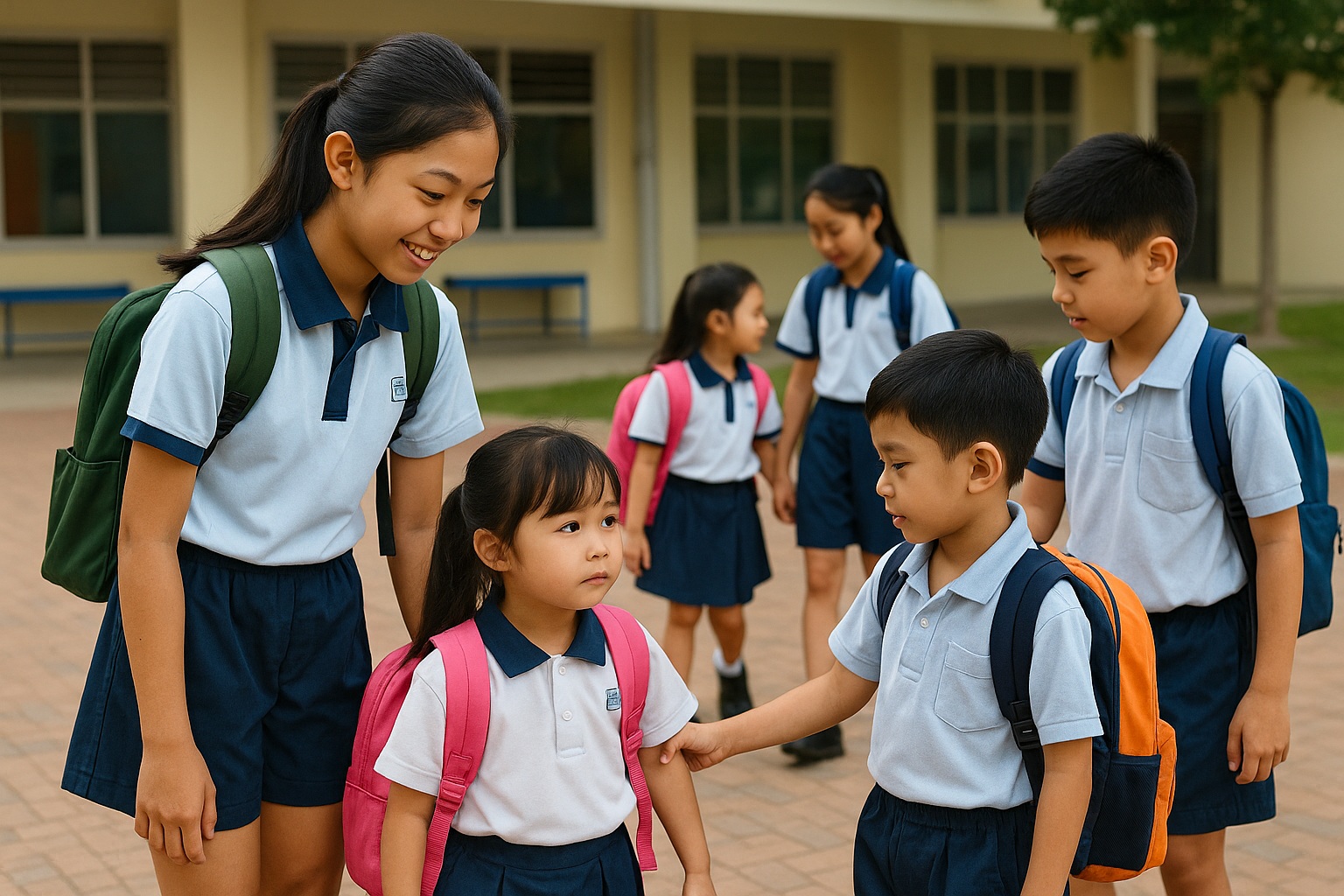
The buddy system is a key initiative introduced at the start of Primary 1 to help new students adjust to their school environment.
- Older student mentors: Selected Primary 4 or 5 students act as “buddies” to guide P1 pupils during the first few weeks of school.
- Recess support: Buddies accompany P1 pupils during recess, helping them buy food, find seats, and make new friends.
- Emotional comfort: Buddies provide reassurance and practical help, reducing separation anxiety and encouraging confidence.
- Peer connection: This initiative helps new students form friendships faster and understand school routines.
2. PAL (Programme for Active Learning)
PAL is designed for Primary 1 and 2 students to encourage experiential learning beyond the classroom.
- Holistic development: PAL activities cover non-academic domains like sports, outdoor education, and performing arts to build creativity, confidence, and teamwork.
- Fun-based learning: Activities are conducted through hands-on projects, games, and group collaboration, making learning enjoyable.
- Social-emotional learning: PAL fosters resilience, empathy, and cooperation—essential life skills that complement academic learning.
- Weekly sessions: Most schools incorporate PAL as part of the weekly timetable for P1 and P2 pupils.
3. Learning Support Programmes for English and Math
MOE provides targeted learning support to ensure no child is left behind in key subjects.
Learning Support Programme (LSP) for English
- Focus group: Designed for students who may require extra help in reading and writing.
- Small-group sessions: Conducted by trained teachers during regular school hours, focusing on phonics, vocabulary, and reading fluency.
- Duration: Typically runs for 6 to 12 months, depending on the child’s progress.
Learning Support for Math (LSM)
- Early intervention: Helps P1 pupils who need additional support to understand basic math concepts such as number sense, addition, and subtraction.
- Hands-on approach: Utilises manipulatives, games, and visual aids to build mathematical confidence.
- Customised pace: Sessions allow slower learners to master foundational skills before progressing.
Why MOE’s Support Matters
These initiatives ensure that Primary 1 pupils feel safe, supported, and confident in their first year of formal education. By focusing on social-emotional well-being and foundational skills, MOE ensures that learning remains joyful and stress-free.
Frequently Asked Questions (FAQ)
1. How long does the buddy system last?
Typically, the buddy system is implemented during the first 2 to 4 weeks of school until children are comfortable navigating recess and daily routines on their own.
2. Are PAL activities mandatory?
Yes, PAL is part of the P1 and P2 curriculum in all primary schools. It is designed to enhance holistic learning and does not require extra fees.
3. How do I know if my child qualifies for LSP or LSM?
Teachers conduct assessments during the first few weeks of school. Parents will be informed if their child is recommended for learning support programmes.
4. Will learning support affect my child’s main lessons?
No. LSP and LSM sessions are held during school hours without disrupting the core curriculum. The programmes complement classroom learning.
5. Can I support these initiatives at home?
Yes. Encourage reading, simple math games, and conversations about PAL activities. Staying positive about school experiences boosts your child’s confidence.
Conclusion
MOE’s support for Primary 1 pupils—including the buddy system, PAL, and learning support programmes—ensures every child starts their primary school journey with a strong sense of belonging, curiosity, and confidence. By understanding these initiatives, parents can better support and encourage their children during this important transition.
It takes a village to raise a child !
Join our WhatsApp Groups or Facebook Group to interact with parents about student care in Singapore..