What to Pack for Primary 1: School Bag, Recess and Daily Essentials
What to Pack for Primary 1: School Bag, Recess and Daily Essentials
Last updated: 11 May 2026
Starting Primary 1 is a big step for a young child. Besides getting used to a new school, new classmates and new teachers, your child also has to learn how to manage a school bag, recess, wallet, water bottle, books, files and personal belongings.
For Singapore parents, a good Primary 1 packing list should be practical, light and easy for the child to manage. The goal is not to pack everything “just in case”, but to help your child feel prepared, independent and confident.
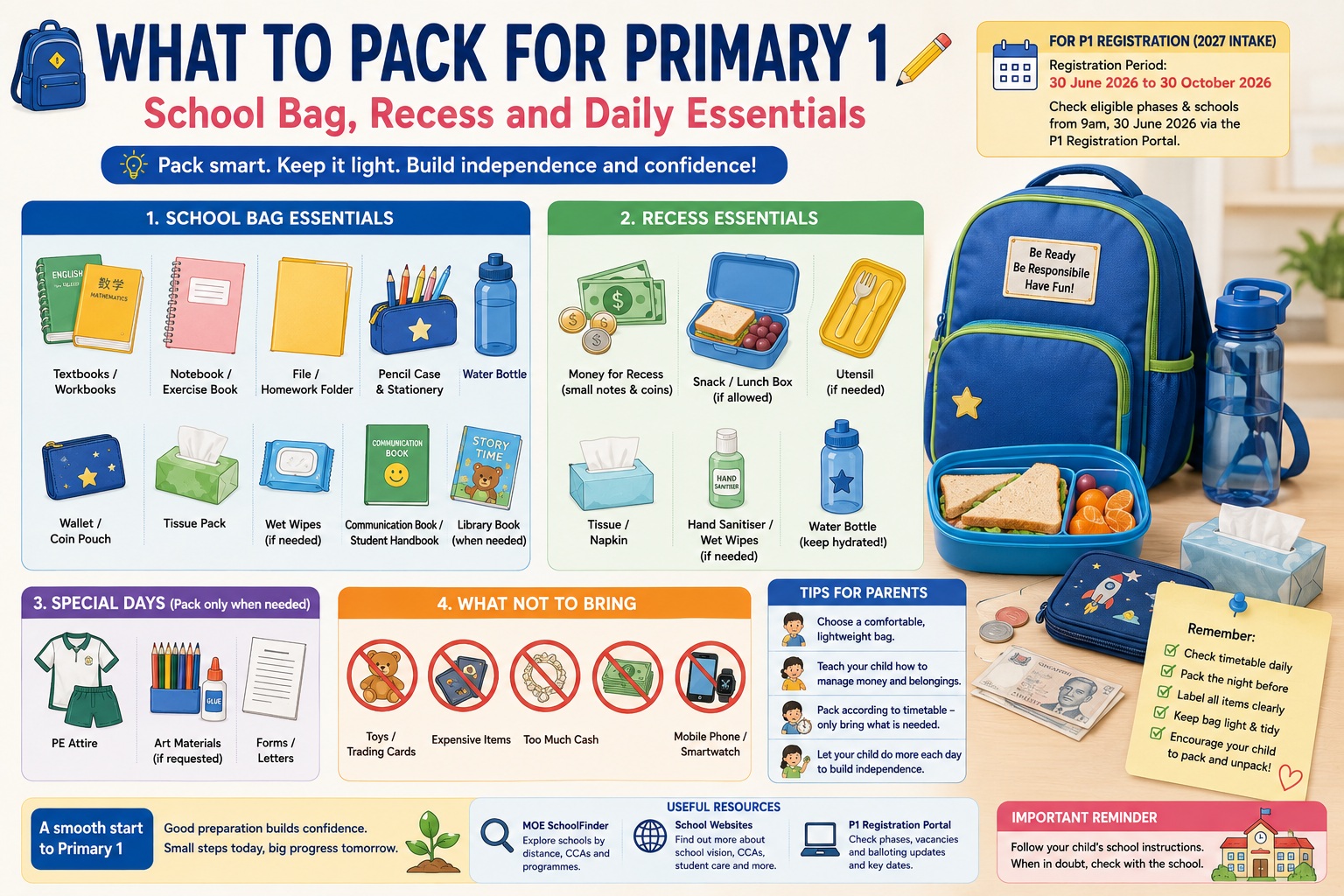
Quick Answer: For Primary 1, your child should usually bring a comfortable school bag, pencil case, required books and files, water bottle, wallet or coin pouch, small tissue pack, wet wipes if needed, name-labelled belongings, snack or lunch box if allowed, and any school-specific items requested by the teacher. Avoid overpacking, expensive items, unnecessary toys and heavy bags.
Who Is This Guide For?
This guide is useful for:
- Parents preparing a child for Primary 1 in Singapore
- Parents whose child is entering P1 in 2027
- First-time P1 parents unsure what to pack
- Parents helping children practise recess and school bag routines
- Parents who want a simple checklist before the first day of school
Before You Pack: Check Your Child’s School Instructions
Every primary school may have slightly different requirements. Before buying or packing everything, check:
- The school booklist
- Orientation notes
- Teacher’s instructions
- School uniform and PE attire rules
- Whether snacks from home are allowed
- Whether the school uses a specific file, folder or communication book
- Whether there are restrictions on smartwatches, mobile phones or toys
If the school gives a specific packing list, follow the school’s instructions first. This article is a general guide to help parents prepare more confidently.
1. Choosing the Right Primary 1 School Bag
A Primary 1 child should have a bag that is comfortable, not too heavy and easy to organise.
Look for a school bag that has:
- Comfortable padded shoulder straps
- A size suitable for your child’s height
- Enough space for books, files and a water bottle
- Separate compartments for better organisation
- A side pocket for a water bottle
- Easy-to-open zips
- A name tag or clear label inside
Avoid choosing a bag that is too large simply because it can fit more items. A bigger bag often encourages overpacking. Your child should be able to carry, open, close and recognise his or her own school bag independently.
2. Primary 1 School Bag Daily Checklist
The exact items will depend on the school timetable, but a basic daily school bag may include:
- Required textbooks or workbooks for the day
- Exercise books or activity books
- Homework folder or clear file
- Communication book or student handbook, if used by the school
- Pencil case
- Water bottle
- Wallet or coin pouch
- Small tissue pack
- Snack box, if allowed
- Library book, only when needed
- PE attire or art materials, only on relevant days
Parents can help by checking the timetable together with the child each night. Over time, let the child take more responsibility for packing the bag.
Connect with parents who are interested in the same primary school, exchange useful updates, and prepare for P1 together. Join here: WhatsApp Groups for Primary 1 in 2027
3. Pencil Case and Stationery Checklist
A simple pencil case is usually better than a large one filled with too many items. Too much stationery can distract children or make it harder to find what they need.
Useful stationery items include:
- 2 to 3 sharpened pencils
- Eraser
- Ruler
- Sharpener with cover
- Colour pencils, if required by the school
- Small glue stick, if required
- Child-safe scissors, if required
Usually not necessary for daily use:
- Too many pencils
- Expensive pens
- Large correction tape collections
- Fancy stationery that becomes a toy
- Sharp or adult-sized scissors unless requested
Labeling stationery can help, especially during the first few months when many children misplace items.
4. Recess Essentials: What Your Child Needs
Recess is one of the biggest changes from preschool to primary school. Children may need to queue, choose food, pay, collect change, carry food to a table, eat within a fixed time and return to class.
Useful recess items include:
- Wallet or coin pouch
- Small amount of pocket money
- Water bottle
- Tissue paper
- Wet wipes, if your child still needs them
- Snack or lunch box, if allowed by the school
- Small spoon or fork, if packing food from home
How much pocket money should a Primary 1 child bring?
The amount depends on the school canteen prices, whether your child buys food daily, and whether food is packed from home. Many parents start with a small amount and adjust after learning the school’s canteen prices and the child’s eating habits.
For younger children, it may be helpful to use a simple coin pouch and practise using coins and small notes before school starts.
5. Recess Practice Before School Starts
Packing the right items is only one part of recess readiness. Your child also needs to know how to use them.
Practise these skills before Primary 1:
- Opening and closing the wallet
- Recognising coins and notes
- Ordering simple food
- Queuing and waiting for a turn
- Carrying food carefully
- Opening snack boxes and water bottles
- Eating within a reasonable time
- Throwing rubbish into the bin
- Returning wallet and bottle to the school bag
A simple way to practise is to bring your child to a food court or hawker centre and let him or her try buying a simple item with your supervision.
6. Water Bottle: What to Choose
Choose a water bottle that your child can open, close and refill independently. It should not leak easily and should fit into the school bag’s side pocket.
A good Primary 1 water bottle should be:
- Easy to open
- Leak-proof
- Not too heavy when full
- Clearly labelled with your child’s name
- Easy to clean
Let your child practise opening, closing and drinking from the bottle before school starts.
7. Food From Home: What to Pack for Recess
If your child is nervous about buying food, or if the school allows home-packed food, you may pack simple snacks during the first few days.
Suitable options may include:
- Small sandwich
- Plain bun
- Fruit pieces
- Biscuits or crackers
- Small portion of rice or noodles if your child can manage it
- Simple finger foods that are not too messy
Avoid packing:
- Food that spills easily
- Food with strong smell
- Food that needs complicated utensils
- Food your child cannot open or finish quickly
- Too much food
Always follow the school’s food policy, especially if the school has allergy-related rules.
8. Hygiene and Health Essentials
Primary 1 children are still learning to manage personal hygiene. Small, simple items can help them stay clean without making the bag too heavy.
Useful hygiene items include:
- Small tissue pack
- Wet wipes, if needed
- Handkerchief, if your child uses one
- Spare mask, if required by school or preferred by parents
- Small zip pouch for hygiene items
If your child has allergies, asthma, eczema or other medical needs, speak to the school before term starts. Do not simply place medication in the school bag unless this has been discussed with the school and proper instructions are given.
9. Emergency and Safety Items
Young children may forget phone numbers or feel unsure when they need help. A simple emergency card can be useful.
Consider preparing an emergency contact card with:
- Child’s full name
- Parent or caregiver’s name
- Parent or caregiver’s contact number
- Student care or transport arrangement, if relevant
- Important medical information, if necessary
Place the card inside the school bag or wallet. Teach your child that this card is for teachers or trusted school staff if help is needed.
10. Name Labels: What to Label
Many Primary 1 children misplace items, especially during the first term. Labelling belongings can save time and reduce stress.
Items to label include:
- School bag
- Water bottle
- Wallet or coin pouch
- Pencil case
- Pencils and ruler
- Files and folders
- Books and workbooks
- Lunch box or snack box
- Jacket or cardigan, if used
- PE attire or extra clothing, if packed
Use labels that are easy for your child to recognise. For children who cannot read their full name confidently, you may use a simple symbol or colour sticker together with the name.
11. What Not to Pack for Primary 1
Some items may distract your child, get lost easily or go against school rules.
Avoid packing unless the school allows or requests them:
- Toys
- Trading cards
- Large amounts of cash
- Expensive watches or accessories
- Mobile phones
- Smartwatches
- Tablets or electronic devices
- Sharp objects
- Too many books not needed for the day
- Messy food or drinks that can spill easily
If your child needs a phone or smartwatch for transport reasons, check the school’s policy first.
12. How to Keep the School Bag Light
A heavy bag can make school tiring for young children. Parents can help by building a simple daily packing habit.
Tips to reduce school bag weight:
- Pack according to the timetable, not the whole week
- Remove old worksheets regularly
- Use a lightweight water bottle
- Pack only required books and files
- Use one small pencil case
- Check whether some items can be left in school
- Clear the bag every weekend
At first, parents can pack together with the child. Later, let the child lead while parents check.
13. First Week of Primary 1: Extra Things to Consider
The first week may feel overwhelming. Your child may be tired, forgetful or emotional. Keep packing simple and predictable.
During the first week, consider:
- Packing a familiar snack if allowed
- Using a simple wallet with a fixed amount of money
- Writing a small reminder card for dismissal or student care
- Checking the bag together every evening
- Keeping after-school activities light
- Giving your child time to talk about the school day
Avoid scolding your child harshly for losing small items in the beginning. Instead, use it as a chance to teach responsibility step by step.
Primary 1 Packing Checklist
| Category | Items to Pack |
|---|---|
| School Bag | Comfortable bag, required books, files, homework folder, communication book if needed |
| Stationery | Pencils, eraser, ruler, sharpener, colour pencils or glue if required |
| Recess | Wallet or coin pouch, small amount of pocket money, snack box if allowed |
| Hydration | Labelled water bottle that is easy to open and close |
| Hygiene | Tissue pack, wet wipes if needed, handkerchief if used |
| Safety | Emergency contact card, dismissal or student care reminder if needed |
| Labels | Name labels for bag, bottle, wallet, books, files, pencil case and lunch box |
| Special Items | PE attire, art materials, library book or forms only when required |
Simple Night-Before Packing Routine
- Check the next day’s timetable.
- Place only the required books and files into the bag.
- Check that homework is inside the correct folder.
- Refill and pack the water bottle in the morning.
- Prepare pocket money or snack.
- Check pencil case items.
- Place uniform, socks and shoes ready for the next day.
- Remind your child of dismissal or student care arrangements.
Frequently Asked Questions About What to Pack for Primary 1
What should my child bring on the first day of Primary 1?
Follow the school’s first-day instructions. In general, your child may need a school bag, water bottle, pencil case, wallet, tissue, required forms, and any books or items requested by the teacher.
Should my child bring all textbooks every day?
Usually no. Parents should help the child pack according to the timetable and school instructions to avoid a heavy bag.
Should I pack food for recess?
This depends on the school’s policy and your child’s readiness. Some parents pack a simple snack during the first few days while the child learns to buy food from the canteen.
How much pocket money should a Primary 1 child bring?
There is no fixed amount for every child. Parents can start with a small amount based on school canteen prices and adjust after observing the child’s needs and spending habits.
Can my child bring a mobile phone or smartwatch to school?
Parents should check the school’s policy. Many schools have rules about electronic devices because they can distract children or be misplaced.
How can I stop my child from losing things?
Label belongings clearly, keep the number of items small, use fixed compartments in the bag, and practise packing and unpacking at home.
What should I do if my child forgets something?
Stay calm. Occasional forgetting is normal in Primary 1. Use it as a chance to build responsibility by reviewing the packing routine together.
Should I pack extra clothes?
This depends on your child’s needs and the school’s advice. Some children may need extra clothes in the first few weeks, especially if they are still adjusting to toileting or after-school care routines.
Final Thoughts
Packing for Primary 1 is not only about buying the right items. It is about helping your child become more independent, organised and confident in a new school environment.
Start simple. Label clearly. Pack light. Practise recess and bag routines before school starts. With time, your child will learn to manage daily school essentials with greater confidence.
Important: This article is a general guide for Singapore parents. Always follow your child’s school instructions on books, stationery, food, uniforms, electronic devices and other school-specific requirements.
Connect with parents who are interested in the same primary school, exchange useful updates, and prepare for P1 together. Join here: WhatsApp Groups for Primary 1 in 2027
It takes a village to raise a child !
Join our WhatsApp Groups or Facebook Group to interact with parents about student care in Singapore..